First Annual Christmas Open House!
It’s time for some sphere-cheer!
On December 11th and 12th we will host THE FIRST ANNUAL CHRISTMAS OPEN HOUSE at the Termesphere Gallery from 9 to 4 pm. There will be a 10% discount on everything purchased during these two days at the gallery or on the Termespheres.com website. Our address is 1920 Christensen Drive, Spearfish South Dakota. Telephone for directions at 605-642-4805 if you don’t know the way. Christensen Drive is the road just west of K mart and we are 1.7 miles down the road.
Important note: If giving a Termesphere to everyone on your Christmas list is a bit out of reach this year, fear not! The Termesphere Gallery has lots of really cool, exceptionally unique gifts starting at $5.00.
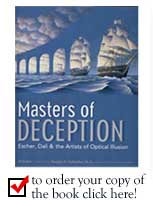
Publications – Masters of Deception
by Al Seckel
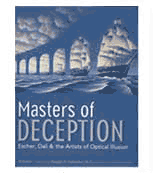
The book I mentioned in the last newsletter is now on the shelves of Barnes and Noble, Borders Books and the Termesphere Gallery. MASTERS OF DECEPTION – ESCHER, DALI AND THE ARTISTS OF OPTICAL ILLUSION by Al Seckel is very exciting indeed. Amazon.com had this to say:
“Astonishing creations by masters of the art, such as Escher, Dali, and Archimbolo; amazing visual trickery; and an illuminating foreword by the Pulitzer Prize–winning author Douglas R. Hofstadter make this 320-page, breathtaking collection the definitive book of optical illusions.”
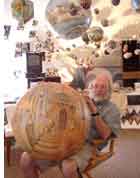 Two of my favorite artists, M.C. Escher and Salvador Dali are featured along with eighteen others including Giuseppe Arcimboldo, Jos De Mey, Rob Gonsalves, Scott Kim, Octavio Ocampo, Istvan Orosz, John Pugh, Roger Shepard and Yours Truly (page 295-304). All are serious artists who love to play with illusions within their work. Each of us is featured in a ‘gallery’ (chapter) with incredible color reproductions of our works along with explanations of how our illusions weave within our art pieces. I think this is an outstanding book that has some of the most exciting illusion art found in the world and just fun to look at again and again.
 Termespheres (some new, some historic) and the thoughts behind them
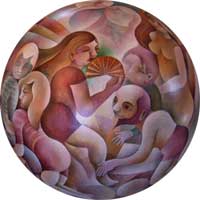
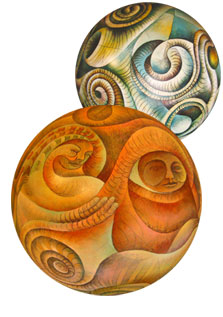
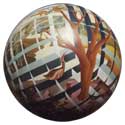
Each newsletter I like to explain one of my completed paintings. This time I would like to explain a little about the sphere ATOM AND EVE painted in 2002. This is a painting which combines science and religion. The science is the circular geometry which became the substructure for the painting. The circles that covered the whole sphere grew from a polyhedron that was first drawn on the sphere. I wanted the images that I invented from these circles to become the Adam and Eve story. The snake does this very well and also the apple and the tree. If you follow the snake it uses the tight fitting circles. Some of the circle grid or substructure is inside the snake and some of the circles are outside the snake. Even if people don’t see the circle substructure they feel the design WORKS. I would rather people didn’t know the strong circle grid was even there. The fear of the white canvas that artists talk about comes into play here, instead of making a scribble like some artist do, my scribble is a precise grid. This really gets my creative mind working and also give me back some results that I don’t expect.
 Recent Work
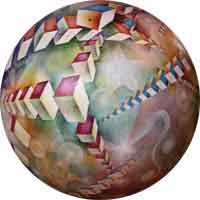
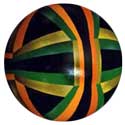
I finished BRAIN STRAIN! Last time I explained a little about this 30 point perspective spherical painting. The substructure for this sphere came from what Plato called the “Universe Polyhedron,” the dodecahedron. Each vanishing point I used is found in the center of the edges of the pentagons on the dodecahedron. There are twelve pentagons on this polyhedron. I used six equal distance points for my six-point perspective. By using the dodecahedron edges I was able to have five sets of cubical patterns, each having their own six point system, all happeing in the same sphere. So this comes to 30 point perspective. When I began this concept I thought it would look disorderly but with the dodecahedron substructure it seems to hold together very well.
The colors for this piece were much more intense than most of my paintings. I started with an almost pure palette as I wanted each of the set of six points to have its own color. I also wanted the cubes that projected to these points to be the same color. This helps people see the order. Most of the colors inbetween these vanishing points were mixtures of those pure colors. I used an orange, blue, green, red violet, and blue violet for the five colors. I used a glazing and stippling technique to do the painting. I also allowed myself to use white to mix in for some scumbling (using white as a thin wash) effects to help with better depth effects.
 Works Sold
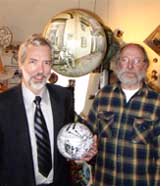
INSPIRATIONS FOR ESCHER sold to James R. Von Ehr II last month. Among his long list of amazing accomplishments, Von Ehr owns the largest collection of M.C. Escher in the world. It was an honor to meet him at the School of Mines and Technology in Rapid City where he gave the keynote speech at the Nanotechnology Conference which focused on the place of nanotechnology in science and society.
There is so much good to say about Mr. Von Ehr. He founded Altsys Fontographer in 1984 and sold it to Macromedia 1995 (an accomplishment that has my webmaster in awe). In June 2003 he was awarded Ernst & Young’s Entrepreneur of the Year Award for Pioneering and now he intends to get in on the ground floor of a second revolution – nanotechnology though his current company, Zyvex Corporation. He’s surrounded himself with the most prominent thinkers and researchers in the field, hoping to develop and sell the machines which will make nanotechnology as common as desktop computers are today. And now, he owns a Termesphere—which goes to show that along with his polished skills as a business man, scientist, innovator and social leader, he also has mighty fine taste in art.
IN THE WORKS -Mount Marty has committed to a commissioned sphere of their library environment and images of Mount Marty.
Works in Progress
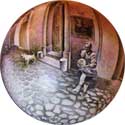 I have just finished a 15 piece one man show at Mount Marty College in the Bege Art Gallery of the Student Union in Yankton South Dakota. It was there until November 25th. While in Yankton I did a slide lecture at Yankton High School for the student body.
I traveled then to Augustana College in Sioux Falls and did a workshop on ONE THROUGH SIX POINT PERSPECTIVE. This two-hour session included students and instructors so it was great fun. It is always interesting to really make the art students think. I have put so much thinking into this workshop that it is fun for me to share the thinking with a captive audience. They tell me I give them a Termesphere headache.
The Tweed Museum of Art at the University of Minnesota, Duluth is touring a show called Mathematical Instinct. One of my Termespheres called FINISHING AN ESCHER is part of this traveling show. It also is being shown at Rutgers University in Camden NJ and the University Art Museum, University of Richmond VA. Sometimes your art work takes on a personality of its own and travels with its own story to tell.
Future Shows and Workshops
- February, 2005 – For the third year I will be doing a week long workshop for CREATIVE CONNECTIONS which consists of 150 Fine Art High School students from the DODDs system. It will take place in Oberwesel, Germany.
- April 28-9, 2005 -I will be one of the instructors at the ALL DAKOTA HIGH SCHOOL EXHIBITION and WORKSHOP, Groton, SD.
- June, 2005 – Termespheres One-man-show at Black Hills State University, Spearfish, SD.
- July 31- August 3, 2005 a showing Termespheres at Renaissance Banff (Canada) Bridges conference plus Coxeter Day.
- July 25th- January 6th One Man Show in stairwell at Washington Pavilion in Sioux Falls SD
SHOWS BEING WORKED ON….
- Iowa State showing at the Octagon Gallery
- Showing of Spheres at Cam-plex Gallery in Gillette, Wyoming
- South Dakota Art Museum in Brookings South Dakota
“IDEA” is how I make my living—Dick Termes
 Dick’s Works in Progress
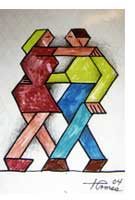
I am working on a spherical painting, which may be titled, OUT OF THE TRIANGLES, that plays with tessellating patterns. Tessellating patterns are patterns which fit tightly with themselves with no background space left over. The basic element I am exploring in this case is the triangle. The triangle as an element, has many different tessellating shapes that can be created from it. Some examples that come out of the triangle are the diamond, the chevron pattern and the hexagon, all can fit with themselves like tiling with no background spaces. A flat painting called COMMON DESCENT that I painted in 1972 made me think about what would happen if I played with this triangular grid on the sphere. This study of triangles led me to see how many interesting human figures might come out (be created) of this grid. I am very pleased with them. It’s as if they are creating themselves. They definitely make the painting OUT OF TRIANGLES into an extremely dynamic piece. As I progress, the tessellation will create the land, mountains and sky, indeed the entire environment the human forms live in.
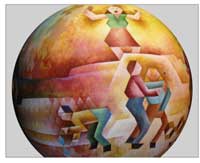 One of the things Escher taught me is geometry or pure optical illusion alone can come off too math-like. Many people don’t relate to this type of study. If this same geometric world is also a landscape with people living in it, it becomes something people can relate to. The study will get to the viewer by osmosis as they look at the painting. I am very much enjoying painting this piece, which has to be a good sign.
Another smaller sphere I have been working on was inspired by Jeff Weeks who is an expert in Topology and Geometry Software. Doris Schattschneide who wrote the book VISIONS OF SYMMETRY suggested I talk to him about tessellations. He suggested a variation on my ARROW SPHERE which has tessellations or tight fitting arrows going both directions to two different poles on a sphere. His idea was to bring the arrow out of one point and bring them back in to the same point. He says this idea is like the way the magnetic energy patterns works. I tried this and it is a pretty exciting little sphere. It is still in process.
End Note
The first newsletter had the thought or question,
“WAS SIX POINT PERSPECTIVE DISCOVERED OR FOUND (INVENTED)?”
I am going to change these words to DISCOVERED OR INVENTED to help make this thought more clear.
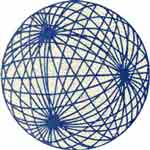 Bill Fleming, friend and fellow artist, suggested he wanted to hear my answer to that question. So this one is for you Bill.
First I want to make a distinction between the two words. The kind of “discovered” I mean is when it was always there and you just have to realize it. The kind of “invented” is not to uncover but rather to make up without the help of nature.
I have a little trouble saying that the six point perspective concept was INVENTED when I also tell everyone it is right out there for us to see. It is hard to say I invented it when it is right in front of us. One could say, if I am the only one that could see it, than it would be INVENTED. I feel, I looked out there and FOUND it. It was waiting for me to imagine myself crawling inside a transparent sphere and copy what I saw onto the sphere. When I envision myself inside my stable transparent ball which is inside a cubical building and I turn in a circle, the three sets of parallel lines which make up the cubical room are right around me. There is a set of lines that run north and south, another set that runs east and west and another set that runs up and down. If  I follow the lines they lead me to the six vanishing points. The lines that I am following are not straight lines but rather curved lines or they wouldn’t be able to go to all six points. Later I realized that there is another way the six points could be found–if I figured out the closest point between me on the four wall and the ceiling and the floor. If I measured with a measuring tape from my eyes to the six planes, the closest point to the walls shows me where the vanishing points are located. Once I think of myself inside my transparent sphere and see how images from the outside room would project to the skin of the sphere this became clear. I guess what I am saying is that I believe I discoverd it rather than invented it. Inventing seem more like I made it up and I don’t believe this is made up. I think this is how it really is. Let me know what you think.
Thank you for reading to the end. I hope some of my thoughts will get some comments back from you, positive or negative and, new ideas. I love the way some of my math friends are making suggestions of concepts for me to consider. If you would like to be taken off this newsletter list please let me know. As always, thank you for your tremendous support and encouragement. I would love to hear what you think.
Feel free to call at 888-642-4805 or email me termes@blackhills.com
 New DVD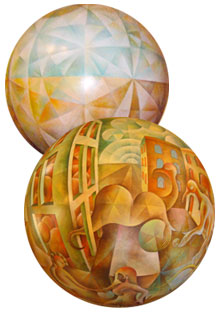
 Should an Artist Re-work Old Paintings?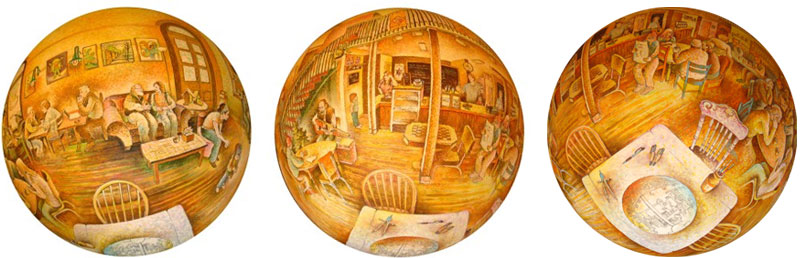
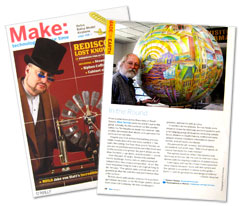 Termes Featured in Make Magazine
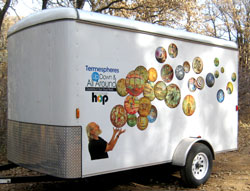 For the last four months I have been working on a traveling display of my concepts for the H.O.P. (Hands-On Partnership) for Science, Literature and Art in South Dakota and the Discovery Center in Pierre. The display goes into a trailer which is checked out by libraries and schools around South Dakota. They set the display up and use it for a month. It has many hands-on exhibits or stations for students to explore different ideas. UP DOWN AND ALL AROUND helps students see and learn about the orders of total visual space.
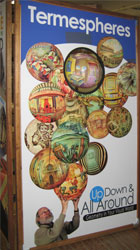 There are two original Termesphere spinning in holes in the entrance walls that invite you into this Exploratorium. There are four hinged walls that explain different parts of the display usually set up like corners of a cube that can be spread out to fit the size of the room it is in. Each of these walls are 4X7 foot.
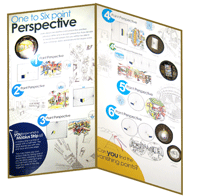 One of the stations is for students to explore ONE THROUGH SIX POINT PERSPECTIVE. The walls that contain this section show the grids used and some drawing results. There is also a DVD in the corner where I show students how to do all of these perspective systems.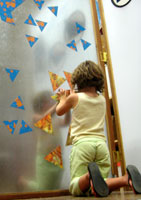
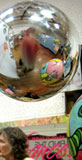 THE MIRRORED BALLS hang in one section. I painted one ball with mirrored faces so they better understand they are always in the middle of the mirrored sphere. There are many questions that are on the wall to get them thinking.
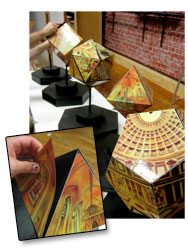 The TERMESPHERE DVD section has a wall of our environment and another of many spherical paintings.
 Science Magazine Artical about Termespheres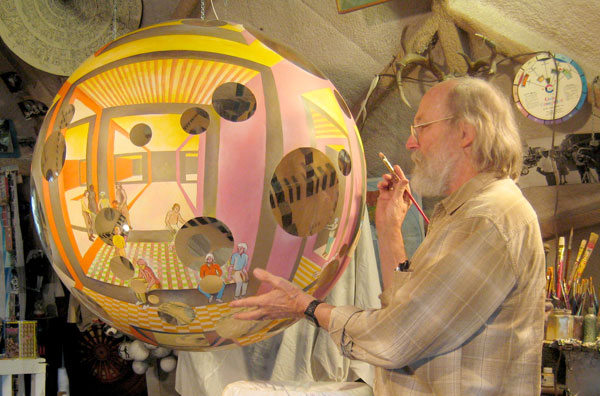

 A site I would like to draw your attention to is one by Rudy Rucker. He visited our place this summer . This was his second trip to our home and gallery. When he got home to his blog he wrote some very nice comments about visiting our world. I hope you will check it out
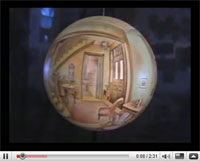 The YouTube video of the Adams House called REFLECTING BACK has drawn many hits from people. The optical illusion of this piece is one of its attractions. Even though the sphere is convex it seems to look concave when it is turning. It is as if you are looking at the inside of the ball. This happens with all of my spheres. An article in Perceptual and Motor Skills, 1991 by Al Brennan from South Dakota State University where he explained the illusion of the Termesphere. He called it the Termes Illusion. The world seems to be excited about it now.
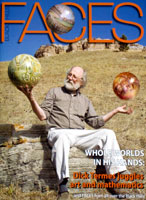 Black Hills Faces Magazine
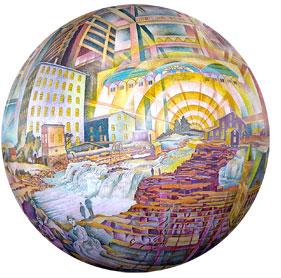 A Round Town
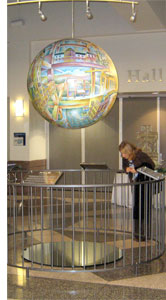 There are historical buildings of Sioux Falls on the bottom of the sphere along with a map of very early Sioux Falls. The grid of the map echoes the Convention Center’s tiled floor. Also in this area is the Falls of Sioux Falls which was the reason why the city was built where it was. The vertical lines of these older building project up into the upper section making the new buildings grow out of the past. The upper part of the sphere holds some of the future Sioux Falls buildings. Above this newer section on the top of the sphere is a cubical grid like the Convention Center’s post and lintel hallway that the sphere hangs in. This cubical structure flows throughout the piece helping to exaggerate the six point perspective used to hold the buildings and the art piece together. The cubical grid also transforms into the sun above the Falls. The rays of the sun expand to create the total Sioux Falls. The upper cubical structure and the lower square tiling both should help the sphere look as if it grew from that architectural spot in which it hangs. The colors play with a cross between pointillism and impressionism. This adds exciting color to look at. The ladies with their umbrellas on the bottom have a feeling of Seurat to them. The colors also have strong contract so the images can be seen from a great distance.
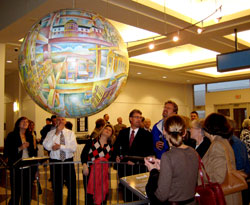 It was wonderful that Avera McKennen commissioned A ROUND TOWN and donated it to the City of Sioux Falls. It is very well displayed. Thanks to Avera McKennen as well as Larry Rehfeld for putting this all together for me.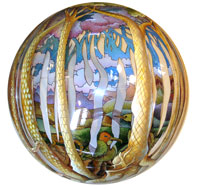
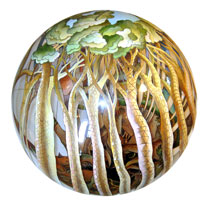 Creatures in the Forest
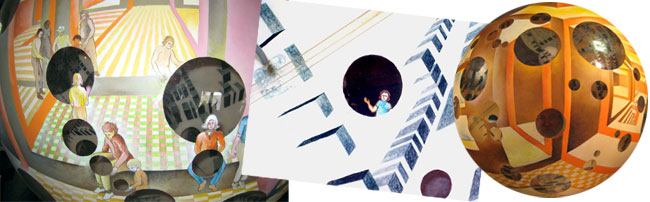
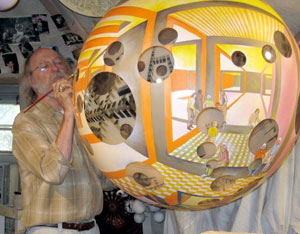 What I am working on at this point is a transparent 36″ diameter sphere. I started with a scene of cubical patterns projecting in six point perspective with a great deal of transparent areas between them. A variety of different size circles where drawn over this. I kept what was inside the circles transparent and painted everything on the outside of the circles with opaque white paint. This white paint now has been turned into a room that these circles (I think of them as spheres) are floating in. People are standing around in the room looking and studying the spheres floating by. The transparent spheres or bubbles have images showing up in them that are coming from the inside of the large sphere. It is interesting that when you look at the small bubbles the image moves across them. When you pull all the images together from all the individual bubbles it makes one total scene. If you get close enough to one of these holes or bubbles you can see the whole inside scene. I am not sure what that means but I think it means something. The transparent spheres do intrigue me. If designed right I can work on the convex as well as the concave sides.
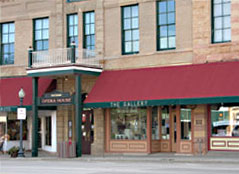 Another spherical painting I am just starting to work on is the MATTHEWS OPERA HOUSE SPHERE. They have commissioned me to paint a 30″ diameter sphere for their stairwell. It is their centennial year +1 of the opening of the Matthews Opera 1906 – 2006. I am just beginning this spherical painting. It will hold the reflection of the Opera as we see it today, the up, down and all around view. I am doing the drawing portion on the sphere at the Opera itself. It is very fun to be able to walk up and study the details right when you need to. Most of my famous interior series are done from the Total Photos I take. Look back at News letter #4 for information on that. This piece will also have historic events that have happened in the Opera woven into it. Paul Higbee of Spearfish is helping me with this history. He is a great historian in relation to the Opera as well as a very good friend.
 If math is the study of patterns, my work is very much related. When every line one draws is related to the first line you drew, there is some connection to Math. When the realism you draw grows out of a geometry grid, there is some connection.
 Where Do Ideas Come From?
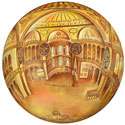
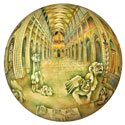
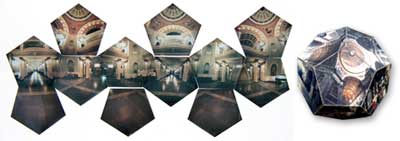
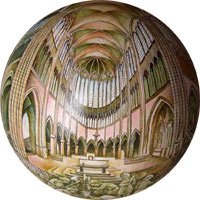
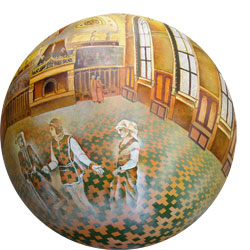 Many building interiors also have inspired my art. I have done a whole series of Famous Interiors of places like Notre Dame, Saint Chappell, St. Denis, Paris Opera in France, Blue Mosque, Hagia Sophia in Istanbul, St. Peters and the Pantheon in Rome, Stone Stonehenge and The Globe Theater in England. The Matthews Opera House that I am now working on is part of this series.
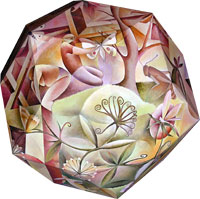 Some of my ideas grow from my subconscious mind. I sometimes paint a loose abstract painting with no image in mind. The patterns and colors stimulate images and ideas. I just have to be brave enough to follow my intuition for these images. It is fun to see what ideas are hidden within my mind.
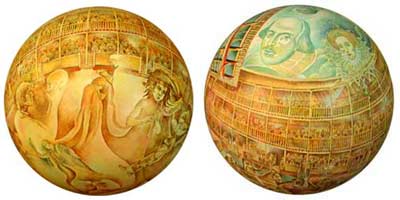 The Globe Theatre in London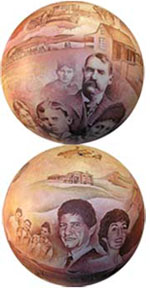
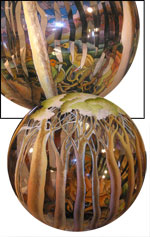 I am working on a 24″ sphere commission for Tom and Theresa Matthews. They live just over the state line in Beulah Wyoming. The sphere plays with images of the Matthews’ Ranch twenty miles south of Gillette Wyoming. Four generations with the name Tom Matthews have worked on this family ranch from 1881 into today. The T7 Ranch, as it is called, has been the foundation for many Matthews individuals. The Matthews family was responsible for the Matthews Opera House as well as the whole Matthews Block of buildings in Spearfish South Dakota. This sphere incorporates these people and their influence in this area.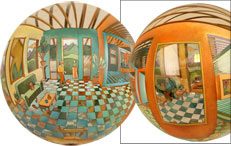
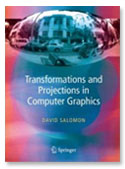 TRANSFORMATIONS AND PROJECTIONS IN COMPUTER GRAPHICS by David Salomon was published by Springer 2006. I am very pleased to have this book dedicated to me. My contribution to this book has to do with the use of many of my images. In the section on CYLINDRICAL PANORAMIC PROJECTION Solomon uses my continuous Four Point Grid and one of my drawings. He also used my grids from one through six point perspective and examples of my drawings with each. The drawing of St Peters as a dodecahedron is also used. My patent on the TOTAL PHOTO is included. I was pleased with this as many new approaches to capturing total 360-degree worlds are coming into being and it is nice to have them know I was there in 1980.
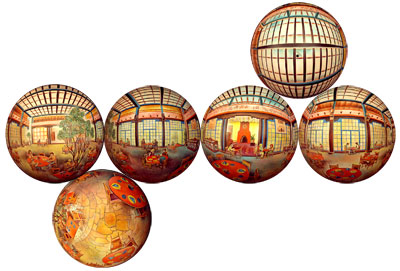
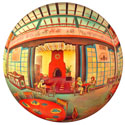
 Ryan Packard has put together some wonderful Virtual Panoramic views of my Termespheres. He puts you inside six spheres that you can turn with your mouse to see any part of them. You can find them on the homepage of my site www.termespheres.com You must look at them! They are way cool. These virtual programs are of FOOD FOR THOUGHT, ST. MARKS SQUARE, LOOKING FOR THE ORDER, THE PANTHEON, LORETTO CHAPEL IN THE ROUND and OLD BALL GAME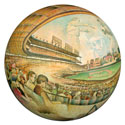
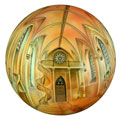 So, my thesis is that these six equal distant points are in the world around us all the time. This isn’t something I came up with just to make the spheres look good, it is real.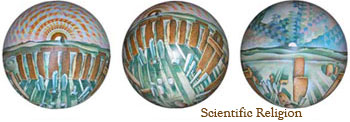
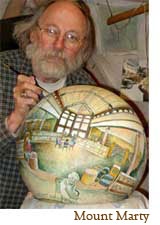 The Mount Marty’s Sphere is close to being finished. It is a 16″ diameter sphere of the inside of the new library at Mount Marty. Images of the history of Mount Marty also float within this building. There is a very interesting shift the architect did to add variety to this building. The outside of the building is organized to a cubical structure but the inside is shifted to a diagonal of that outside structure. This required me to use eight rather than four points around the middle of the sphere. It took me a while before I discovered this is what the architect did. The piece is coming along very well and should be finished soon.
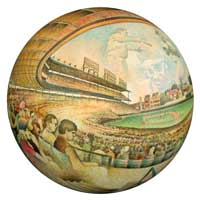
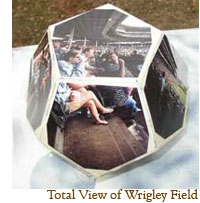 Wrigley Field is another commission I am soon to start on. It will be a 16″ diameter sphere also. It was commissioned by Alyce Schavone of Spearfish for Tony, her husband, who has passed away. Tony spent a lot of time at the Cubs games when he was a kid. I remember almost every time I saw Tony he would always say, “Hey Termes, you’ve got to paint Wrigley Field on one of your Termespheres.” Alyce caught me a while back and said, “Let’s do it.” I think it will be very exciting to paint. I took a trip to Chicago and got to see the Cubs play the Dodgers. It didn’t work out so well for Chicago. The score was 11 to 1 but I did get three wonderful total photos and many detailed photos of the experience. I will begin this painting very soon.
 Thoughts on the Total Photo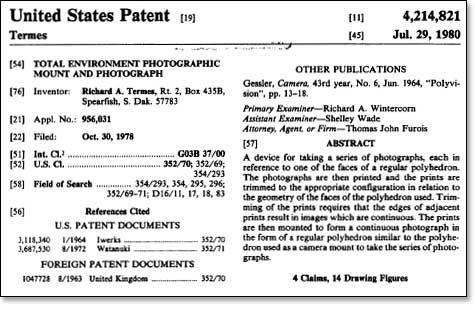
 It would look more normal if you were inside the polyhedron and let it be an environment around you. I have taken pictures of many famous interiors around the world. Some of these have helped me to paint spherical paintings of these environments.
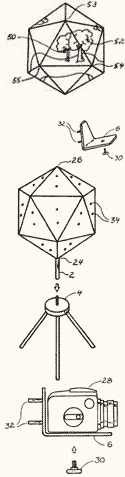
 Taking pictures of one of my Termesphere paintings was what inspired me to figure out the total photo. I wanted to take pictures all around a spherical painting so it could be put together on the flat surface. I learned
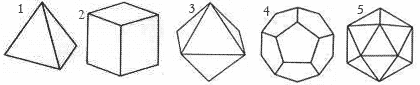
 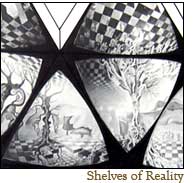 very quickly if the photo were to be put back together in some kind of orderly way, it had to be photographed in some geometric way. I knew about the different polyhedra that fit on the sphere. I drew the icosahedon onto the surface of a painting with erasable ink. I set my camera and tripod up so I could shoot straight into each of the triangles. This was done by turning the sphere in a cylinder until the center of each triangle was in the center of the lens. The result turned out very well but I learned the triangles were bulging out triangles rather than straight line triangles. This was a problem as I had to either cut off part of the image or have a black pattern between each triangle. I ended up with dark patterns between the triangles. This wasn’t as smooth as I was hoping but it opened my mind to painting on polyhedra and taking on the concept of the total photo. The total photo has become a great tool for me for doing the famous interior Termespheres. I believe this total photo concept has transformed into what is now called virtual panoramic photos.
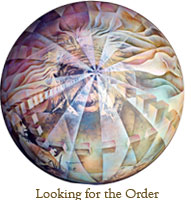 Ryan Packard has done some extensive exploration with this system and is getting very close to helping me reproduce my spheres without melting them down. This is a really exciting for me because three of my past spheres that I wanted to reproduce are now only found in flat disk forms. In the past I had to actually heat the hemisphere of my acrylic original spheres until they melted to the flat. Once they were flat I could take that image and silkscreen it on flat pieces of plastic. These flat silk-screened on plastic would then be blown back into hemispheres and glued back together as spheres. Ryan has so far taken pictures all the way around three of my spheres and made Virtual Panoramic pieces out of them. This means with the help of your computer, you can be inside the sphere and turn and look up, down and all around. It is a wonderful experience.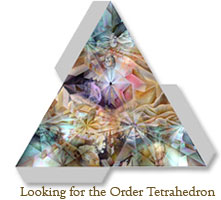
 WE ARE HAVING AN OPEN HOUSE on December 10th from 9:00am to 4:00pm and on the 11th from 12 to 4pm.
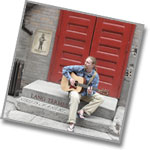 I want to start this news letter off with some information on my son Lang Termes. I am very proud of what he has done with his music career. Not only is he finding steady gigs in Bozeman Montana but also creating 80% of the music he plays. I am pleased he sees the difference in playing what the world has already accepted and trying to find new paths. I know this is a much harder path to travel but in the end it is much more rewarding.
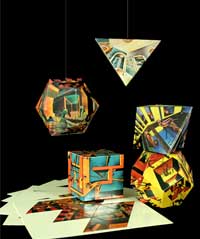 CAPTURED WORLD POLYHEDRA
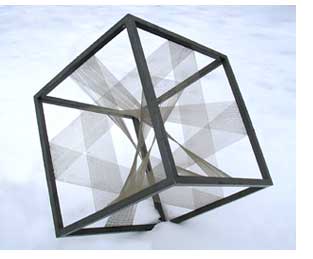 I created this sculpture around 1972. It was made from one inch metal cubical tubing welded together to make a stable two foot cube. From one corner a rod was welded so it could be displayed from a corner as the bottom. Holes were then drilled into the metal about an eight of an inch apart. Clear plastic line was woven into these holes and stretched around to three different edges of the cube. These three edges were going in three different directions, Up and down, north and south and east and west. The result was three bands of these triple twisted patterns floating inside the cube. I only strung these lines from the center one third of the edges of the cube. Something special goes on with the geometry because not one of the patterns created from this touched each other. My question to this day is, would this not touching have happened if I would have continued each of these bands out to the corners?
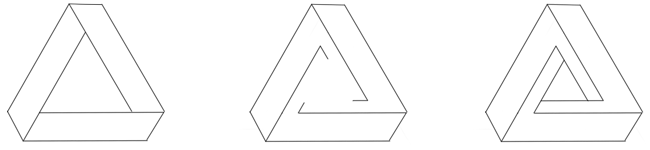 I would like to make a comparison with this impossible cubical structure. The drawing below shows how I progress from this cubical structure to an impossible cylinder structure. What do you think? Is it the same illustration except in cylinder form?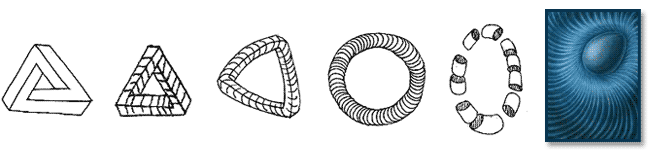
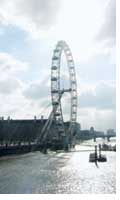 I spent a week in Germany at Creative Connections and met my wife Markie Scholz in London on the way back. While in England we both did two days of workshops, Markie with her puppets shows and workshops and me with my perspective and polyhedron workshops. We also had the opportunity to see Stonehenge while we were there which has been something Markie and I have dreamed about over the years. We both agreed we were not in the least disappointed. I couldn’t believe how noncommercial it was, a very large compliment to their State Park System ( English Heritage). Viewing one of the world’s largest stone circles was an inspiration that will undoubtedly grow into a future Termesphere. Back in London, we attended a play, HIS DARK MATERIALS which had a great concept behind it and included some wonderful puppets. You know who really got into that! Another fun and circular stop was the LONDON EYE. Billed as a combination of the elements of air, water, earth and time, it took 30 minutes for our one rotation. The view of London from on top of the giant Observation Wheel was extremely impressive.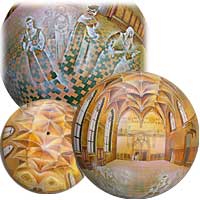
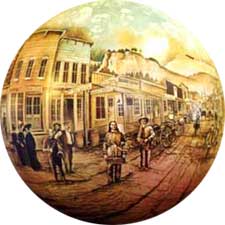
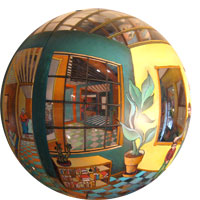
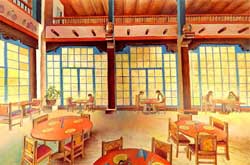
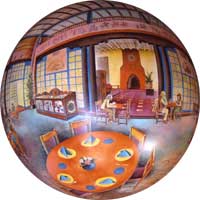 The latest finished sphere is a 24″ diameter spherical painting called FOOD FOR THOUGHT. This painting shows the total environment of the inside of the restaurant in the La Fonda Hotel in Santa Fe, New Mexico. I selected this site because of the colors and the strong structures that lend themselves to my perspective. There were some interesting challenges to this piece like getting round tables to fit into the six point perspective of the building.
 Past Workshop and Shows
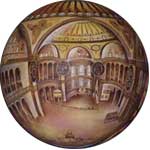 Termespheres are currently part of a Group Show at Bradford Brinton’s 3rd Biennial Invitational which includes sixty five artists from across America. Bradford Brinton is a wonderful Museum/Gallery on a ranch near Sheridan Wyoming. This current show will be open to the public through October 3, 2004.
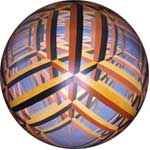 At the Tweed Museum of Art the Termesphere FINISHING AN ESCHER is currently showing. The University of Minnesota, Duluth put together a traveling show called Mathematical Instinct. Some of the tour stops include Rutgers University in Camden NJ and the University Art Museum, University of Richmond VA.
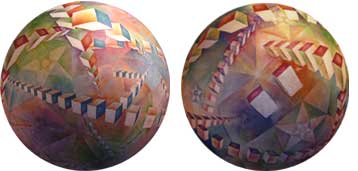 The 24″ diameter sphere I am painting now is called BRAIN STRAIN. It is a 30 point perspective piece using rows of cubes as the subject. The object of this piece is to show that you can use more than six points for perspective. To use more than six points requires that there be some other things going on in a room which are not moving parallel to the original room.