This 16″ Termesphere overlaps the six senses over the six vanishing points. Trees take the shape of faces who’s ears, eyes, mouths etc. overlap the vanishing points. It makes the point that the environments are only possible to understand if our senses are doing their job.
Author: Dick Termes
-
Thinking in the Round on KELOLand
Full-Circle Success For Spearfish Artist
You may have seen one hanging from the ceiling of various buildings throughout… -
April 2009 Newsletter
Thinking in the Round Exhibit
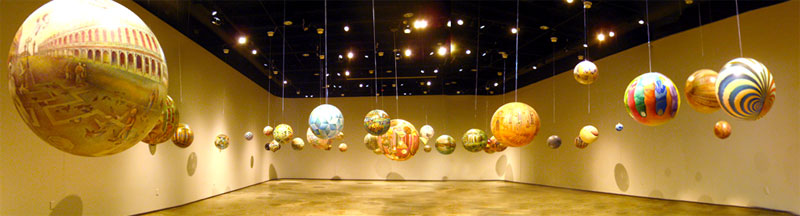
50 Termespheres are hanging and rotating in the Stan Adelstein and Lynda Clark Gallery at the Dahl Arts Center in Rapid City South Dakota. This is the largest exhibition I have ever put together. The space is wonderful for hanging Termespheres!
 New DVD
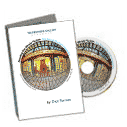
I recently developed a DVD on ONE THROUGH FIVE POINT PERSPECTIVE. This DVD shows me using grids to creating drawings of one through five point perspective. This system of using perspective grids is a wonderful new way to teach students. The DVD is in fast motion so you can go through the six drawings in 40 minutes.
 Should an Artist Re-work Old Paintings?
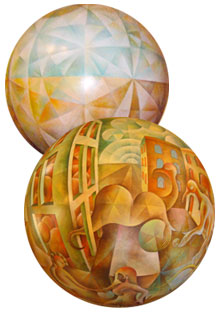
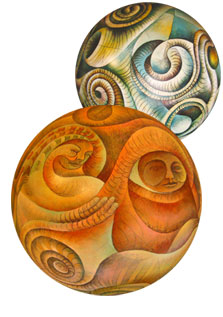
The question is; should an artist ever take older works and go back into them years later? I guess my feeling is, sometimes it seems like a good idea. Sometimes after an idea circles in your mind for a number of years you understand more the second time around.
Common Grounds Sphere
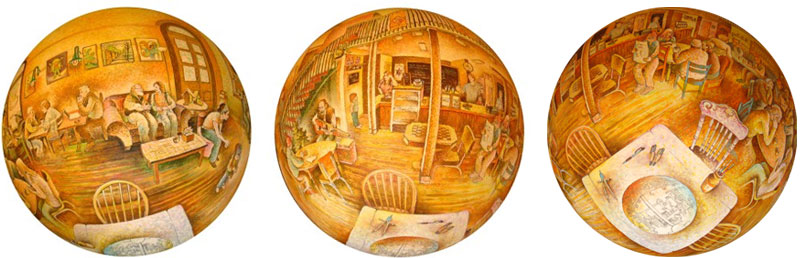
My latest Termesphere is called COMMON GROUNDS. It is a 16 ” diameter sphere of our local coffee shop. Markie and I go for coffee there most mornings. I spend a lot of time watching people when we are there.
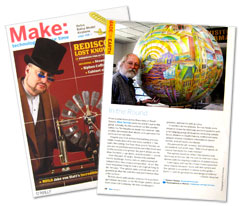 Termes Featured in Make Magazine
“In the Round” by Donna Tauscher was published in volume 17 of Makezine. To quote the information about the ezine, “MAKE is a quarterly project-based magazine… MAKE brings the do-it-yourself mindset to all the technology in your life.
http://termespheres.com/blog/common-grounds-sphere/
-
Circular Logic
by David Eisenhauer
Almost everything in Dick Termes’ world is round – the sun breaking through morning haze, the tennis ball he batted back and forth before breakfast, the four geodesic domes in which he lives and works.
For more than 30 years, Termes has eschewed traditional flat canvases to create his art on polycarbonate globes he calls “Termespheres.” He came up with the idea while completing his master’s degree at UW in the late 1960s, and it has been his passion ever since. Termes estimates he has painted more than 200 major spheres so far – about a third of those by commission – and his work is displayed internationally, from North Pole High School in Alaska to the Tokyo Museum in Japan.
“In art, the most important thing to find is an original thing to do,” he says. “There have been lots of paintings done over thousands of years, most on flat surfaces. The sphere adds a whole new set of geometries that fits with the real world better than a flat surface. Three-dimensional space is what we live in.”
-
New Termesphere depicts story of early Deadwood
The city of Deadwood and the Deadwood Historic Preservation Commission will unveil the Deadwood Termesphere on Monday, April 1. The ceremony will be at 7 p.m. at the Deadwood History and Information Center, 3 Seiver St. Refreshments will be served after the presentation. A Termesphere is a spherical representation that tells a story from many angles. Deadwood commissioned the work from Spearfish artist Dick A. Termes last summer for $25,000. Termes completed the six-month project in time for the upcoming tourist season. The Termesphere depicts Main and Lee streets between 1876 and 1879, during the early days of the gold rush. It portrays numerous buildings and people of the time, including Calamity Jane and Wild Bill Hickok. “I believe this will be a very important art piece for the city of Deadwood, because it will show what the city actually looked like those years before the fire of 1879,” Termes said. “Because of the uniqueness of my art form, I believe people will get a much stronger sense of what that early Deadwood was like. My six-point perspective concept will put the viewer in the middle of Deadwood seeing it to the north, east, south, west, up and down.” For more information, call the Deadwood Historic Preservation Director Jim Wilson at 578-2082.
-
Termesphere goes to St. Luke's Hospital
SPEARFISH – In celebration of Avera St. Luke’s Hospital 100th anniversary in Aberdeen, artist Dick Termes was commissioned to create a Termesphere dedicated to the cycle of life. He has been working on this project for the past three months. Termespheres are hanging, rotating spherical paintings that show up, down and all around environments. Forward to the Beginning is a 24 inch diameter spherical painting. Black Hills artist Termes examines life from beginning to end in a very unique way in this spherical painting. Using a six-point perspective Termes creates a maze of stairs which emerge from a white hole in space. The stairways go up and down and in and out in space. The stairs symbolize paths through life and choices. Some of the stairs lead to nowhere. When people emerge from the white hole they are babies. As they crawl and then walk up and down and around on the stairs, they become young children, then teenagers, young adults and senior citizens. The older people finally arrive at the same white hole the children emerge from. They walk into this white space or tunnel. This adventure called life leads them back to where they started.
“I think this is a unique way to talk about life and a universal way to talk about the beginning and terminus of life.” Termes said. This past year he has had one man shows at the University of Wisconsin-Eau Claire, at the Grace Museum in Abilene, Texas and at Cal State University in Bakersfield. Next week the termespheres will be shipped to the University of South Alabama in Mobile and the Eastern Shore Art Center in Fairhope, Ala. Next they will go to the County College North East at Ft. Worth, Texas, Missouri Western State College in St. Joseph and to Evansville Museum in Indiana.
-
Dick Termes : Termespheres
Termespheres are three dimensional “inside out” views of the physical world around us. Dick Termes has been painting spheres for 37 years. His work has been recognized in America, France and Japan and has featured in many articles over the years.
For those of us who want to attempt this style of painting he has a booklet on the 6 Point Perspective he uses to create his spheres.. although the concept is clear, getting you head around painting in a 6 point perspective on a globe takes some doing!
Was there anyone in particular that influenced you to choose this path of painting?
There were a number of artists and other people that influenced me in my art form. M.C. Escher of course influenced me with his ideas connecting illusions with the realistic world. He also had a wonderful tightness l liked in painting and drawing. I seemed to run into his work with every new idea I came up with. Bucky Fuller excited me with his three dimensional geometries and his philosophies.. Seurat help make science and art come together for me.. Picasso and Klee helped me to know a painting is its own thing and not a copy of something and Victor Flach, an instructor from University of Wyoming taught me to put thinking into my work.What made you choose a sphere to paint on rather than the traditional canvas?
The sphere became important to me because I needed an endless canvas to create endless ideas, ideas that showed north, east, south, west, up and down directions. The sphere also gave me a new set of geometric substructures that I could use and explore in my paintings. The geometry of the sphere and the flat surface are totally different. It was an area that had not been explored before by a painter.How long have you been painting on spheres?
I have been painting on the sphere since 1968-9. I started painting flat work in High School in 1958.Are there other 3 dimensional shapes you have used?
I have explored the regular polyhedra which consist of the tetrahedron, octahedron, hexahedron, dodecahedron and the icosahedron. Also I have explored the rhombic dodecahedron and other complicated polyhedra. What is interesting about painting on these different enclosed forms is their geometries for me seem to dictate where the subject goes. My interest was to apply my six point perspective to each of these forms and be able to create up, down and all around worlds out of them. These polyhedra would make it possible to reproduce my ideas. The sphere was very hard to reproduce in those early years. The cylinder has also been fun to explore and the moebius strip both create art you would never expect.Can you explain in “layman’s terms” how you go about painting using the six-point perspective system?
The easiest way to explain my six point perspective is to imagine you are inside a beautiful building like Notre Dame in Paris or Hagia Sophia. You take along with you a transparent sphere. You crawl inside a transparent sphere. With you head in the center you copy everything you see outside the sphere onto the surface of the sphere. As soon as you have copied everything you move to the outside of the spherical painting to look at what you painted. As I can’t get inside all of the spheres I paint I had to come up with a system to create these ideas from the outside of the sphere. This part of my site helps to explain that perspective system from one through six point perspective.How do you make your Termespheres? Do you paint directly onto the globe?
I use to make my spherical canvases out of fiberglass and others out of Styrofoam but now I buy light fixtures from the factory. These plastic spheres are made out of polyethylene and polycarbonate plastics and are much stronger and more spherical. I have to sandpaper the surface of the sphere to rough it up before I gesso it. Also I usually have to fill the seam to make it a perfect sphere.Do you paint in oil or acrylics?
I use Acrylics because I need something that will dry faster so I can turn the sphere to work on the back side of the sphere.What type of protective lacquer do you use if any on the finished product?
When I am finished with the acrylic paint on the sphere I usually spray with an acrylic matte or gloss finish.Normal painters use an easel. What type of prop do you use to steady the sphere while painting?
The sphere is held in a padded cylinder while I paint on it. This easel is different as it also can spin because motion is very important to my work. I also can adjust the height of the easel so the height is just right for sitting or standing.Have you ever treated the sphere as a 3 dimensional canvas, where the subjects you painted have different depths in the sphere?
Sometimes I have painted on the inside of the sphere when it is to be out in the elements outside. This protects the paint some. I have played with black and transparent spheres so you can look through the sphere and see the back side along with the front side. I have used mirrors inside spheres and hemisphere, I call them hemismirrors. I have played a little with spheres within spheres for different effects.Are there different ways of displaying your spheres? Such as a tabletop prop that you can use to rotate the spheres?
Most of the time I hang the spheres from ceiling motors so I can control the motion speed. Some spheres I have mounted from below so they can come off of a pedestal. An outside sphere at the Law Enforcement Academy in Wyoming is mounted from below. So is a piece I did for Coca Cola Corporation.They look very complex and time consuming. How long does it take for you to finish a project?
Most of my spheres take two to three months. The larger ones, can take 9 months.What makes a good subject for a Termesphere?
In order to be honest to the sphere, the subjects for the spheres have to talk about spherical ideas. I have painted a variety of subjects from the interiors of great architecture.What is the project you are working on at the moment?
I am working on three different spheres at this moment. STONEHENGE, where I am standing in the middle of the monoliths and turning in a circle. Wonderful geometry comes from the Sun and the Moon on the horizon. I think it is exciting that early man was so curious about the order of the universe.You have painted hundreds of Termespheres. What is there that you still want to explore and that keeps you painting on spheres?
You know, I don’t think of it as painting on spheres. I think of it as painting in a different dimension, a dimension that allow total worlds around you, like the world we live in. This dimension has as much or more to say than the flat surface and look how many paintings have been done on the flat surface. Once you have played in this dimension it is very hard to come back to the flat world. Have you read the Flatlanders?The flat artist allows the viewer to look into his or her window, I allow people to come in through the window and turn around and see the whole room, even the people outside the window. The computer people are now allowing people to crawl through the window, look around in a circle and take a walk in that room and even enter into other rooms.
How do you see your work evolving in the future?
Every day when I get up I think about what is the most important thing I can do for that day in case it is my last day. Of course if I knew where my work was going I wouldn’t have to explore to find it, right? So, I don’t know where I am going. I just go in circles anyway. That’s kind of a joke, or is it? -
December 2008 Newsletter

Up Down and All Around
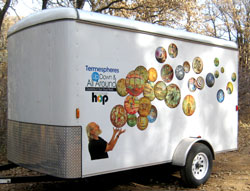 For the last four months I have been working on a traveling display of my concepts for the H.O.P. (Hands-On Partnership) for Science, Literature and Art in South Dakota and the Discovery Center in Pierre. The display goes into a trailer which is checked out by libraries and schools around South Dakota. They set the display up and use it for a month. It has many hands-on exhibits or stations for students to explore different ideas. UP DOWN AND ALL AROUND helps students see and learn about the orders of total visual space.
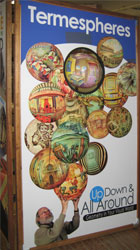 There are two original Termesphere spinning in holes in the entrance walls that invite you into this Exploratorium. There are four hinged walls that explain different parts of the display usually set up like corners of a cube that can be spread out to fit the size of the room it is in. Each of these walls are 4X7 foot.
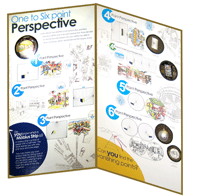 One of the stations is for students to explore ONE THROUGH SIX POINT PERSPECTIVE. The walls that contain this section show the grids used and some drawing results. There is also a DVD in the corner where I show students how to do all of these perspective systems.
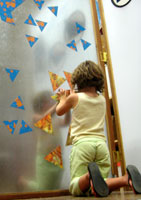
Another section has magnetic stick and steel balls for the students to put together to EXPLORE POLYHEDRA and THREE DIMENSIONAL GEOMETRIES. The goal is to help the attendees understand the total space around them by better understanding the geometries that fit in that total space.
The walls show the step by step processes of my workshop I do in this area. Also there is a DVD that shows students a step by step process to learn these basic building blocks of nature and man.
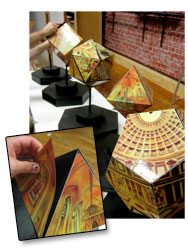
Polyhedra of the CAPTURED WORLDS are on a table for the students to fold up.
TETRAEARTH AND TETRA ART Flat and three dimensional puzzles coming from the Earth and Art on the tetrahedron are in this section. One of the 4X7 walls is made of sheet metal which allows the magnetic puzzle sheets to attract to. A complicated three dimensional puzzle of the Tetra Earth with 28 faces is part of this section. John Conway from Princeton suggested this polyhedron. The four triangles of the Earth repeat seven times to fill this puzzle which is made up of a tetrahedron coming out of a icosahedron. This is a great challenge for the students.
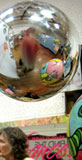 THE MIRRORED BALLS hang in one section. I painted one ball with mirrored faces so they better understand they are always in the middle of the mirrored sphere. There are many questions that are on the wall to get them thinking.
THE TRANSPARENT SPHERE OF ST. PETER BASILLICA Questions:
- Why does spinning this sphere make your eye/mind see only the front or the back?
- Why do most people only see the concave or the back of the sphere when it is spinning?
- What happens to the direction the ball is spinning?
- Where are you located when you see the back side of the ball?
 The TERMESPHERE DVD section has a wall of our environment and another of many spherical paintings.
THREE DIMENSIONAL POLYHEDRON PUZZLES TO PUT TOGETHER Five 16″ in diameter, three dimensional polyhedron, of the icosahedrons, dodecahedron, octahedron, hexahedron and the tetrahedron are on tables in the center. Each is covered with total environment images coming from Termespheres. These puzzle images are in the shape of triangles, squares, and pentagons. The students job is to fill in the sides with the proper polygon images to make total environments. Magnetic sheets are used to hold the polygons to the different sides of the three dimensional polyhedron. This helps students to be able to see in three dimensional space, the up, down and all around space.
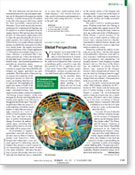 Science Magazine Artical about Termespheres
SCIENCE magazine just came out with an article on Termespheres called Global Perspectives. Barbara Jasny who is Deputy Editor of the Science visited the Gallery this summer. I was pleased with her excitement about my work. You can see her article by Clicking Here.
Hole of the Whole
Look for this sphere to be unveiled at the Dahl Fine Arts Center in Rapid City in March!
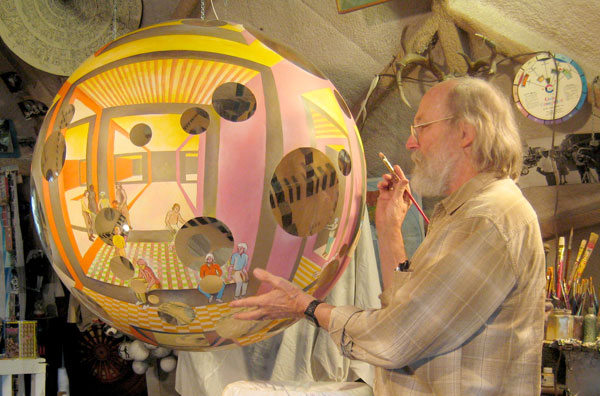
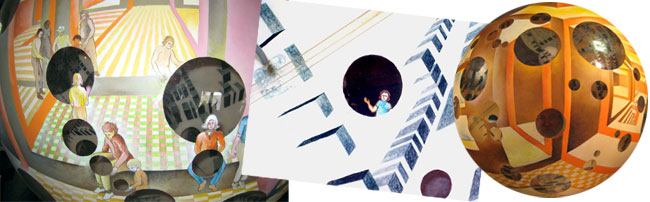
Discovering Perspective
DISCOVERING PERSPECTIVE is a new sphere that shows where perspective comes from:
This sphere has a cubical city in the round, 360 degrees in all directions. Square and rectangle canvases appear around the sphere showing the space of each of the different systems of perspective. This sphere makes you realize the same problems that map makers had when they tried to flatten the Earth into maps. These are the same problems we have when we try to draw the space around us on the flat surface. These photos show the different systems of perspective on the six point perspective sphere.
Click on this image to see all the perspective points.
True Perspective by Dick Termes
When people ask me about the rules of one and two point perspective I have a little trouble answering their questions. I think of the flat perspectives as being systems which do the best they can to replicate but the real world the real visual world is a sphere world. The same as the flat maps of the Earth, they try the best they can but they are distortions of the real thing. This is a very touchy area to be in because one and two point perspective have been around for 500 years and are thought of as very perfect systems.
I believe that all scenes that artists crop out of the world around them for their paintings are just that, a piece of the whole, the whole being the sphere or globe. So whenever artists want to know how to deal with flat perspectives I have to tell them it is a imperfect system. We must realize the images that are around us, if we tie them all together, would be best thought of as fitting on or in a sphere. Just because our eyes can see only about 160 degrees of our horizon we still know more is there. Stand in one spot and turn in a circle. Now standing in that same spot, turn again and look up and next, look down. Do you see that it is all tied together? How do we best map what you see and on what object? I believe the object that best fits that task is a sphere. When I paint my Termespheres I imagine I am inside a transparent sphere looking out at a world I want to paint. I copy that world onto the surface of the sphere. I then move to the outside to look at what I was inside of. When things fit as well as this, you know something is right. Nature’s answers are beautiful and so is the way these worlds fit onto a sphere. I do think of six point perspective as a discovery rather than an invention. The cubical six point perspective works very well. If all of the cubical world is parallel to each other, six points are all that are needed to capture that world. If a table is turned a little in that cubical world another four points are needed on the horizon line to take care of that twist. These points would be equally spaced pointss. If the table were turned 45 degree to the other cubes its vanishing points would be half way between the original points. There is a very tight system involved in spherical perspective that isn’t there in flat perspective. In spherical six point perspective, all lines are greater circles. All cubes within the scene project to all six vanishing points. The truest perspective probably would be found from within these spheres but some wonderful insights happens from looking at the outside of the spherical paintings
Rudy Rucker and Dick Termes
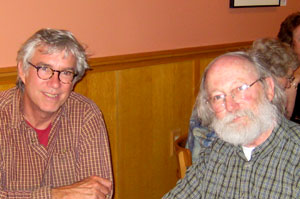 A site I would like to draw your attention to is one by Rudy Rucker. He visited our place this summer . This was his second trip to our home and gallery. When he got home to his blog he wrote some very nice comments about visiting our world. I hope you will check it out
Markie pointed out that some of you may not know who Rudy Rucker is. In short, Rudy is quite a guy. So I could be sure to cover as much of his genius as possible, I headed over to Wikipedia and grabbed this snippet from his entry, “Rudolf von Bitter Rucker (born March 22, 1946 in Louisville, Kentucky) is an American mathematician, computer scientist and science fiction author, and is one of the founders of the cyberpunk literary movement. The author of both fiction and non-fiction, he is best known for the novels in the Ware Tetralogy, the first two of which (Software and Wetware) both won Philip K. Dick Awards. At present he edits the science fiction webzine Flurb.”
27,500 Look at Termesphere, Reflecting Back on YouTube
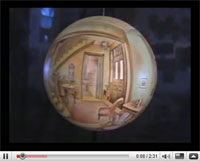 The YouTube video of the Adams House called REFLECTING BACK has drawn many hits from people. The optical illusion of this piece is one of its attractions. Even though the sphere is convex it seems to look concave when it is turning. It is as if you are looking at the inside of the ball. This happens with all of my spheres. An article in Perceptual and Motor Skills, 1991 by Al Brennan from South Dakota State University where he explained the illusion of the Termesphere. He called it the Termes Illusion. The world seems to be excited about it now.
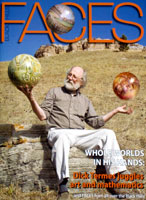 Black Hills Faces Magazine
Black Hills Faces Magazine did a nice article on me. I even got to be on the cover…This was an article written by Kaija Swisher with photos taken by Mark Wanek and James Van Nuys. It was a rare article that gets into my personal world. I guess that is why they call it FACES FROM ALL OVER THE BLACK HILLS. I was excited about this magazine article. They do have extra copies of this at www.blackhillsfaces.com
Thank you for reading to the end
I hope some of my thoughts and new ideas will get some comments back from you, positive or negative.
I love the way some of my math friends are making suggestions of concepts for me to consider. As always, thank you for your tremendous support and encouragement. I would love to hear what you think.
Feel free to call at 888-642-4805 or email me termes@blackhills.com -
December 2007 Newsletter

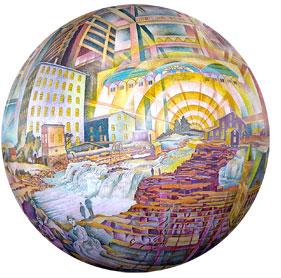 A Round Town
The sphere called A ROUND TOWN painted for the Convention Center in Sioux Falls has been installed!
This new four foot diameter spherical painting called A ROUND TOWN was recently delivered and hung at the Convention Center in Sioux Falls. It was donated to the City of Sioux Falls by Avera McKennen Hospital. I spent six months on this painting.
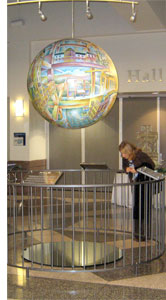 There are historical buildings of Sioux Falls on the bottom of the sphere along with a map of very early Sioux Falls. The grid of the map echoes the Convention Center’s tiled floor. Also in this area is the Falls of Sioux Falls which was the reason why the city was built where it was. The vertical lines of these older building project up into the upper section making the new buildings grow out of the past. The upper part of the sphere holds some of the future Sioux Falls buildings. Above this newer section on the top of the sphere is a cubical grid like the Convention Center’s post and lintel hallway that the sphere hangs in. This cubical structure flows throughout the piece helping to exaggerate the six point perspective used to hold the buildings and the art piece together. The cubical grid also transforms into the sun above the Falls. The rays of the sun expand to create the total Sioux Falls. The upper cubical structure and the lower square tiling both should help the sphere look as if it grew from that architectural spot in which it hangs. The colors play with a cross between pointillism and impressionism. This adds exciting color to look at. The ladies with their umbrellas on the bottom have a feeling of Seurat to them. The colors also have strong contract so the images can be seen from a great distance.
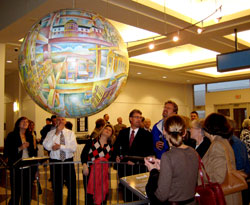 It was wonderful that Avera McKennen commissioned A ROUND TOWN and donated it to the City of Sioux Falls. It is very well displayed. Thanks to Avera McKennen as well as Larry Rehfeld for putting this all together for me.
New Sphere Just Finished
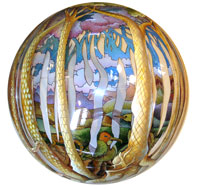
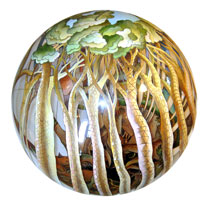 Creatures in the Forest
Creatures in the Forest is a forest scene that has transparent spaces between the trees. When you look into the sphere you see a landscape with creative animals in it. The foreground is basically vertical lines and the background landscape is horizontal lines. Both are painted in the same space, one is seen on the front while the other is seen on the inside of the same space.
In the Works
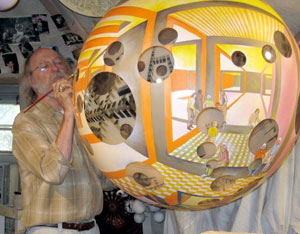 What I am working on at this point is a transparent 36″ diameter sphere. I started with a scene of cubical patterns projecting in six point perspective with a great deal of transparent areas between them. A variety of different size circles where drawn over this. I kept what was inside the circles transparent and painted everything on the outside of the circles with opaque white paint. This white paint now has been turned into a room that these circles (I think of them as spheres) are floating in. People are standing around in the room looking and studying the spheres floating by. The transparent spheres or bubbles have images showing up in them that are coming from the inside of the large sphere. It is interesting that when you look at the small bubbles the image moves across them. When you pull all the images together from all the individual bubbles it makes one total scene. If you get close enough to one of these holes or bubbles you can see the whole inside scene. I am not sure what that means but I think it means something. The transparent spheres do intrigue me. If designed right I can work on the convex as well as the concave sides.Matthews Opera House Sphere
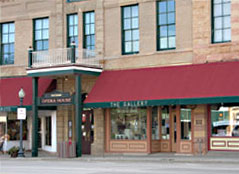 Another spherical painting I am just starting to work on is the MATTHEWS OPERA HOUSE SPHERE. They have commissioned me to paint a 30″ diameter sphere for their stairwell. It is their centennial year +1 of the opening of the Matthews Opera 1906 – 2006. I am just beginning this spherical painting. It will hold the reflection of the Opera as we see it today, the up, down and all around view. I am doing the drawing portion on the sphere at the Opera itself. It is very fun to be able to walk up and study the details right when you need to. Most of my famous interior series are done from the Total Photos I take. Look back at News letter #4 for information on that. This piece will also have historic events that have happened in the Opera woven into it. Paul Higbee of Spearfish is helping me with this history. He is a great historian in relation to the Opera as well as a very good friend.
I am excited to get to paint this sphere for the Opera House because it has been very much a part of my life. It is extra special to have people from your home town fund your work! I have had one of my Termespheres in the Opera House stairwell for many years now. This new piece will be a little larger. It will be 30″ diameter rather than the 24″.
It will be wonderful to mark 100 years of theatre activities and this incredible symbol for Spearfish with an art piece. I very much want to thank Linda and Bob Meyer for their work in finding the moneys for this painting.
Where Have I Been Lately
The North West Math Conference in Bellevue Washington was a wonderful experience. I was pleased to get to show six Termespheres and get to talk with people about them for three days. I was also one of the keynote speakers for the conference. I enjoyed the other speakers and the displays of books and other items. There were over 1800 math teachers from Washington, Oregon, and British Columbia at this conference.
I am Fascinated by my Connection with Mathematics
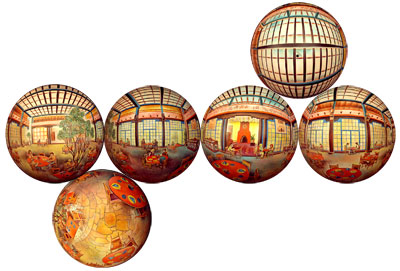 If math is the study of patterns, my work is very much related. When every line one draws is related to the first line you drew, there is some connection to Math. When the realism you draw grows out of a geometry grid, there is some connection.
When I use the six-point perspective, which is six equal distant points on the sphere, and all lines must always extend to two opposite poles, there is math in this. When every cubical structure I draw must extend to all six equal distant points there is some connection to math. Every cubical line I draw on the sphere is a part of a greater circle.
When the realistic world around you fits into this system of perspective, which all-cubical worlds do, that is mathematics. Many artists find their work fits with other disciplines, my work seems to go over very well with mathematicians.
Does Art HAVE to Be Created on the Flat Surface?
You might think this is a fact when you talk to many artists. Why can’t a painting idea be created in three dimensional space? Why do you have to take six-point perspective back to the flat surface? What if the idea works best in three dimensions?
Just because we would like all things to fit in books doesn’t mean all things have to. You know, we live in a three dimensional world, not the two dimension of the book. I think also many artists wanted to be able to reproduce their ideas for more sales and it is much harder to reproduce in the third dimension. That, maybe could have a lot to do with how they wanted their images to turn out.
When I was at Otis Art Institute in Los Angels I was ask by one of my fellow students, when was I going to “Get serious and get back to the Flat Surface”. I am pretty glad I didn’t get serious.
Why does the Termes Illusion work?
Why does the Termesphere seem to flip and read like it was a concave surface and the motion reverse? My opinion is this: all illusions work because the mind is used to one thing and the designer or artist pushes the image away from that normality. The illusion happens when the mind pushes it back to what it thinks is normal. With the Termesphere, your mind wants to be on the inside of this image to have it be normal. The normal visual world around us is, to our minds, concave. Our minds will push the sphere image, convex, back from the outside of the sphere to the inside, concave. The realism is important for this illusion to happen because we feel like we are more in a normal world with realism. The abstract or geometrically painted spheres can just be that, paint on a sphere. Why is the faster motion important? That is a little harder for me but I think it has to do with you being able to pull the total image together and not think of it as pieces of pictures. When it is all one scene, we know that it is like the world that is always outside of us and we know that scene is on the concave.
 Where Do Ideas Come From?
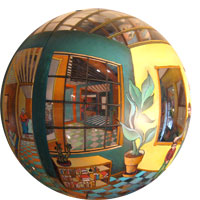
I believe most of my ideas come from art pieces I have done in the past. Ideas grow from ideas.
Ideas also come from other artist’s work and from studying geometry of the sphere and also from theories in Science that I read.
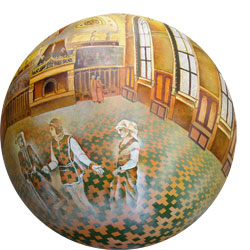 Many building interiors also have inspired my art. I have done a whole series of Famous Interiors of places like Notre Dame, Saint Chappell, St. Denis, Paris Opera in France, Blue Mosque, Hagia Sophia in Istanbul, St. Peters and the Pantheon in Rome, Stone Stonehenge and The Globe Theater in England. The Matthews Opera House that I am now working on is part of this series.
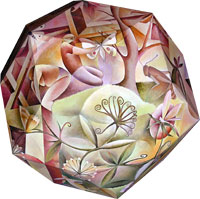 Some of my ideas grow from my subconscious mind. I sometimes paint a loose abstract painting with no image in mind. The patterns and colors stimulate images and ideas. I just have to be brave enough to follow my intuition for these images. It is fun to see what ideas are hidden within my mind.
Thank you for reading to the end
I hope some of my thoughts will get some comments back from you, positive or negative and new ideas.
I love the way some of my math friends are making suggestions of concepts for me to consider. If you would like to be taken off this newsletter list please let me know. As always, thank you for your tremendous support and encouragement. I would love to hear what you think.
Feel free to call at 888-642-4805 or email me termes@blackhills.com -
December 2006 Newsletter

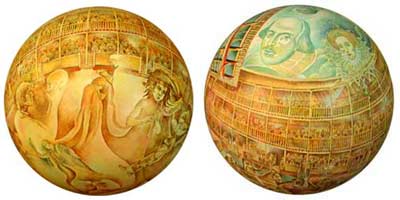 The Globe Theatre in London
This is a 24-inch diameter spherical painting of Shakespeare’s Globe Theatre in London. Markie and I were there two years ago. It seemed the perfect subject for a Termesphere globe of the Globe. Later when I decided to create this piece I researched it in books, the Internet and the movie “Shakespeare’s in Love”. The cylindrical auditorium with the small compartments for seating helped with the idea that “all the world’s a stage.” Images of five plays are shown in this piece as well as images of Queen Elizabeth and Shakespeare.
In the Works
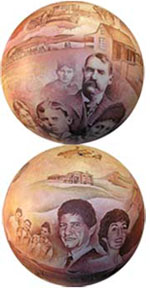
 I am working on a 24″ sphere commission for Tom and Theresa Matthews. They live just over the state line in Beulah Wyoming. The sphere plays with images of the Matthews’ Ranch twenty miles south of Gillette Wyoming. Four generations with the name Tom Matthews have worked on this family ranch from 1881 into today. The T7 Ranch, as it is called, has been the foundation for many Matthews individuals. The Matthews family was responsible for the Matthews Opera House as well as the whole Matthews Block of buildings in Spearfish South Dakota. This sphere incorporates these people and their influence in this area.
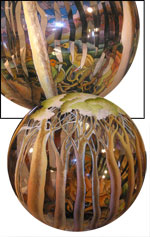
I am also working on a transparent sphere which may be called CREATURES ON THE FOREST. It will have a forest on the front side of the sphere. Through the open transparent spaces between the trees you will see creatures and a landscape on the backside of the sphere. This sphere seems to open another whole direction for the Termespheres. The image shown below is an in-process photo of the two sides of this painting. It is a challenge to paint two different images on the same place. Another transparent sphere painted ahead of this one is REFLECTIONS THROUGH THE MIRROR (which is also transparent).
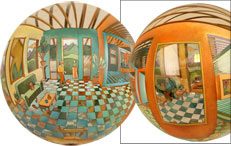
This room is filled with mirrors on the walls. When you look into the transparent mirrors you see what is on the back side of the sphere. The cool part of this piece is that the reflection is reading correctly, it is what would be behind you and also a backwards mirror image. It is an odd place to find a true refection–on the back side of the ball.
Publications
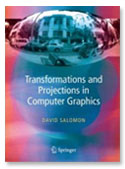 TRANSFORMATIONS AND PROJECTIONS IN COMPUTER GRAPHICS by David Salomon was published by Springer 2006. I am very pleased to have this book dedicated to me. My contribution to this book has to do with the use of many of my images. In the section on CYLINDRICAL PANORAMIC PROJECTION Solomon uses my continuous Four Point Grid and one of my drawings. He also used my grids from one through six point perspective and examples of my drawings with each. The drawing of St Peters as a dodecahedron is also used. My patent on the TOTAL PHOTO is included. I was pleased with this as many new approaches to capturing total 360-degree worlds are coming into being and it is nice to have them know I was there in 1980.
FOOD FOR THOUGHT AND THE SPHERE CALLED EMPTINESS are shown in full color.
Workshops
The South Dakota Lions Club hired me to do workshops with a group of International students in Volga South Dakota July 2-3 and 4th. We produced a large icosahedron that was left at the sight.
I was at Western Washington University in Bellingham July 11-14 this summer. I worked with 70 math teachers. They came from all over the state of Washington. I did the perspective workshop and the polyhedra workshop. It was exciting for me to see how the math mind related to these workshops. They did a wonderful job, by the way.
The end of September I flew out to Phillips Exeter Academy and spent three days. I had sent ahead a showing of Termespheres. I also did workshops with the math and art students. What a fun educational environment that was!
I spent a day doing workshops on perspective with the National Veterans Creative Arts Festival in Rapid City October 20th 2006. Along with the workshop I had eight Termespheres hanging around in the environment.
Virtual Termespheres
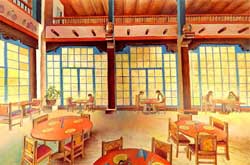 Ryan Packard has put together some wonderful Virtual Panoramic views of my Termespheres. He puts you inside six spheres that you can turn with your mouse to see any part of them. You can find them on the homepage of my site www.termespheres.com You must look at them! They are way cool. These virtual programs are of FOOD FOR THOUGHT, ST. MARKS SQUARE, LOOKING FOR THE ORDER, THE PANTHEON, LORETTO CHAPEL IN THE ROUND and OLD BALL GAME
Quicktime credit to Ryan Packard
Awards
I received a couple of honors this last month.
RUSHMORE HONORS by the Rapid City Area Chamber of Commerce Sept 14, 2006.
SPEARFISH HIGH SCHOOL FINE ARTS HALL OF FAME which will be given December 14, 2006.
Six Point Perspective
SIX POINT PERSPECTIVE ISN’T JUST FOR THE FUN OF IT,
IT’S IN THE REAL WORLD ALSOBy Dick Termes 10-06-06
This will become a major paper but I will try to condense this idea for the newsletter.
My thesis is that spherical paintings are closer to reality than flat paintings.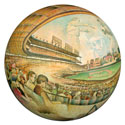 Any painter should be aware that if you are true to the reality of what we see, all paintings, including flat ones, are a piece of the whole visual sphere around you. If you don’t think the visual world is a sphere around you, take another look. The image in front of you is attached to more and more image until it comes right back to the original image, any direction you might want to go. This is a sphere. Six point perspective is the order this world around you can be organized to. Six point perspective especially works well if the environment around you is a cubical environment.
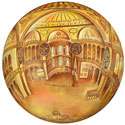 To help explain the statement above, think about this: Imagine being inside a transparent ball that you have put six equal distant dots on. With the transparent ball on your head, move inside a cubical building. Look through the transparent ball at the building’s three sets of parallel lines. They run north/south, east/west and up and down. The rule in traditional perspective is all parallel lines go to the same vanishing point. In my system of six point perspective on the sphere, all parallel lines go to two vanishing points, north/south, east/west and up/down. These points will be opposite poles on the ball.
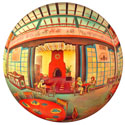 As you look through your transparent ball, make sure one of the dots on the transparent ball is directly above your head. Keep your eyes in the center of the ball when observing all of this. Now, look at the outside building and look where one of the vanishing points would be located. Remember, all parallel lines go to the same vanishing point. When you have located one of the vanishing point of your building, line up this vanishing point with a dot on the ball. After you have overlapped this vanishing point with the dot on the ball, keep the ball stable. Now rotate your eyes within the ball and notice all the other lines of the outside building will project to the other dots on the ball. If the first set of lines you worked with run to the north direction then they will also run across the ball to the south direction. Turning your eyes now within this stable ball notice the next dot to the east will also line up with the dot on the ball. Those lines that aim at the east vanishing point (and dot also) will swing across the ball in greater circles to the west vanishing point which is also another dot on the ball. You don’t have to be in the center of the cubical room for this to happen, it will happen no matter where you are located within the cubical building.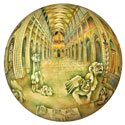
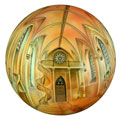 So, my thesis is that these six equal distant points are in the world around us all the time. This isn’t something I came up with just to make the spheres look good, it is real.
The Termesphere is not just a fun technique, in my mind, it is closer to how things are than any flat surface can be. It is the way we see–that whole picture is always there. All we have to do is turn and look.
Seeing is a spherical idea just like the Earth is a spherical idea. Both are distorted when seen on the flat. Both read correctly when seen on the sphere. The same problems and the same solutions can be used for trying to get them to the flat. All of these have distortion. Polyhedra can be used but they have distortion. Different kinds of projections also can be used. One through Five Point Perspective is our attempts to get this spherical information onto the flat surface.
Why is this important? This visual sphere is with us every second of our lives. It is always around us. I think it is important to understand something we have to live with so closely.
Thank you for reading to the end
I hope some of my thoughts will get some comments back from you, positive or negative and, new ideas.
I love the way some of my math friends are making suggestions of concepts for me to consider. If you would like to be taken off this newsletter list please let me know. As always, thank you for your tremendous support and encouragement. I would love to hear what you think.
Feel free to call at 888-642-4805 or email me termes@blackhills.com
