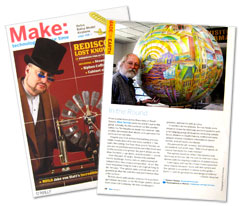
A conversation with artist Dick Termes, creator of the Termesphere, quickly becomes part geometry lesson, part art lesson.
There’s talk of six-point perspectives, dodecahedron three-dimensional puzzles and total visual space. He admits that one student at a Termesphere workshop suffered a “Termesphere headache” trying to understand the dimensional challenges of the spheres.
Most people, however, don’t study the geometry of Termespheres in such mathematical depth. Most merely enjoy the uniqueness of a painting wrapped around a giant sphere, hanging from the ceiling.
“I don’t want them to be just a geometry piece. I want it to be an art piece,” Termes said.
Termes grew up in Spearfish, getting his first taste of art in third grade when his class painted a mural. The experience opened his eyes to the arts and the possibility of a career as an artist.
During a college art class, the Termesphere concept first emerged when a fellow student commented that Termes’ painting looked like a ball. Termes decided to paint his next piece on a sphere, out of curiosity. “When I finished it, I thought, well surely people have been doing this … because it’s so obvious,” he said.
He quickly realized that no one was.
“It just seemed very natural to me to explore this,” he said. “When you find this dimension, it’s hard to go back to a flat surface.”
So he never did.
For the past 30-some years, Termes has made a name for himself with his Termespheres, painting images of everything from Lewis and Clark to Shakespeare’s Globe Theatre on Termespheres.
He speaks at both art schools and math conferences, and continues to create Termespheres at his dome-shaped studio, which also houses his gallery and home, near Spearfish.
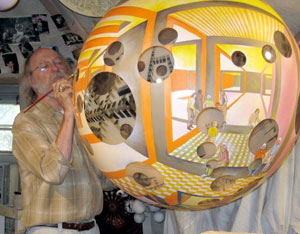
Termes’ studio dome epitomizes an artist’s space. Drawings, photographs and sketches are pinned here and there. Paints, brushes and clutter circle the room. Termespheres in various stages are hung from the ceiling. And in the hot spot right now is a new piece, still in the works. It’s an exploration of not only images painted on the sphere, but images that can be viewed inside the sphere.
On the new piece, still unnamed, Termes has left clear windows or mirrors into the Termesphere, allowing viewers to see the back side of the image he’s painting on the outside.
To accomplish the image, he first painted a geometric design on the ball. Then he painted the back side of his painting, including drawings of people and plant life. Afterward, he covered it with a coat of paint and began painting the front of the image. The result: a viewer can look into the window and see every dimension of the painting’s world.
“I play with inside-out complete worlds,” he said. “This is going to be a shocker, I think. It’s very odd, the things that go on in this piece.”
This is his third Termesphere on a clear globe. Most of his Termespheres are painted on opaque spheres. He usually begins each painting by plotting perspective points. Once his six-perspective points are in place, he begins building the image around them. “Six-point perspective is the key,” he said.
That mix of art and mathematics is what makes Termespheres so unique, said Mary Maxon, curator at the Dahl Arts Center.
“The way he uses perspective… It’s kind of mind-boggling,” she said. “A lot of people have trouble with perspective with just a couple of points in it.”
His ability to paint in such a multi-layered perspective and his creation of a new artistic concept has earned him one especially interesting accolade, said Debbie Smoot, business manager at the Mathews Opera House in Spearfish.
“Whenever you get a new piece in, you put the medium (used for the artwork). Guess what, his medium is his name. … That’s just really awesome that someone from here has something that unique about what they do,” Smoot said.
Termes has created Termespheres as large as 7-1/2 feet wide. One hangs in the law enforcement center in Douglas, Wyo.
In his studio, an 8-foot section of the floor can be removed to accommodate the larger spheres. Once completed, the Termespheres can be lowered through the hole into the room below. From there, they are transferred through the garage door, located on the lower floor.
Two of Termes’ most recent pieces hang in the new Sioux Falls convention center and at the Mathews Opera House in Spearfish.
The opera house Termesphere celebrates the 100 years of the theater and was installed in the theater last year. On the sphere, Termes painted images of the theater itself and then interspersed images from the various events that have occurred in the theater.
Smoot said performers and artists have made it a game to study the Termesphere to see if they recognize themselves in any of the images. “It just seems like it brings the theater alive,” Smoot said. “People are amazed.”
Termes currently is working with the Discovery Center & Aquarium in Pierre on a new traveling exhibit, “Up, Down, All Around: Geometry in Your Visual World.”
The exhibit will allow children to explore geometric shapes and drawings from multiple perspective points. The goal is simple, said Kristie Maher, director of the center.
“Kids in South Dakota should know about Dick Termes. He has created an original form of art that mystifies other artists worldwide. And, by studying his work can motivate a curiosity about how it is made … geometry,” Maher said.
Termes likes the idea of challenging kids to explore geometry through art. And he hopes that they might use the things they learn at the center to begin exploring their own concepts of art and geometry, and maybe even become artists themselves.
“I hope that they come away with a better understanding of total visual space,” he said. “Total visual space and … the geometry of that kind of space.”
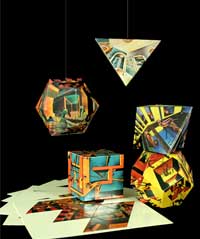
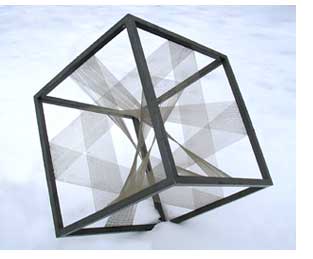
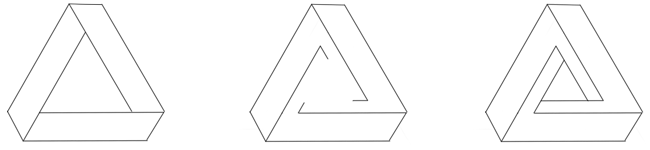
 What I am working on at this point is a transparent 36″ diameter sphere. I started with a scene of cubical patterns projecting in six point perspective with a great deal of transparent areas between them. A variety of different size circles where drawn over this. I kept what was inside the circles transparent and painted everything on the outside of the circles with opaque white paint. This white paint now has been turned into a room that these circles (I think of them as spheres) are floating in. People are standing around in the room looking and studying the spheres floating by. The transparent spheres or bubbles have images showing up in them that are coming from the inside of the large sphere. It is interesting that when you look at the small bubbles the image moves across them. When you pull all the images together from all the individual bubbles it makes one total scene. If you get close enough to one of these holes or bubbles you can see the whole inside scene. I am not sure what that means but I think it means something. The transparent spheres do intrigue me. If designed right I can work on the convex as well as the concave sides.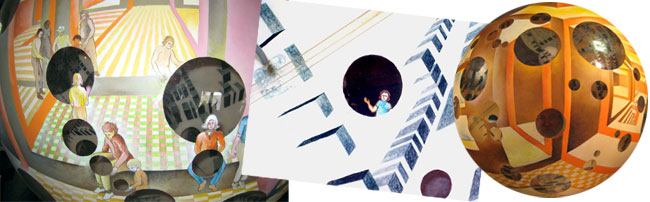
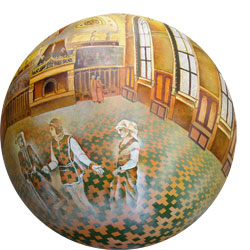 Many building interiors also have inspired my art. I have done a whole series of Famous Interiors of places like Notre Dame, Saint Chappell, St. Denis, Paris Opera in France, Blue Mosque, Hagia Sophia in Istanbul, St. Peters and the Pantheon in Rome, Stone Stonehenge and The Globe Theater in England. The Matthews Opera House that I am now working on is part of this series.
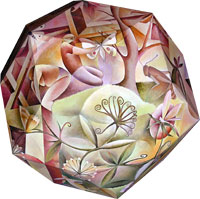 Some of my ideas grow from my subconscious mind. I sometimes paint a loose abstract painting with no image in mind. The patterns and colors stimulate images and ideas. I just have to be brave enough to follow my intuition for these images. It is fun to see what ideas are hidden within my mind.