Author: Dick Termes

  • Marshall University attends workshops in Termesphere Gallery

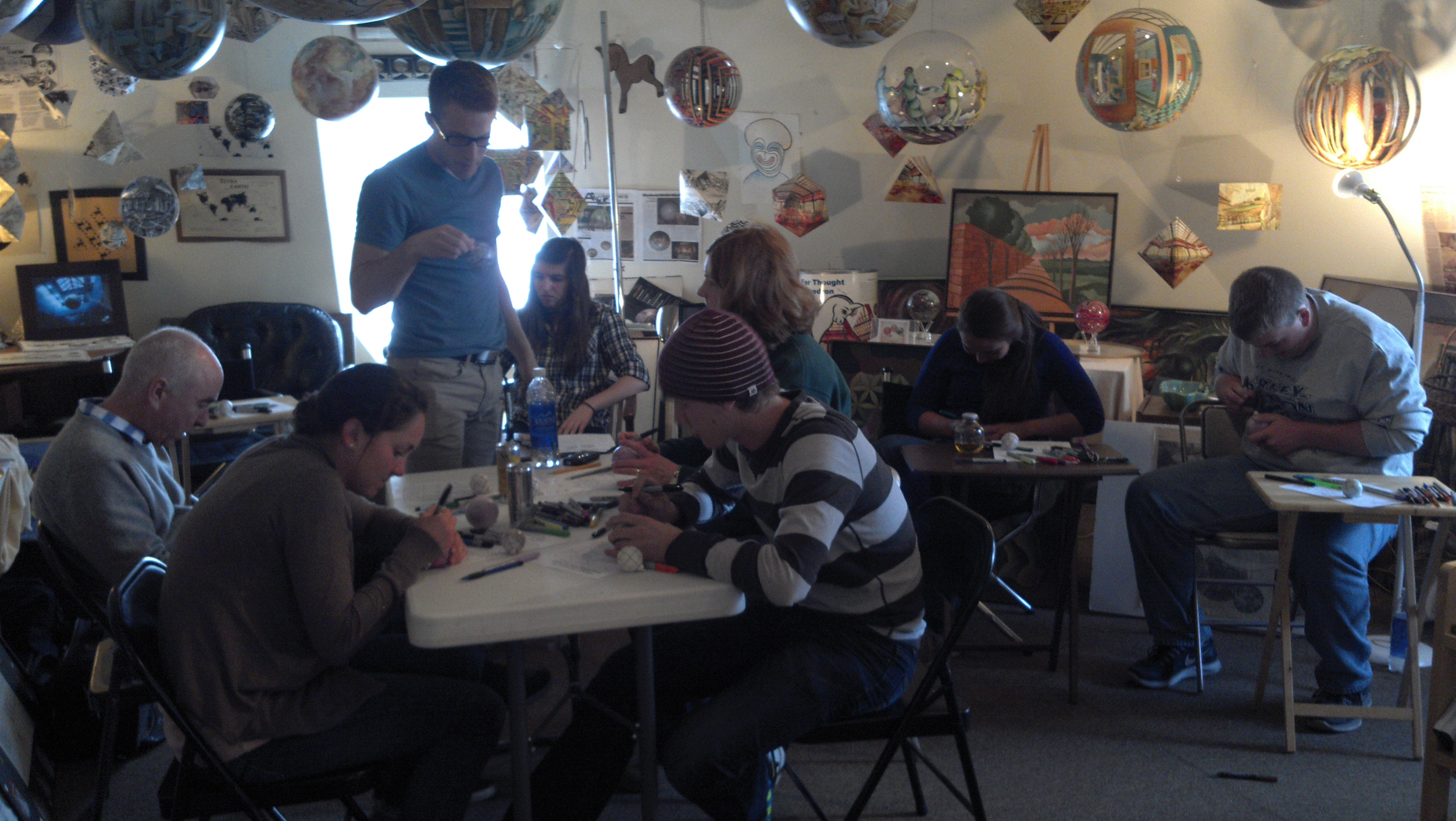
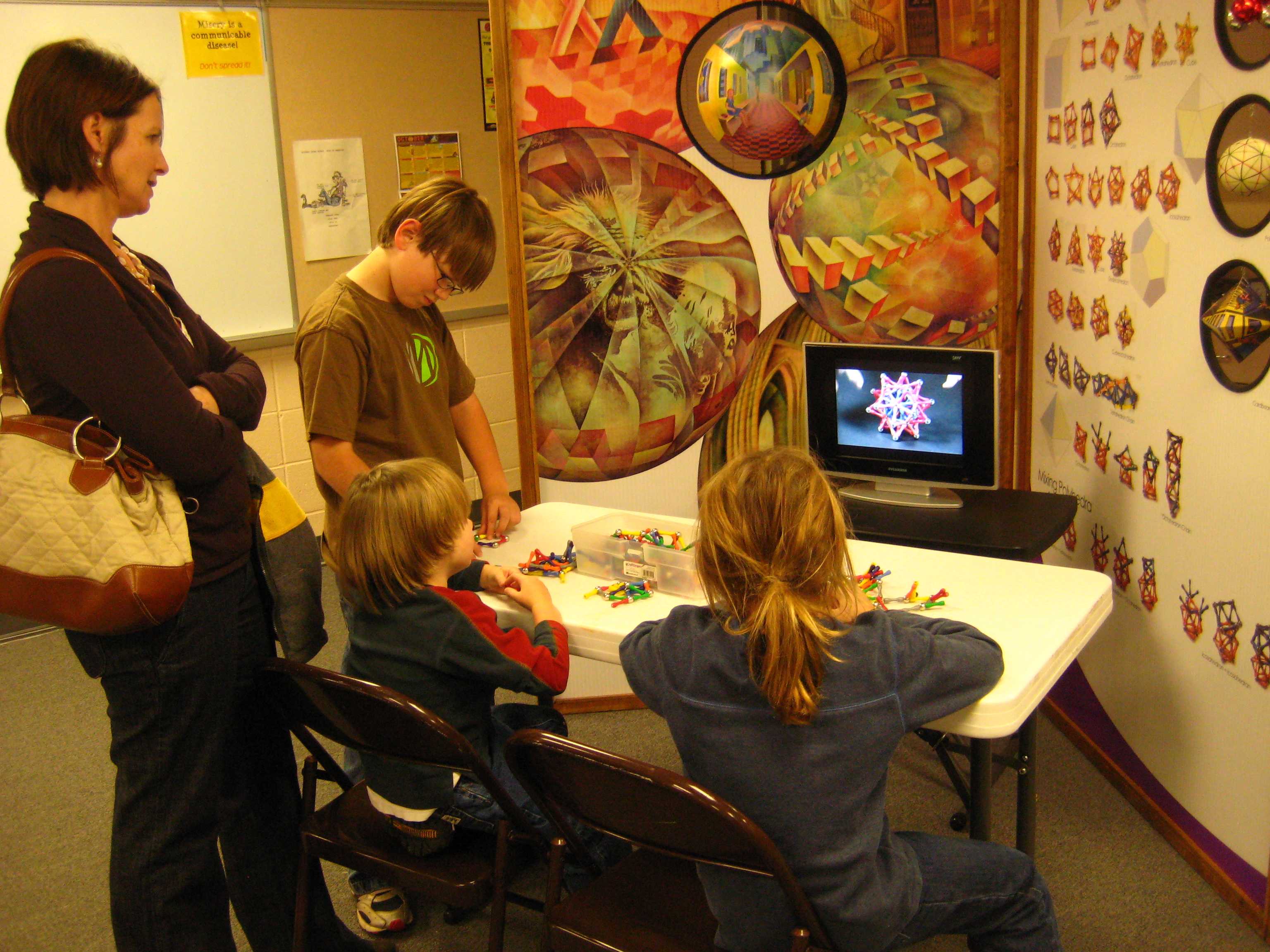
    For the third year in a row, this last Saturday and Sunday, students and instructors mixing tetrahedrons and octahedronscame to my Termesphere® Gallery from Marshall University from Huntington West Virginia.   They came for workshops on Spherical Geometries and One through Six Point Perspective.   Professors Dr. Judith Silver, the Department of Mathematics and Professor Jonathan Cox, the Department of Art and Design have brought students to the Termesphere® Gallery and the Black Hills.  When they finished the workshops they tour the Hills. So there was a nice double reason for them being here.

    The students are always outstanding and very fun to work with.   It is interesting to transform my gallery into a Marshall Univ. in the Galleryclassroom environment with desks and chairs, an overhead projector and screen.  It is wonderful to have my work hanging all around so whenever I need an example of what I am talking about I can just point up and show them.

    I am hoping to draw attention to these types of workshops with other Universities.   I enjoy doing these presentations in my gallery very much and think I can get twice as much across with my workshops with my art work all around me- up, down and all around me.

    Save

  • Nature Wins?

    There is a video of the piece we are trying to name.  Look at this video and help me out with a name.   I am very pleased with some of the name result so far.

  • Nature Wins? Termesphere®

    IMG_4463_cropNATURE WINS is a 24” diameter spherical painting that plays off of Villers Abbey in Belgium.

    It was founded in 1146 and was abandoned in 1796.  Accounts suggest that roughly 100 monks and 300 lay brothers resided within its walls.  In 1893, the Belgian State purchased the site and launched a conservation effort. Classed as an official historic site in 1973, the abbey has subsequently enjoyed considerable restoration. .

    Over the years plants have come to take it over. IMG_4446_crop The mixture between man and nature makes it very interesting to me.

    Because I didn’t know what the whole building looked like from this one spot,  I made up some of this building as to what I thought it should look like.  I exaggerated the plants to show more of their energy and power.  I opened up the floor with cracks letting in more plants but also showing the building may be floating in the sky.   As nature attacks man’s creation so does the cat move after the birds.  This piece was in process for over four months.IMG_4442_crop

    Save

  • Illusions Create the Total Picture in Gillette News Record

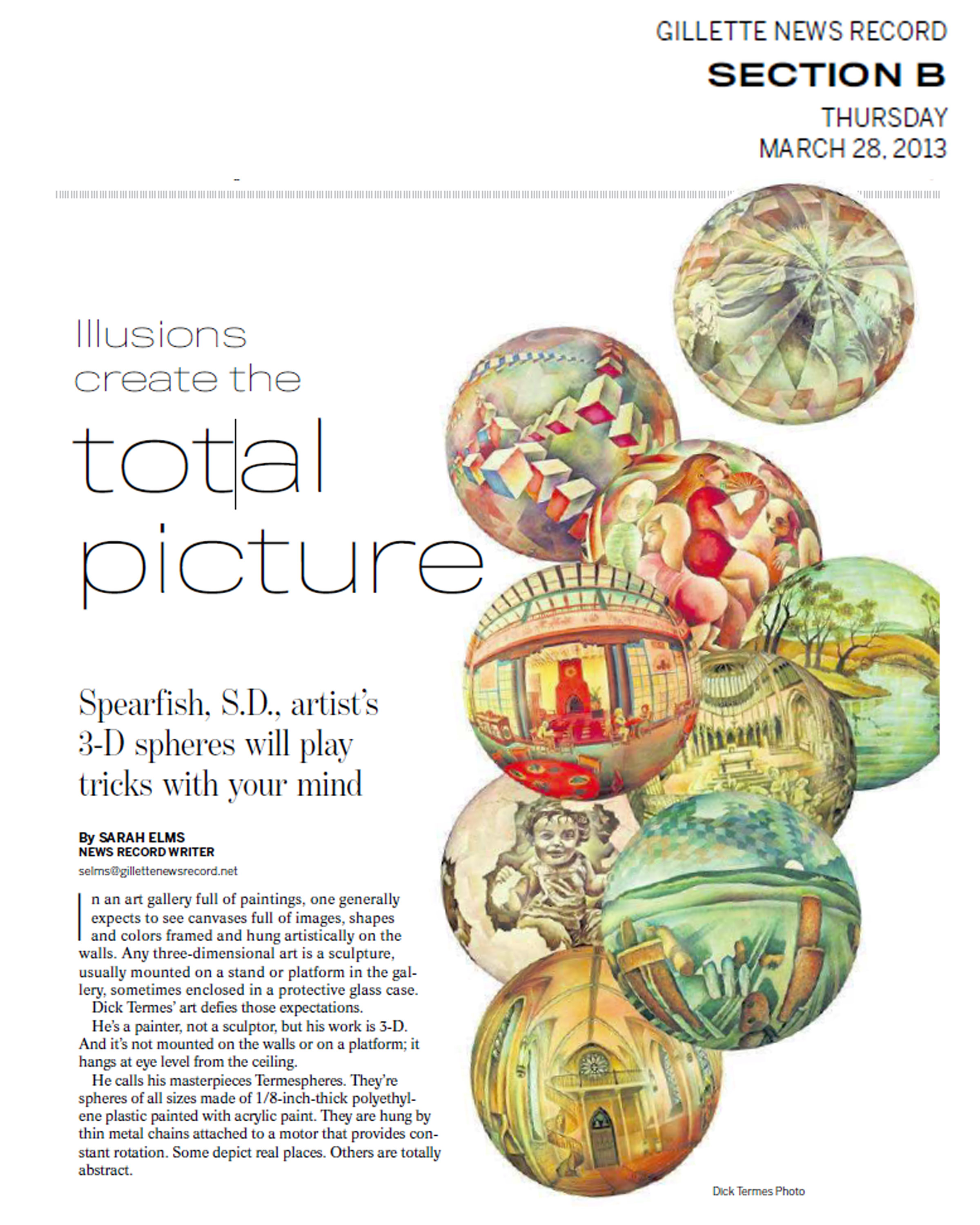
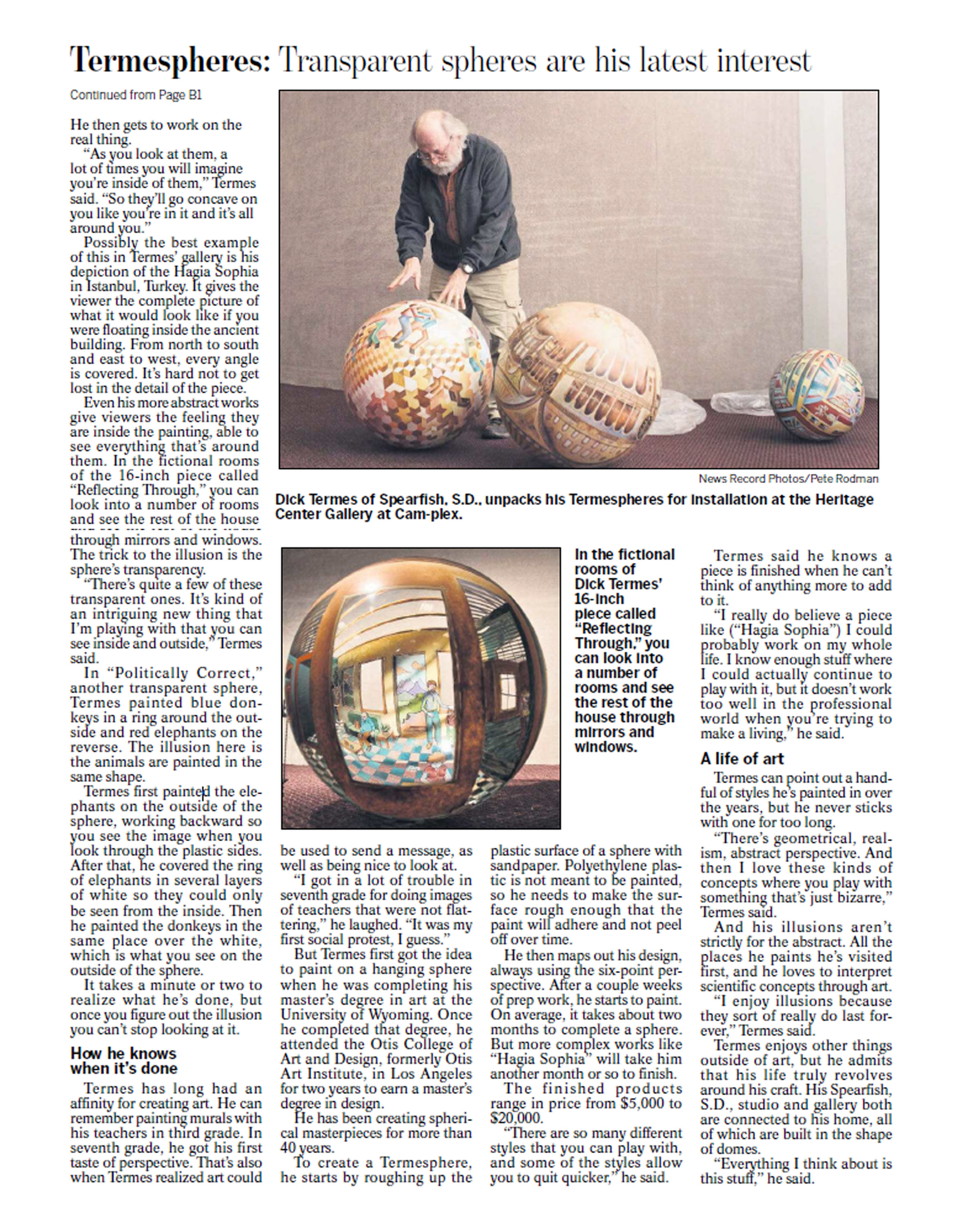
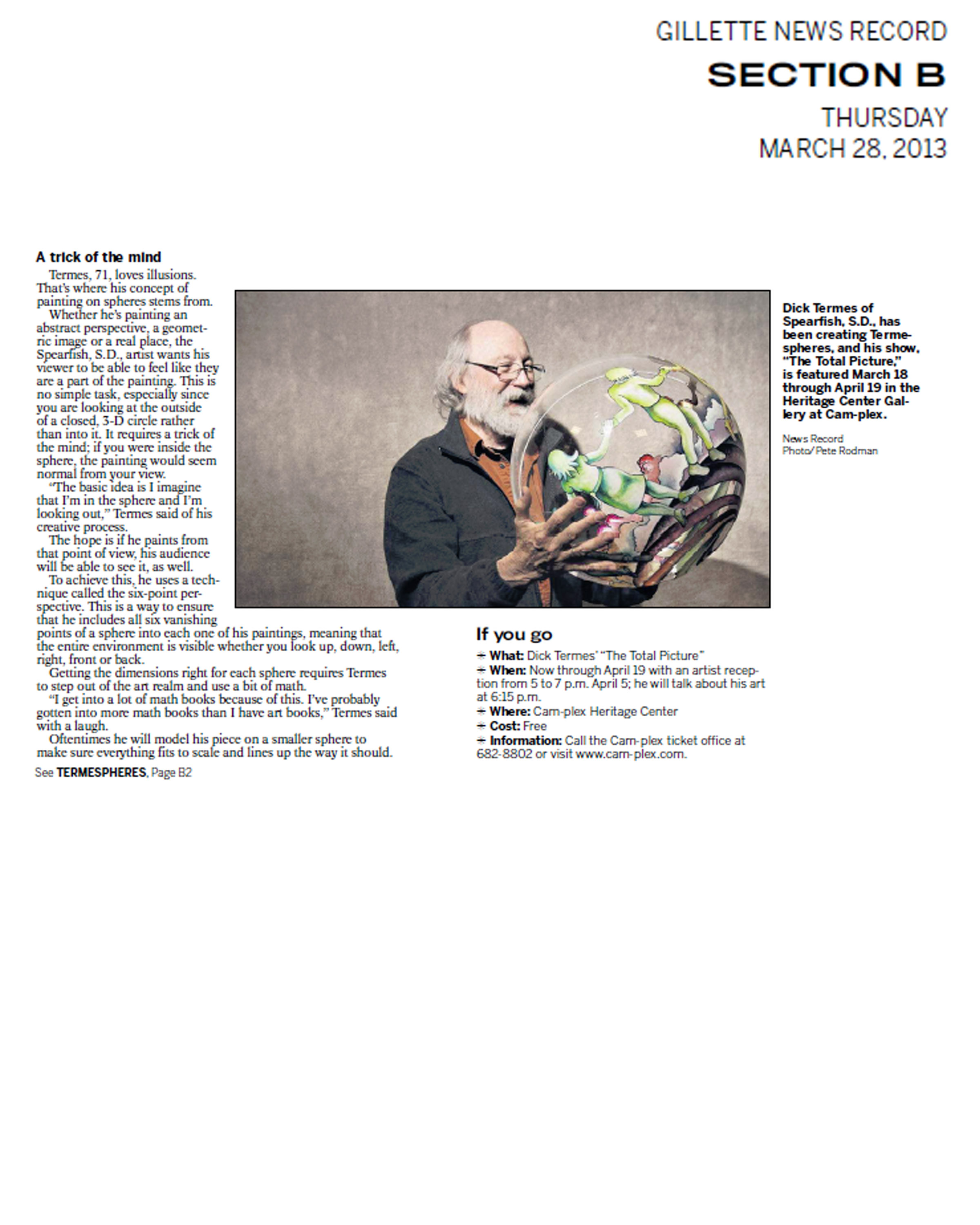
    This is a great article written by Sarah Elms in the News Record Writer for my show at the Cam-plex Center in Gillette Wyoming.    This show will be up until April 19th.

    NewsRecord Ad 3-28-2013


    NewsRecord Ad 3-28-2013-3NewsRecord Ad 3-28-2013-2

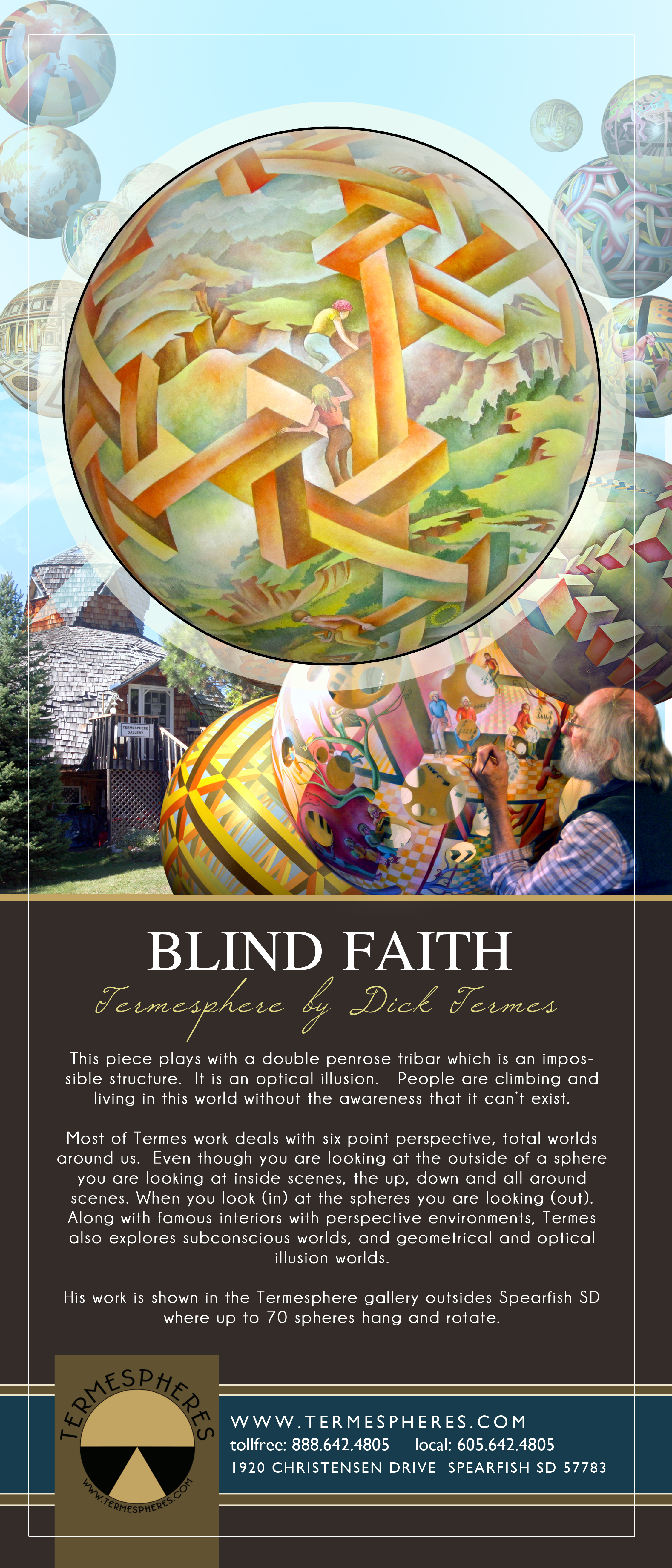
  • Blind Faith Termesphere® on display at Black Hills Visitors Center

    Termes -Blind Faith Card

    There is a new Termesphere® on display at the Black Hills Visitor Center in Rapid City South Dakota called BLIND FAITH.This is a nice opportunity. This piece is fun to look at because it shows an optical illusion structure that the people in the spherical painting are living in and climbing on.  The Penrose Tribar is the basis of this structure.  M.C. Escher used this structure for the substructure of some of his art pieces.

    It can be seen in motion in the video below.

    Save

  • Workshops at Lander Wyoming

    I just finished a four day residency in Lander Wyoming from March 4th through the 7th 2013.  I think this is the third year I have been there. lander5

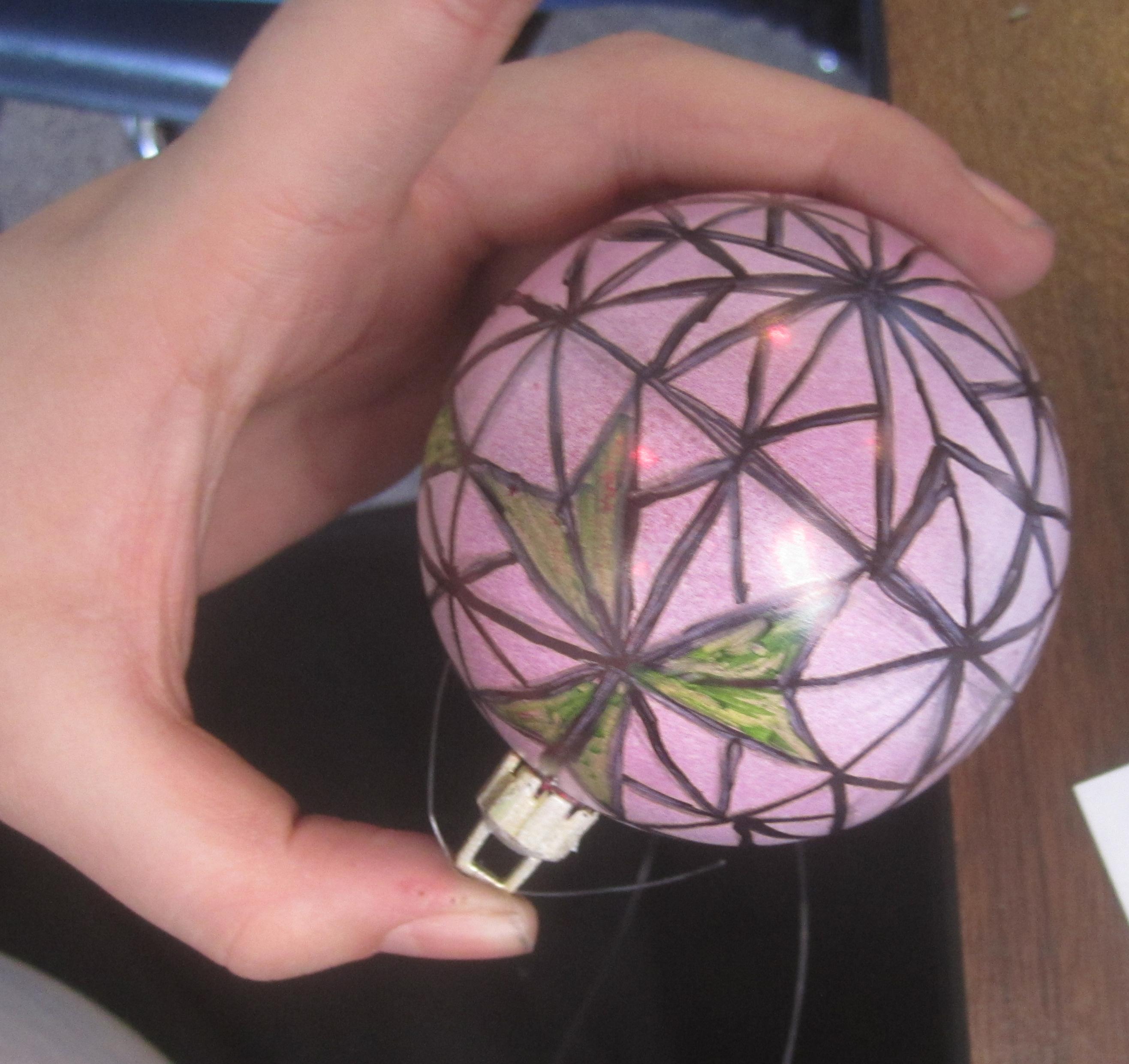
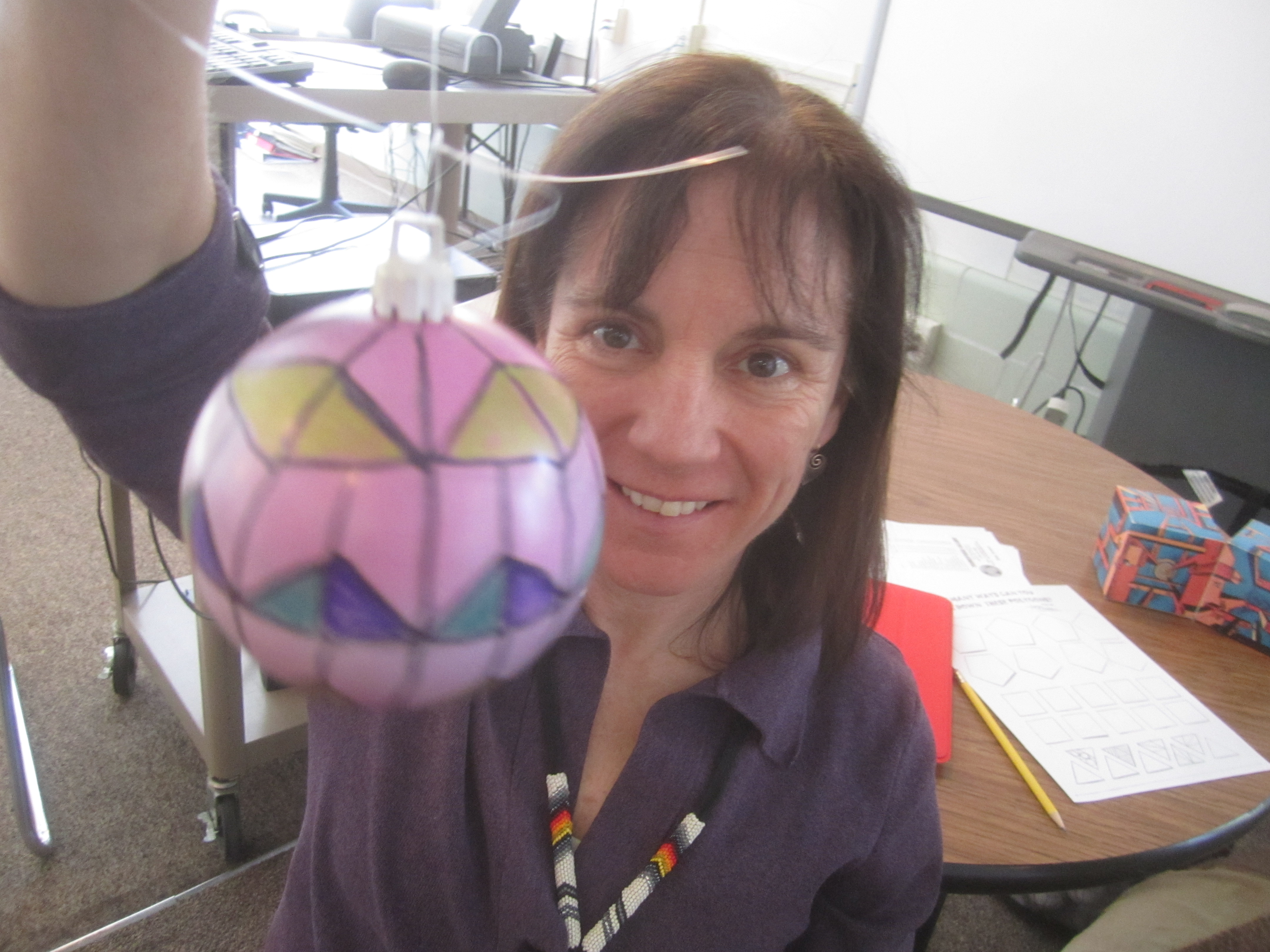
    The first day I worked with the Middle School Art students with one and two point perspective. I use a grid system which makes learning perspective much easier.  Most teachers switch to this system of teaching perspective once they see it.  I also spent a couple of periods with the six grade art students going through some of my basic drawing techniques.  My attitude with this is nothing can be too simple.  What is a line?   How do you draw cubes, cylinders and spheres?   As I tell them, if you can draw these three things you can draw about everything in the Universe.  I carry this over into landscapes.   The last two hour period of the day I worked with the Pathfinders High School with magnetic sticks and steel balls to build threLANDER 9_crope dimensional polyhedron and also had time to give them a small ball to draw their own geometric designs on.   It was the first time I have been able to mix these two workshops together at one time.   It worked very well studying the polyhedron first and using that knowledge to make their own cool designs.  I think most of their designed balls will be hanging in a very special spot in the rooms.  This knowledge will pop up again in chemistry, biology, architecture, geometry and art in their futures.

    The second day I worked with 149 math students at Lander High School.  I showed them how to create the five Platonic Solids on a sphere after they had experimented with drawing geometric designs in triangles, squares and pentagons.   They selected one of their own designs to repeat into the         polygons of the polyhedron.   Using permanent black pens and later colored permanent pens they created their own personal designed sphere.   What is the most exciting about this assignment is none of the designs are the same and most    LANDER 7_cropstudents are very surprised how their designs turn out when repeated in the twenty triangles of the icosahedrons or twelve pentagons of the dodecahedron or six squares of the hexahedron or cube.  By playing this way they see how many of the other polyhedra were discovered.  Some students who struggle with school do very well with this type of spatial thinking.

    The third day I worked with sixth grade math students.   We also did the designed sphere idea but I held it to the octahedron and the cube so it wouldn’t be quite so complicated.  They still came up with some great sphere designs.   I hear the comment, “I wish math class were like this all the time, it would be a lot more fun”.

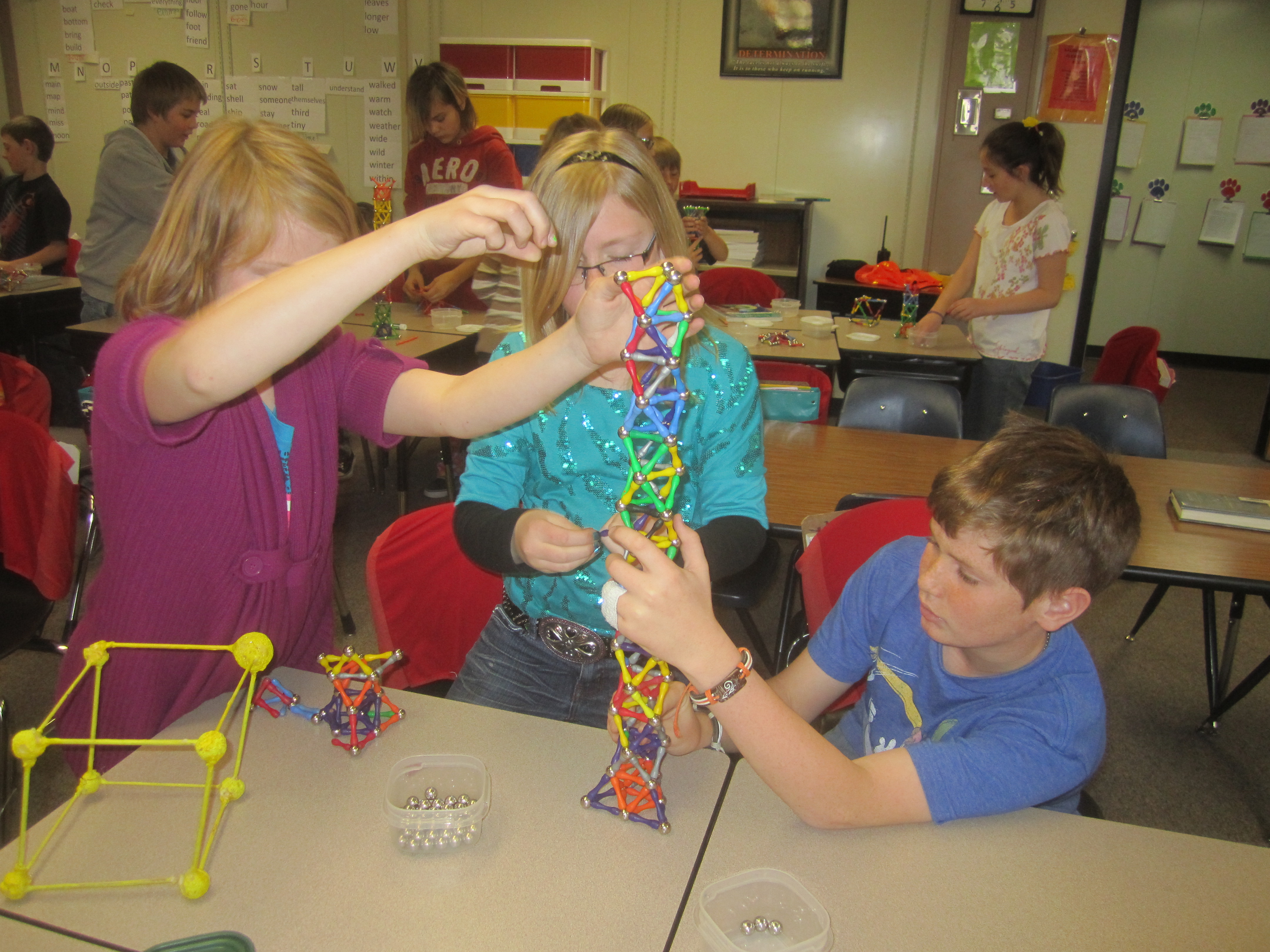
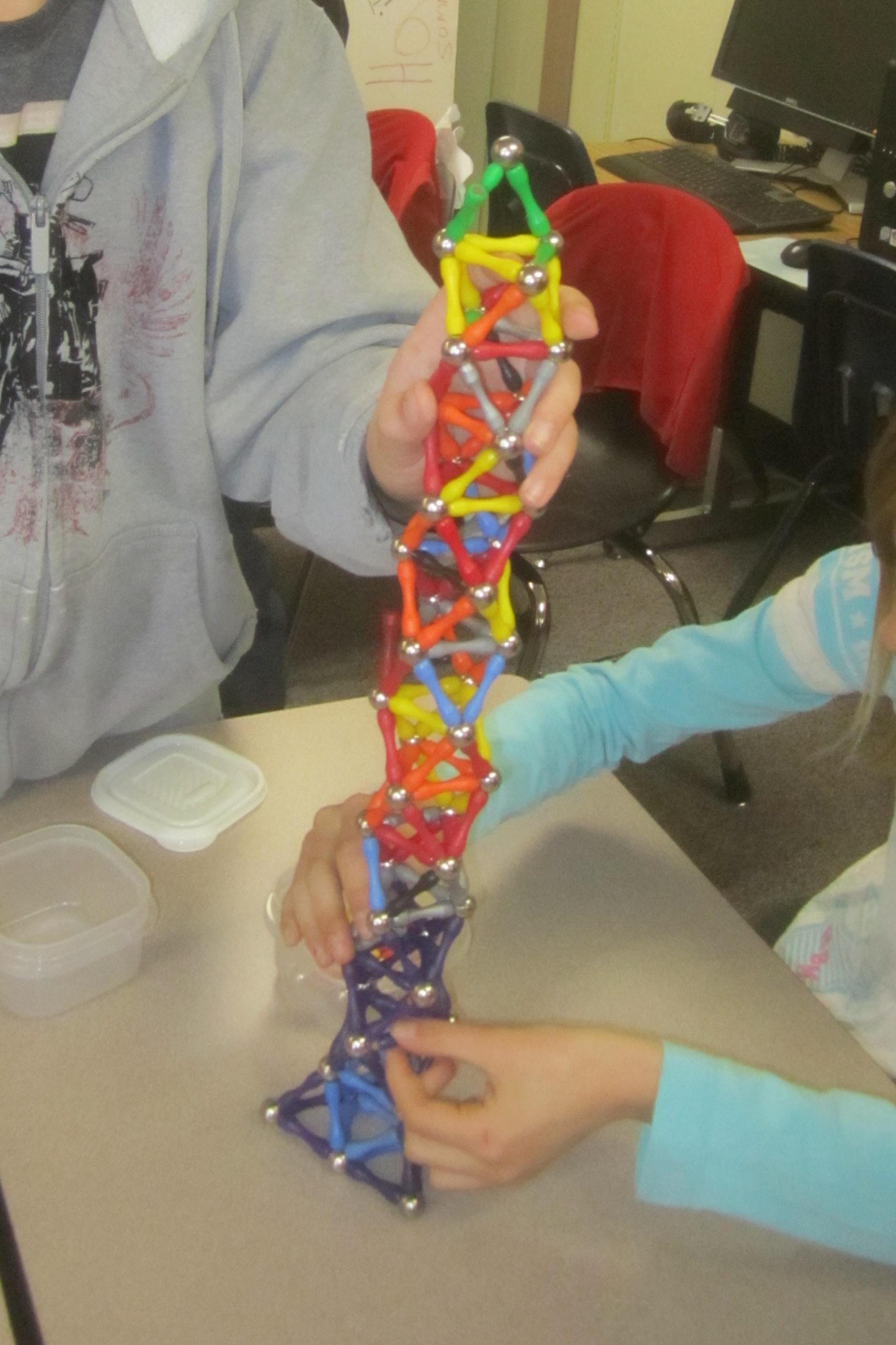
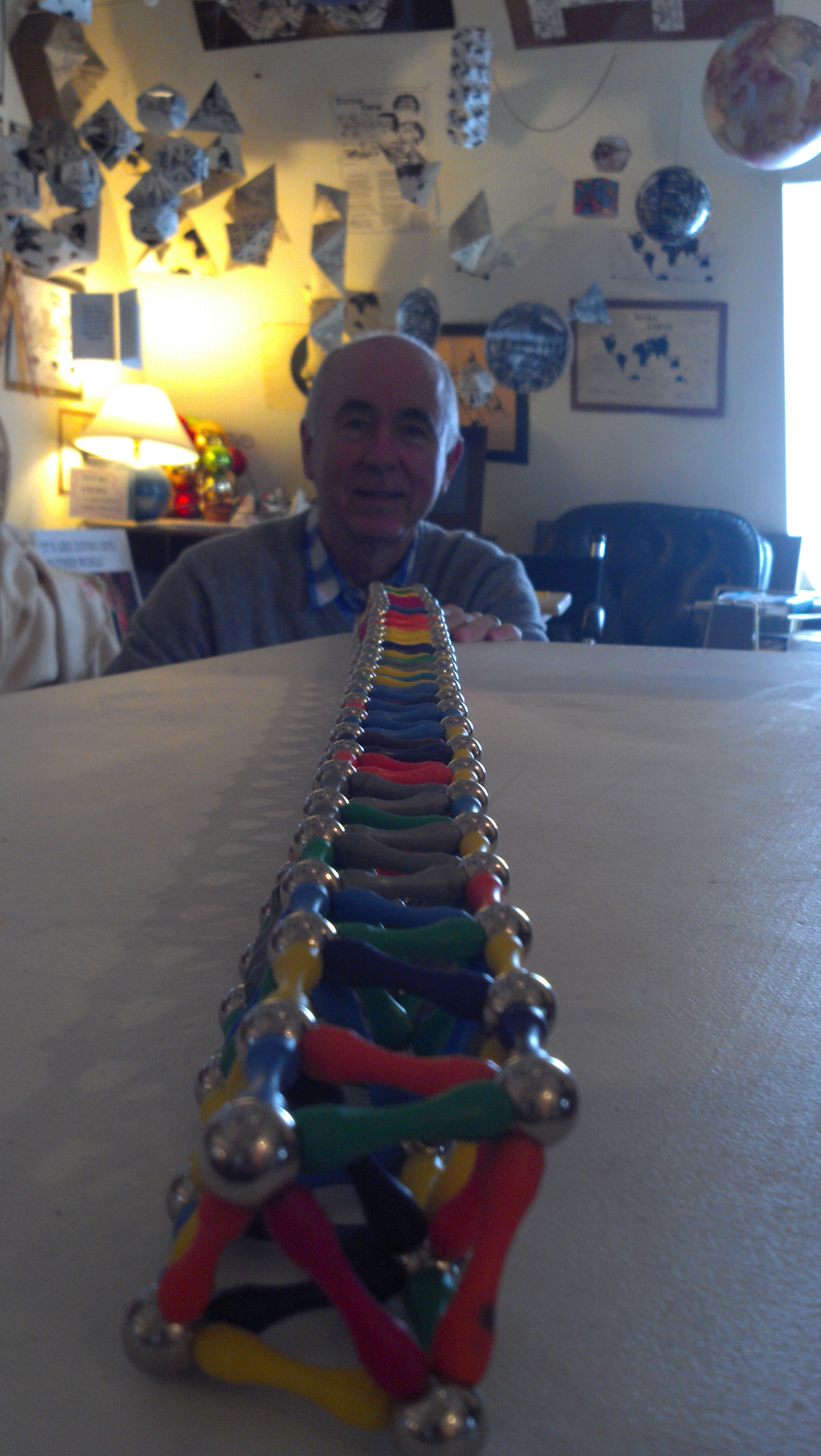
    The fourth day I worked at Baldwin Creek Elementary with fifth grade students.  I used Magz or the magnetic sticks and balls with these students.   I have a whole suitcase full of lander 10them so there are enough for 30 students to create up to 20 different polyhedron with them in an hour.   They also experience what one polyhedron stacking with itself looks like in a chain.  This workshop teaches them that out of these fundamental five polyhedron plus some curved shapes everything in the universe can be constructed.    The students really like this workshop and learn a lot whether they know it or not.    I love the ah-ha moments like when you stellate or add points from the center of the face of an octahedron and it turns into a cube and you point that out to students, they say “ah-ha!”   I love that moment.

  • The Thought Behind The Platonic Relationships Termesphere

    Platonic Relationship
    Platonic Relationships

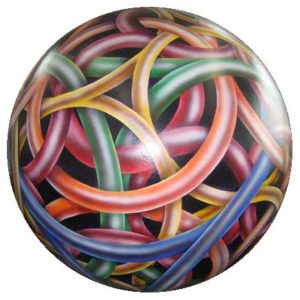
    This 36” diameter spherical painting, known as a Termesphere®, by Dick Termes is a study of the five regular polyhedra also known as the Platonic Solids. Geometers have studied the Platonic Solids for thousands of years because of their fascinating interconnectivity and logical beauty.

    Platonic Solids are polyhedron whose faces are congruent regular polygons, and where the same numbers of faces meet at every vertex. The best known example is a cube whose faces are six congruent squares.

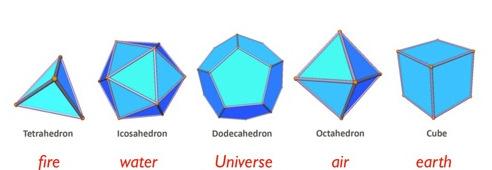
    The five polyhedra that are part of this are the tetrahedron, octahedron, cube, icosahedrons and the dodecahedron.   How do they relate to each other?    If you create a icosahedrons ( twenty adjacent equilateral triangles) and find the center of each triangle and connect these points to each other you create the dodecahedron (twelve  adjacent pentagons).   If you take one vertex of the dodecahedron and draw an line between that vertex, skip a vertex and go to the next vertex and continue that to the next pentagons you will get a square.   If this is continued around the whole dodecahedron you will produce a hexahedron or cube (six adjacent squares).   From the cube you can produce the last two polyhedra.   The octahedron ( eight adjacent triangles) is found by adding center points to the square faces of the cube and connecting these points together.   The tetrahedron (four adjacent triangles) is found by taking the squares of the cube and drawing diagonals to each of the squares.  This creates a tetrahedron.   This shows how they all relate to each other.

    platonic solids

    I made the triangles, pentagons and the squares of these polyhedron into circular tubes of different colors and different thicknesses when I created PLATONIC RELATIONSHIPS.

    Plato believed the four regular polyhedron were the structure of the atoms, water, air, earth and fire.  It was not true but we have found out they are the shapes of packed atoms and molecules like crystals.  Sodium chloride is cubical and calcium fluoride is octahedral and pyrite is dodecahedra.   So much of the early thinking for chemistry came from these solids.

    Kepler  1571 – 1630 spent a large part of his life studying how these solids made up the spacing of our solar system.  This was a great study even if it turned out to be untrue.


    Save

  • SD Discovery Center UP DOWN AND ALL AROUND

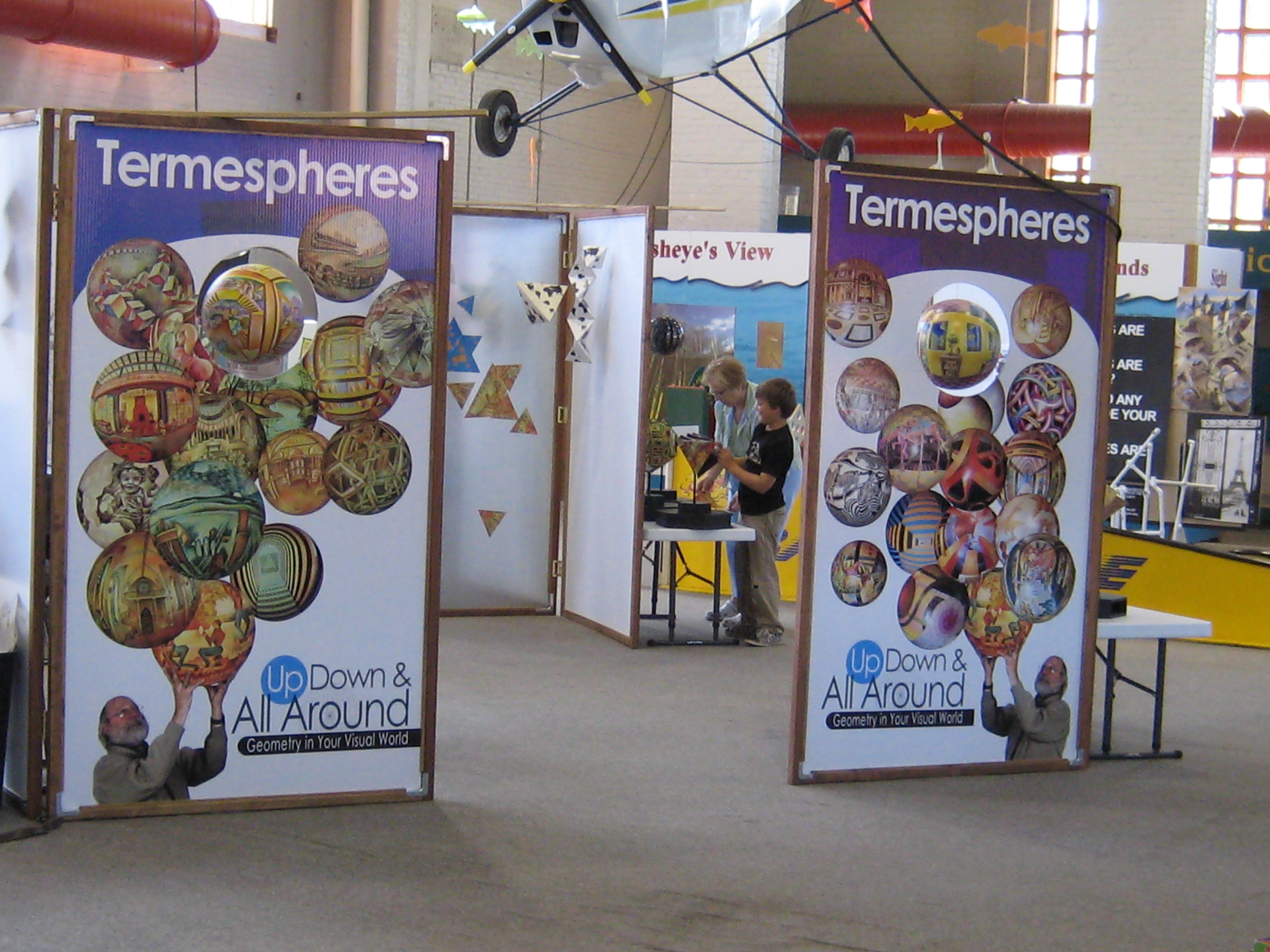
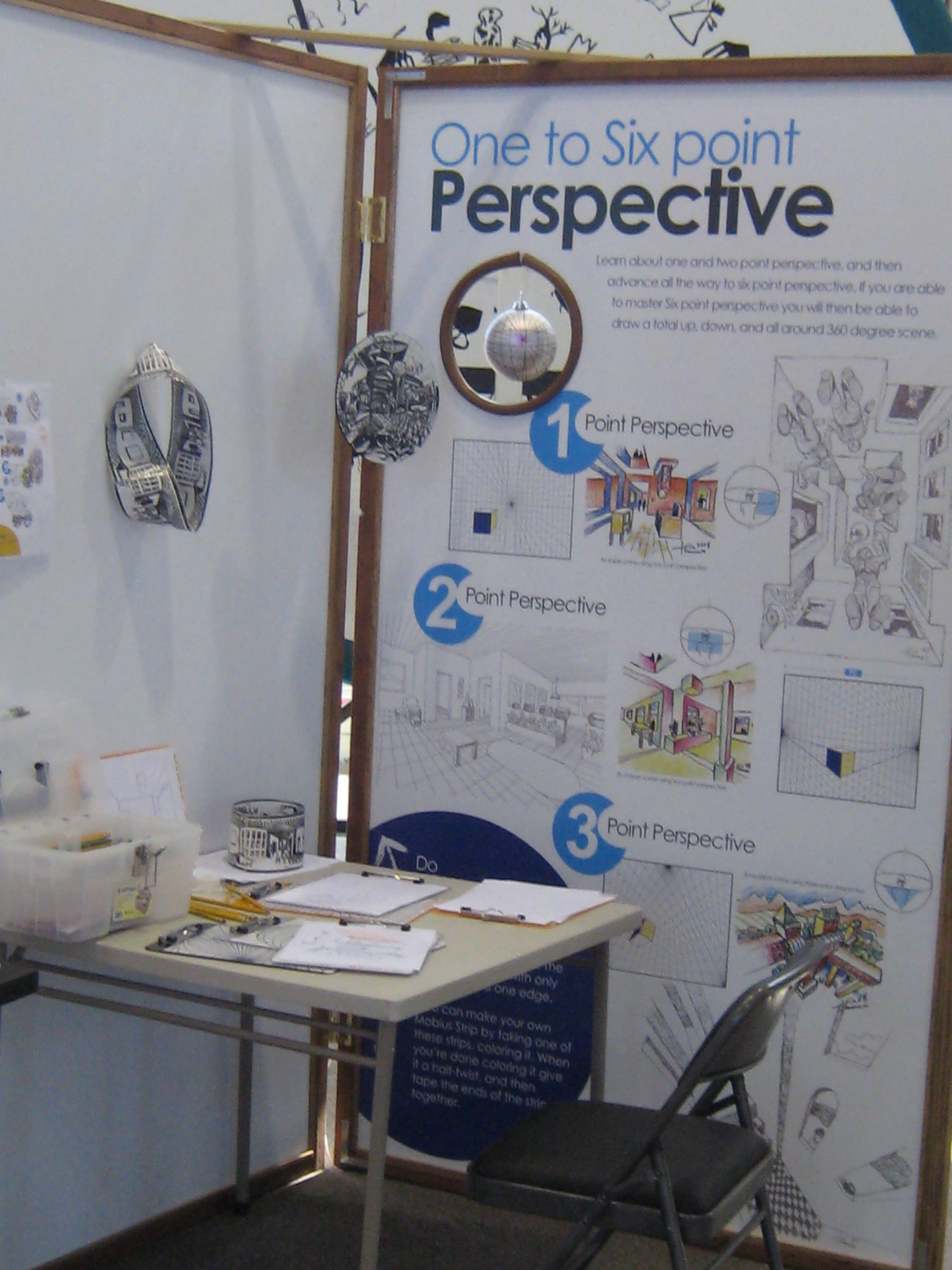
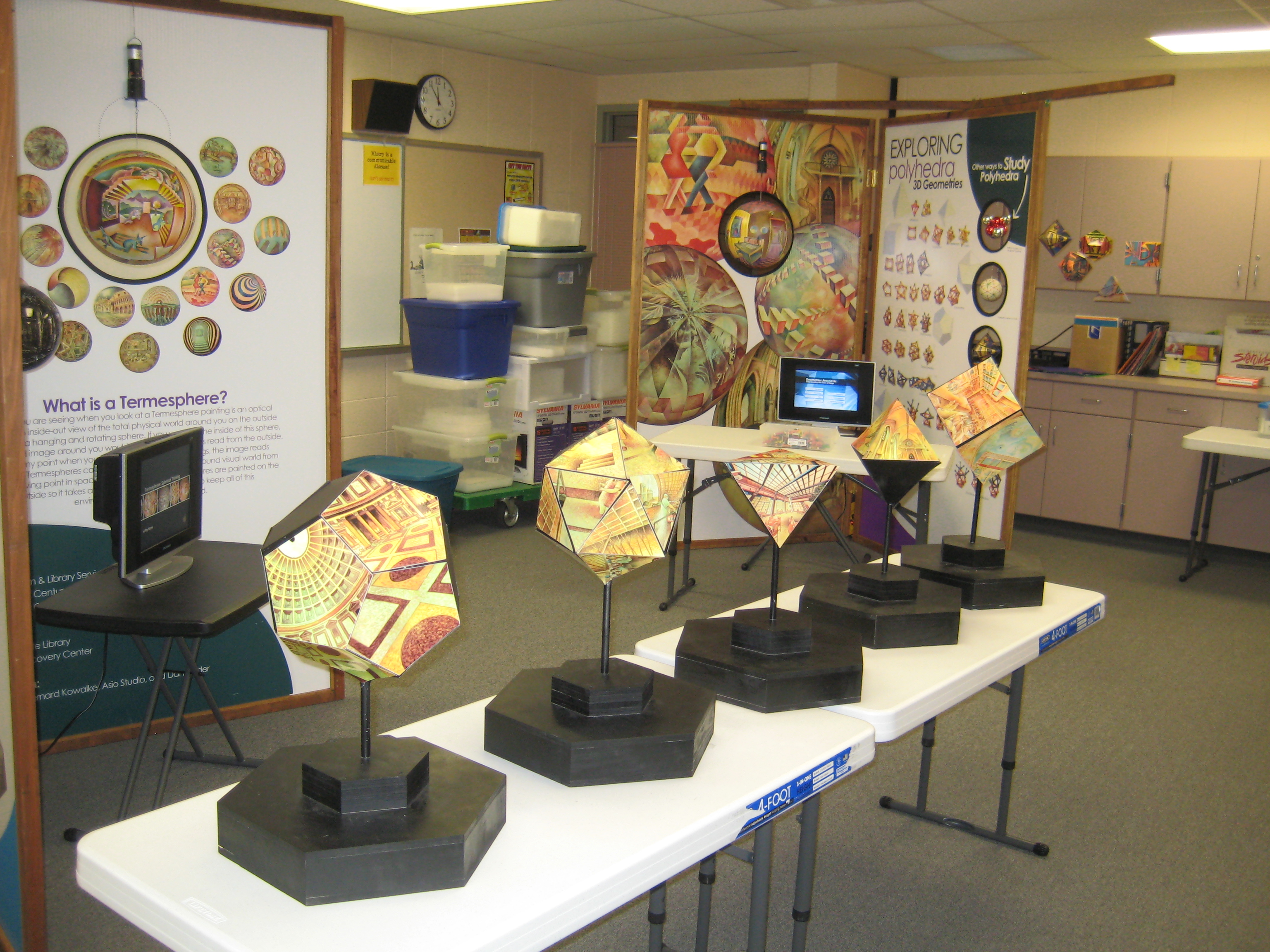
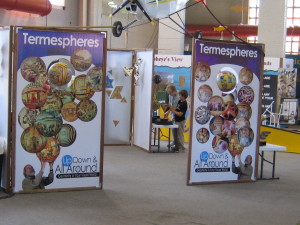
    A few years ago I got a call from Kristie Maher, Executive Director of the South Dakota Discovery Center and Aquarium, Hands On Children’s Museum in Pierre SD. She explained to me that one of the most successful things they do at the Center is put together different displays that can be hauled by trailers to many towns in South Dakota.  When they are set up, they explain things like electricity, light and color, dinosaur and animals as architects.   She told me the next display they would like to put on the road was an exhibit revolving around IMG2359_itA_205Termespheres and the Termes concepts such as Six Point Perspective, the study of polyhedra, puzzles, tessellations, and mirrored spheres.   I asked how they were going to do this.  She said that they weren’t, I was.    So I spent the next four months putting together the UP DOWN AND ALL AROUND exhibit for Hands on Partnership.  It was very exciting to put together.  It allowed me to create stations that explored my thoughts and concepts in a concrete way.    If you take a look at the video you will see what I mean:
    https://www.youtube.com/watch?v=MSXvdO7Lspw


    There are nine station in the UP DOWN AND ALL AROUND Termesphere exhibit .


    -There are two original Termespheres at the entrance to the display.
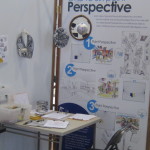
    IMG2357_357_203-A perspective station where participants can explore One through Five Point Perspective drawings.

    -A study of optical illusions

    -Three dimensional puzzles that go from the sphere to the polyhedron. Magnetic puzzle pieces assemble on a polyhedron, when it is together, it is an image of a IMG_3219Termesphere in polyhedron form.
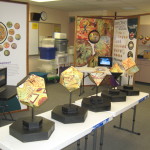
    -Puzzles and tessellations which come from flattened tetrahedrons are magnetized to mount on a metal wall panel.

    -A Mobius strip growing from one of my Four Point Perspective drawings that can be colored and then assembled.

    -A station where students put together Termes images called Captured Worlds, five polyhedron shapes that have total environments on them.

    -Tetra Art flat puzzles growing from the Tetrahedron and the many ways they fit together.

    -An area exploring the mirrored ball and the geometry within its reflection.
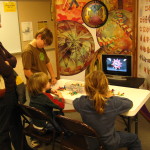
    IMG_3274Three DVD players are also part of the display, explaining:

    An interactive video on One to Five Point Perspective.

    An interactive video on 3D structures and how to create them

    An explanation of Termespheres and the concepts behind them


    What makes UP DOWN AND ALL AROUND very exciting for me is to watch participants see how ideas that intrigued me also intrigue them.  For more information on how to get UP DOWN AND ALL AROUND in your town contact Anne Lewis   annelewis@sd-discovery.com


  • Three Termespheres® of Deadwood

    73,140 people have looked at the youtube of the Termesphere® titled REFLECTING BACK.   This is the sphere of the Adams House in Deadwood South Dakota. It shows how

    Reflecting Back (Adams House)
    Reflecting Back (Adams House)

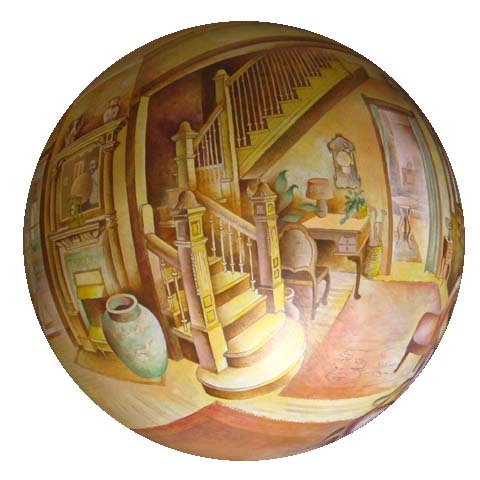
    modern media has changed the world and art itself. In the past, I would have had to have it in Louvre to get that many people to see it.    You can see this interior of the Adams House in Deadwood in motion at Reflecting Back.  This was John Adams’ House at the time of his death.  His wife, Mary inherited it.  Shortly afterwards, she moved to California, leaving the house and all its furnishing exactly as they were for 50 years.  I painted this sphere on the spot shortly after the new owners, the Crosswaits, took over the Adams House.  It was wonderful to see all of the antiques in their proper place after so much time.  If you look closely, you can see me in the mirrors painting the sphere.


    PORTHOLE TO THE PAST

    Porthole to the Past
    Porthole to the Past

    Deadwood has been a town of inspiration for me.  My 3 foot diameter sphere called PORTHOLE TO THE PAST in the Deadwood Visitors Center is an accurate spherical image of what Deadwood looked like between 1876-1879.   The buildings are as they were and the historical figures are on the road around us.  This can be seen on Youtube  PORTHOLE TO THE PAST  Within the sky are images of many other inhabitants who had a large influence in the creation of Deadwood.


    ENCOMPASSING THE PAST 1990

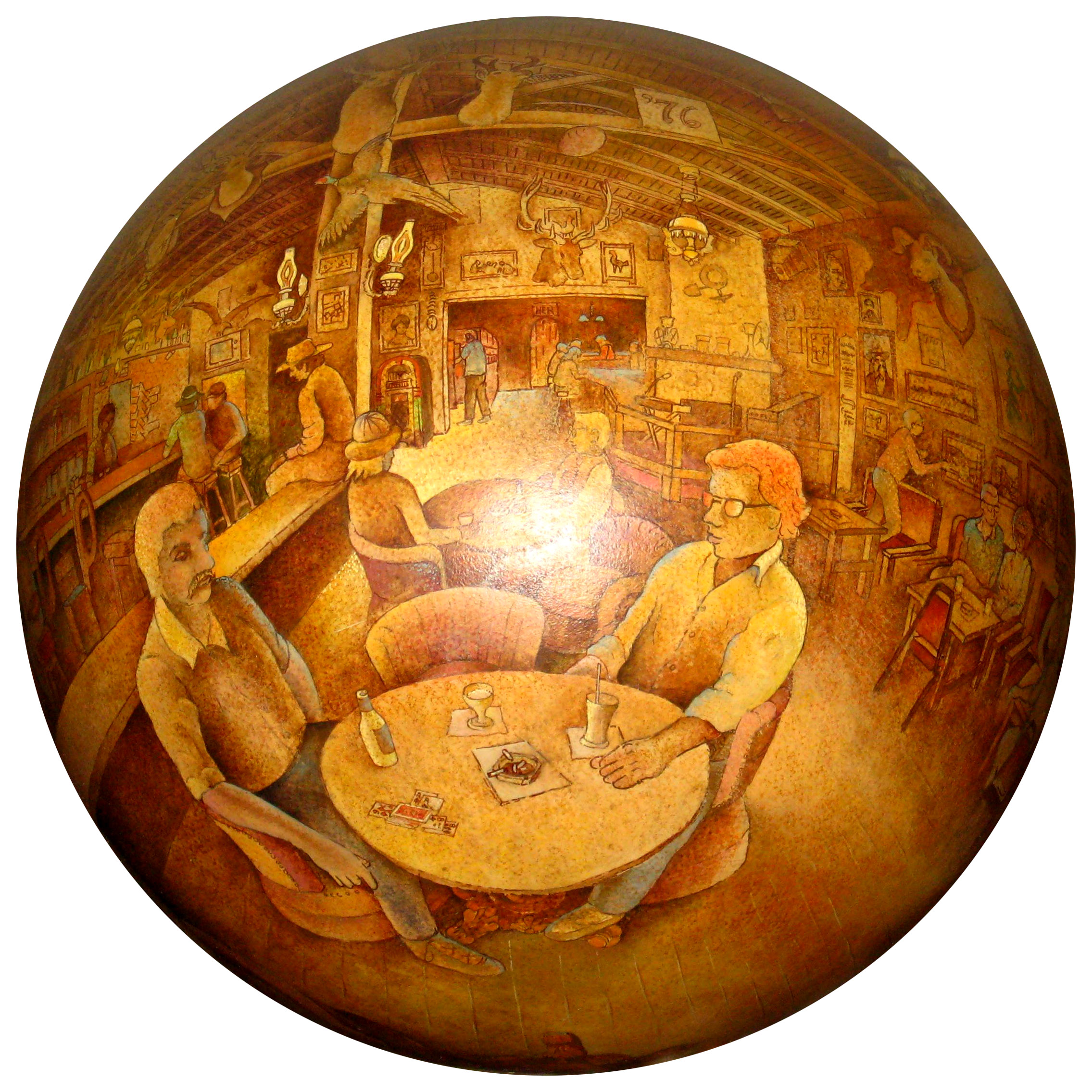
    The first Termesphere of Deadwood was of the Saloon # 10  called ENCOMPASSING THE PAST.  This 24” sphere captures the interior of Saloon Number #10 in Deadwood.  It Encompassing-the-Past depicts the wonderful history of Deadwood displayed throughout the Saloon’s interior.   I painted this piece on the spot from the location I wanted everything to be seen from, up, down and all around.   It hangs where it hangs in the painting, above the cash register.   I painted this in the mornings before too many people came into the bar.  I found later in the day people got to talkative and I didn’t get anything done.   Visit the Termesphere® Gallery and go to Deadwood to see these three pieces.

    Dick Termes  www.termespheres.com


    YouTube – Videos from this email


    0

    Save

  • Show of Termespheres® at the School of Mines and Technology Library

    Tech show 3

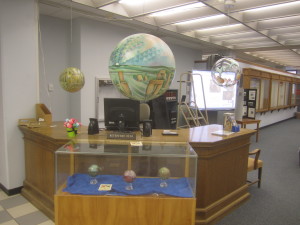
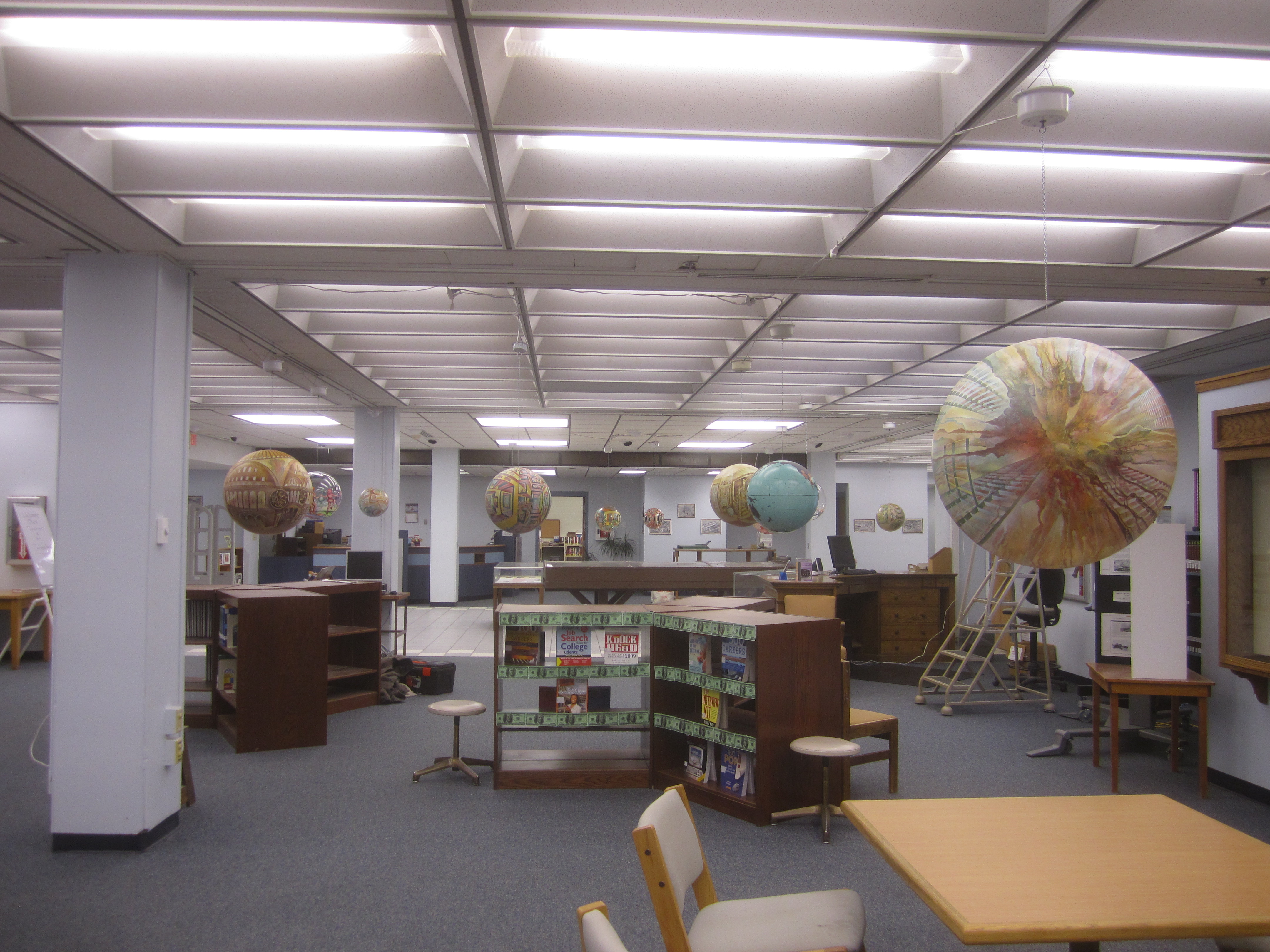
    There are 18 Termespheres® hanging in the Devereaux Library at the School of Mines and Technology in Rapid City South Dakota for the month of February.  The library environment is a wonderful place for my work.  It catches students that normally might not go to galleries to see my  work.  The environment is perfect for study and when they look up, they see spherical worlds spinning all around them.    The collection of Termespheres®  are rotating throughout the library holding geometric and scientific themes.  I hope these themes relate to the students and faculty at the School of Mines.  Pieces like Cubical Universe,  Five Dimensional Room, Hollow Earth,  Looking for the Order,    Out of Chaos,  Parallel Universe,  Push not Pull,  Tetraspirals and  Tri Every Angle all play with ideas which grow out of science. I enjoy getting input back from students and faculty.

    2-8-13
    2-8-13


    I will be doing a lecture on the spheres in the Library as well as showing videos of other pieces on February 19th at 3:00 in the Library.  I hope there will be good questions at that time.   I can also be reached at termes41@gmail.com

    Save

    Save