[cs_section style=”margin: 0px; padding: 10px 0px; “][cs_row style=”margin: 0px auto; padding: 0px; ” inner_container=”true”][cs_column style=”padding: 0px; ” fade_animation=”in” fade_animation_offset=”45px” fade_duration=”750″ type=”1/1″][cs_text]Most artists have a particular directions they take their art. I am pretty well known for my six point perspective spheres and I must say that is mainly the direction I play. There are however a number of other directions I find fascinating to explore. The last three pieces I have completed show some of the areas I find interesting. These three pieces show how many different directions you can take the sphere. [/cs_text][/cs_column][/cs_row][/cs_section][cs_section style=”margin: 0px; padding: 0px; “][cs_row style=”margin: 0px auto; padding: 0px; ” inner_container=”true”][cs_column style=”padding: 0px; ” fade_animation=”in” fade_animation_offset=”45px” fade_duration=”750″ type=”1/3″][x_custom_headline level=”h2″ looks_like=”h3″ accent=”false” class=”center-text “]DRIPPING DREAMS[/x_custom_headline][cs_text]Dripping Dreams is an exploration of the right side of my brain. I loosely dripped paint down the sphere and explored many different colors in artistic patterns. After it dried I sat and looked at it to see what I could see in it. This is like looking at the clouds and finding images in the clouds. The images I found I would not question where they came from or what they meant. A surreal world is the outcome of this approach. My interest in Hieronymus Bosch from the 15 hundreds seems to influence some of this.[/cs_text][/cs_column][cs_column style=”padding: 0px; ” fade_animation=”in” fade_animation_offset=”45px” fade_duration=”750″ type=”1/3″][x_custom_headline level=”h2″ looks_like=”h3″ accent=”false” class=”center-text “]PRACTICE WHAT YOU PREACH[/x_custom_headline][cs_text]Practice What You Preach explores the basic elements for drawing. This is a class I teach where I show students how to draw by learning all the potentials of the cube, cylinder and the sphere. I show students how to add cubes to cubes and how to subtract cubes from cubes. I also do this with the cylinder and the sphere. This piece shows what can be done using only what I teach in that class. I now have this class as a DVD. In June South Dakota Public Television will begin turning the information on the DVD into an educational drawing series.[/cs_text][/cs_column][cs_column style=”padding: 0px; ” fade_animation=”in” fade_animation_offset=”45px” fade_duration=”750″ type=”1/3″][x_custom_headline level=”h2″ looks_like=”h3″ accent=”false” class=”center-text “]GLOBAL PEACE[/x_custom_headline][cs_text]Global Peace explores a grid of concentric circles from one side to the opposite side. From these points radiating line also go from pole to pole. The given rectangles then have lines crisscrossing them throughout the sphere. Many tessellating patterns were found in this grid to give the viewer some insight into how many patterns can come from such a simple grid system. It is a good sphere for meditation. It gives the mind much to concentrate on. It is like a ever changing campfire.[/cs_text][/cs_column][/cs_row][/cs_section]
Category: Termes News
-

Adventures in Brookings
Recently, Dick did a 12-piece show for a month in the Brookings Public Library which was very fun. He also gave a lecture one of the evenings and enjoyed the great questions and conversation with the attendees. Some great questions came out of that lecture. South Dakota State University had him do my video/lecture to their design students. After the lecture he did a workshop on One Through Six Point Perspective. This was a wonderful mix of art students and architectural students.
-
18 Piece Collection in Ames, Iowa
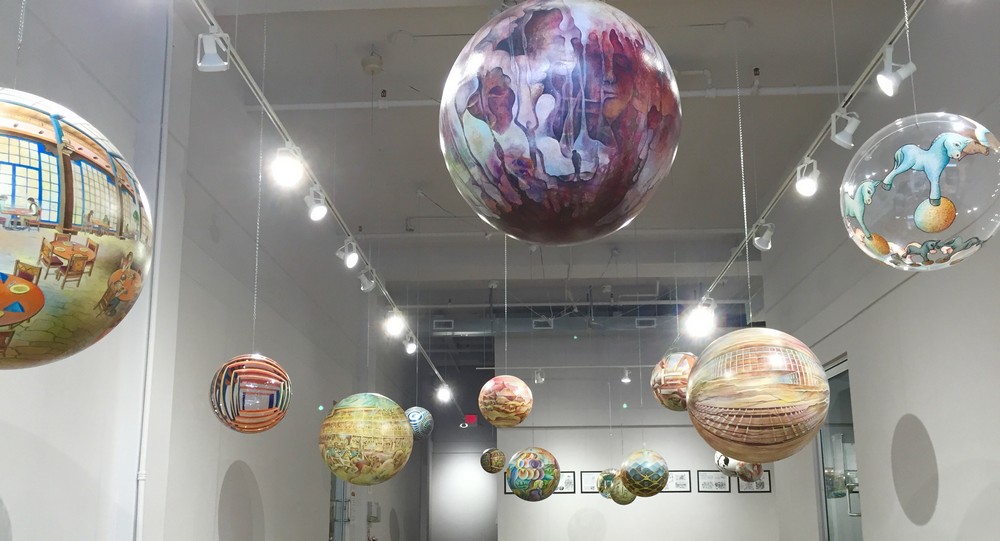
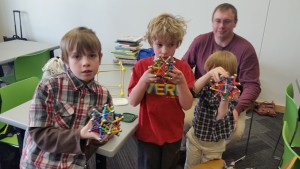 On January 8th, the Octagon Gallery in Ames Iowa hung an 18-piece collection of Termespheres. This is the second showing of Dick’s artwork at the Octagon Gallery. The first show was ten years ago. On February 11th Dick came to Iowa State University’s Center of Excellence in the Arts and Humanities, to present as part of the 2016 Donald R. Benson Memorial Lecture series a lecture on his Termespheres. He also did a One through Six Point Perspective lecture opened to the art students on the Iowa State University campus. On February 14th he did a workshop on polyhedra at the Ames Library. The participants ranged from 3 years old to beyond 80. It was a really fun filled afternoon.
 -
Indra’s Net Delivered to San Francisco
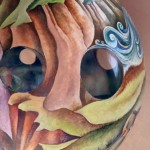
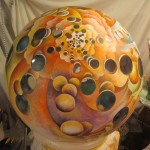
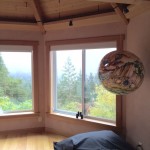
Termes has been working for about five months to complete a commission Termesphere called Indra’s Net. Indra’s Net is a concept that everything in the Universe is covered by a net. Each knot in the net is a crystal that reflects every other crystal so all actions affect everything. This 24” sphere is transparent. Termes started with a full painting of the net, depicted as neurons of the brain. He painted this on the outside of the sphere. Then he covered everything with many layers of gesso (white acrylic paint) except for transparent bubbles that allowed you to look into the painting that now looked like it had been painted on the inside . Then he painted a seascape on the outside along with the Big Bang. But the bubbles still let you see inside. So this becomes a triple paintings, allowing you to see the painting on the inside, the painting on the outside and how the two interact. This was a most challenging sphere to do but it was also very fun.
In September, Dick and his wife, Markie, delivered Indra’s Net to its owner north of San Francisco. It is a wonderful location. A magnificent octagonal home overlooking the Pacific through a gorgeous wooded area. It is the perfect home for Indra’s Net.
-
Black Hills State University show at the Ruddell Gallery October 24th through November 21.

 The Ruddell gallery hosted 20 Termespheres plus posters explaining one to six point perspective. The spheres were a tremendous draw for the students and the community alike. The show was tied in with Dr Tom Jackson, BHSU’s new president’s inauguration.
 -
Marshall University attends workshops in Termesphere Gallery
For the third year in a row, this last Saturday and Sunday, students and instructors
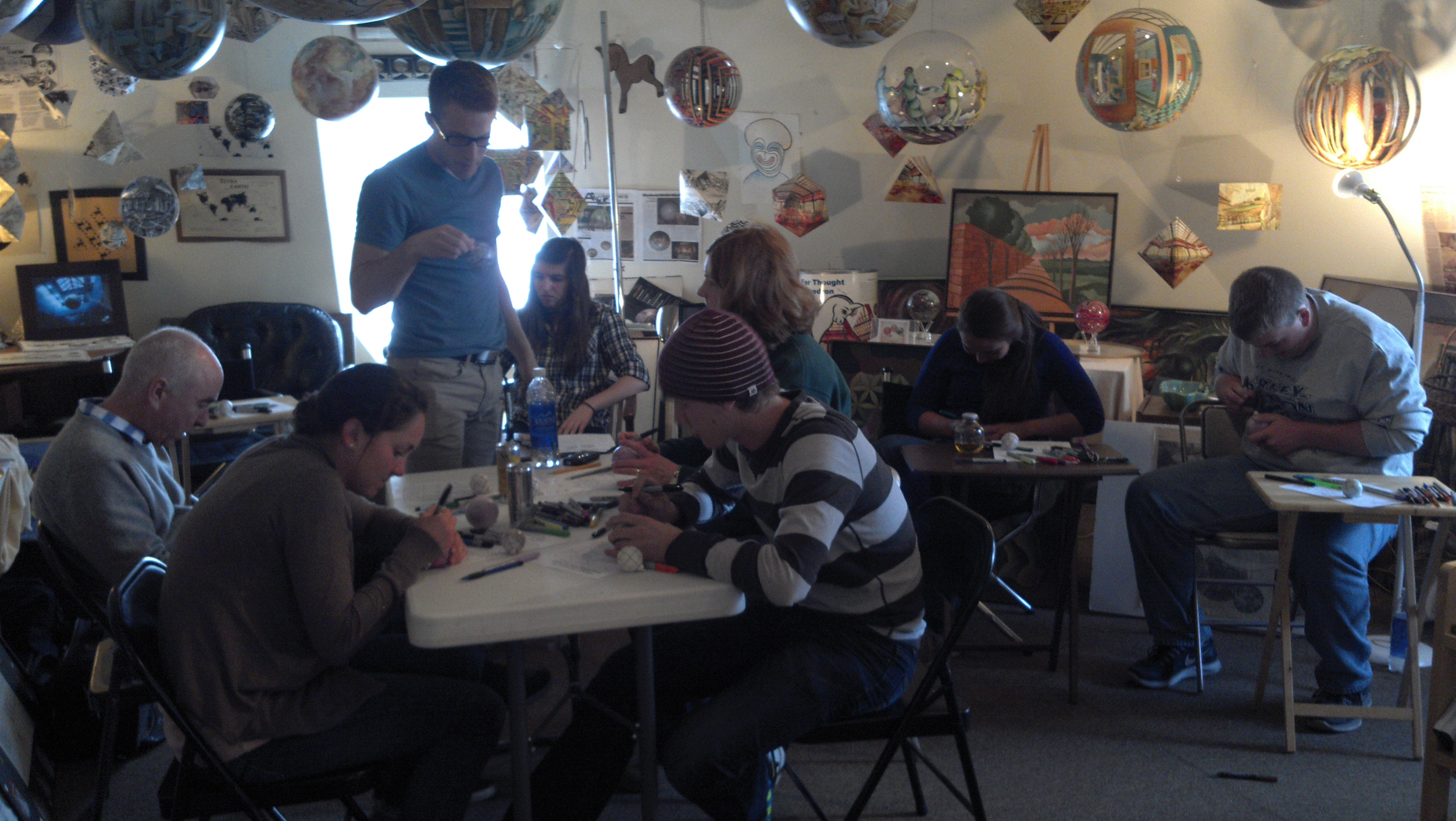
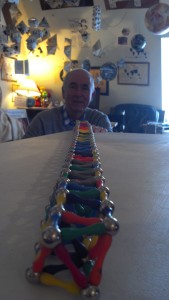 came to my Termesphere® Gallery from Marshall University from Huntington West Virginia. They came for workshops on Spherical Geometries and One through Six Point Perspective. Professors Dr. Judith Silver, the Department of Mathematics and Professor Jonathan Cox, the Department of Art and Design have brought students to the Termesphere® Gallery and the Black Hills. When they finished the workshops they tour the Hills. So there was a nice double reason for them being here.
The students are always outstanding and very fun to work with. It is interesting to transform my gallery into a
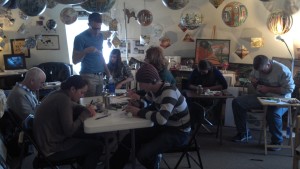 classroom environment with desks and chairs, an overhead projector and screen. It is wonderful to have my work hanging all around so whenever I need an example of what I am talking about I can just point up and show them.
I am hoping to draw attention to these types of workshops with other Universities. I enjoy doing these presentations in my gallery very much and think I can get twice as much across with my workshops with my art work all around me- up, down and all around me.
-
Nature Wins?
There is a video of the piece we are trying to name. Look at this video and help me out with a name. I am very pleased with some of the name result so far.
-
Nature Wins? Termesphere®
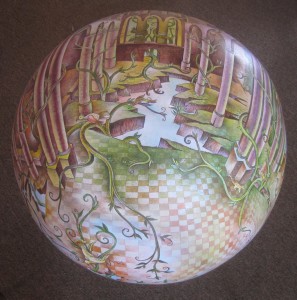
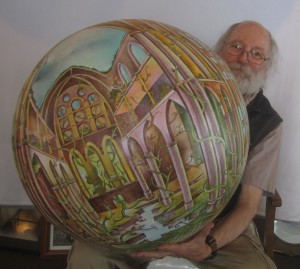 NATURE WINS is a 24” diameter spherical painting that plays off of Villers Abbey in Belgium.
It was founded in 1146 and was abandoned in 1796. Accounts suggest that roughly 100 monks and 300 lay brothers resided within its walls. In 1893, the Belgian State purchased the site and launched a conservation effort. Classed as an official historic site in 1973, the abbey has subsequently enjoyed considerable restoration. .
Over the years plants have come to take it over.
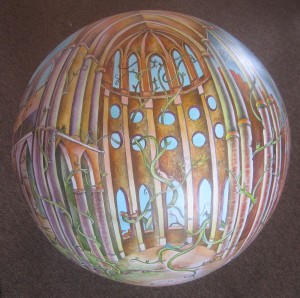 The mixture between man and nature makes it very interesting to me.
Because I didn’t know what the whole building looked like from this one spot, I made up some of this building as to what I thought it should look like. I exaggerated the plants to show more of their energy and power. I opened up the floor with cracks letting in more plants but also showing the building may be floating in the sky. As nature attacks man’s creation so does the cat move after the birds. This piece was in process for over four months.