Category: Headlines

  • Artist Dick Termes To Visit Vermillion July 7

    Workshop, Lecture Among Community Events Planned That Day

    David Lias/Vermillion Plain Talk
    Spinning Silently
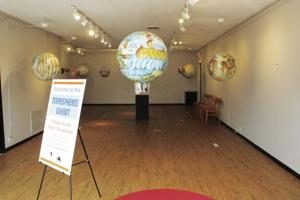
    Termespheres®, the unique works of art by Spearfish artist Dick Termes, spin silently while on display in the First Dakota National Bank Coyote Gallery located next to the Coyote Twin Theatre in downtown Vermillion. These unique works of art will be on display throughout the month.

    During the month of June, the First Dakota National Bank Coyote Gallery is showcasing a stunning exhibition of unique paintings by artist Dick Termes, as part of a series of events sponsored by the Vermillion Area Chamber & Development Company and hosted by the Vermillion Cultural Association.

    Based in Spearfish, South Dakota, Dick Termes is an internationally acclaimed artist whose work has been recognized from San Francisco to Paris, France, and New York to Japan. His one-of-a-kind spherical paintings have been published in books all over the world. Many southeastern South Dakotans have undoubtedly seen his stunning sphere in the Sioux Falls Convention Center lobby known as “A Round Town.”

    Termes is known for his unique method of painting on spheres, which when completed, are known as Termespheres®. Each Termesphere® is a revolving, dimensional exploration of an entirely closed universe; meaning that what you see, rotating in front of you, is one complete world or environment. Eighteen of these incredible spherical wonders are on display until July 7.

    “There were many reasons to bring a Termesphere exhibit to Vermillion,” said Jessi Hanson, Vermillion Cultural Programming chair. “Not only is he a South Dakota native and beloved artist, but he is world-renowned. Now our community will be able to experience his work for themselves. His six-point perspective spheres are simply mesmerizing and awesome to behold, especially in a room filled with them! This is just one more facet of South Dakota heritage that people should experience.”

    In conjunction with this exhibition will be a full day of community events with the artist on Saturday, July 7. The first of these will be a public workshop at the Vermillion Public Library in which the artist will teach curious minds and novice artists alike the techniques of six-point perspective. The workshop takes place in the Kozak Community Room from 10 a.m. to noon and is free and open to the public. Basic drawing materials will be provided. Children aged 11 and above are welcome.

    “We’re fans of Termes’ work, as you might imagine,” said Nate Welch, president & CEO of the Vermillion Area Chamber & Development Company. “Knowing that the beautiful, community-painted mural on our new 2 E Main building was led by Dick Termes makes us incredibly proud to underwrite his visit to Vermillion. Also knowing that ‘Missouri Weave’ is one of only two remaining Termes murals, and that a South Dakota Historical Society publication on his murals is forthcoming, just made us that much more excited about having him here to share some important history with our community.”

    The day of events will continue with a 1 p.m. private meet and greet at the First Dakota National Bank Coyote Gallery. This event will feature a light lunch, beverages, the chance to hear the artist personally discuss the works on display, and preferred seating for the subsequent public lecture. The cost for tickets for this event are $25, and space will be limited to 40 attendees. Tickets for the event can be purchased at www.vermculture.org, and will help support the overall costs of the public events.

    At 2:30 p.m. Termes will present a public lecture on his work in the RED Steakhouse Auditorium in the Coyote Twin Theater, adjacent to the gallery. The day will wrap up with a closing reception of the Termesphere exhibition from 7 to 9 p.m. This reception is open to the public, takes place inside the Coyote Gallery and will represent the end of the exhibit.

    For further questions about these events or others planned for the First Dakota National Coyote Gallery, please contact Shannon Cole, the Vermillion Cultural Association executive director at executivedirector@vermilliontheaters.com.

    Any other questions can be directed to Susan Heggestad, marketing & tourism manager at susan@vermillionchamber.com.

  • Throwback Thursday: Termes in Black Hills Monthly

    Throwback Thursday: Termes in Black Hills Monthly

    In February 1980, Black Hills Monthly launched its first edition by featuring Dick Termes on the cover with an article. Below is the text from the article as well as a PDF of the scanned issue.

    If you think Spearfish. South Dakota is an ordinary town filled with ordinary folks, please close your eyes and conjure up a vision of Joseph Meier as the Christus high atop a life-size Calvary in the Black Hills. Now superimpose an image of Gary Muledeer Miller with his Three Mile Island haircut and a typewriter perched on his shoulder doing his version of the eleven o’clock news on Don Kirschner’s Rock Concert.

    Yes, Spearfish partially nurtured both these geniuses. Mr. Meier made Spearfish his adopted home; Mr. Muledeer grew up in Spearfish and then left to find his fortune with Dina Shore and Woody Allen. But can Spearfish both raise a genius and hang on to one?

    Drive south two miles on Christensen Road for the answer; On the left hand side of the road, in a grove of trees growing on some fine bottomland, sit two geodesic domes, a large one and a small one. Behind the domes, up the hill a way, you will see what looks like a six foot sphere with a painting covering its entire surface. And the domes are the studio and home of painter Dick Termes, his wife Markie Scholz and their infant son Lang.
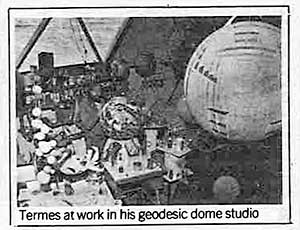
    Although the appearance of the Termes spread indicates the presence of a mind that marches to the beat of a different drummer, if not a different parade entirely, Dick Termes does not look like the traditional wild-eyed genius artist. (He has both his ears and no fancy cravat.) On the contrary, Termes is most likely to be found wearing a nondescript, unfashionable, one-finger, button-down shirt of early sixties vintage (“Well geez, it’s almost good as new!”), a faded pair of jeans complete with hole in one knee and a pair of cowboy boots he really did buy in high school. Dick Termes is thirty-eight.

    Perhaps his only sartorial concession to eccentricity is the Termes hat – a crumpled, wide-brimmed affair decorated with bright beads and dark stains of undetermined origin. He has the build of a runner (which he is), the beard of a logger (which he is not), and the haircut of a man who thinks about barbers at irregular intervals.

    In short, if you saw Dick Termes on the street you probably wouldn’t point and stare. If you saw him at home you might not even notice him for his studio-home demands full attention. But don’t be fooled by Termes’ nondescript appearance.

    Back to home. Outside, his geodesic domes are covered with cedar shake shingles. Inside, they are filled with combinations of fantasy, geometry and motion. The big dome, thirty feet in diameter, serves as the living space. It contains finished works which include traditional, flat paintings, and, about thirty Termespheres.

    A Termesphere (Ter-mi-sphere) is a globe or ball with a painting covering the surface. These spheres hang from the ceiling of the dome at various heights; most of them spin slowly, powered by small, silent, electric motors. Up a narrow, spiral staircase you find the master bedroom and baby Lang’s nursery. A gently rising stairway leads through a tunnel-like hall to the smaller, eighteen foot dome that serves as studio. It is the home of works in progress, files full of notes, brushes, palettes, paint pots and tubes, the various paraphernalia common to painters and bunches, of tennis ball size spheres and cardboard polyhedra – rough ideas for Termespheres past, present and future.

    The Termesphere is the heart of Termes’ work. Termespheres are combinations of surreal fantasy and geometric design. They range in diameter from eight inches to six feet and represent both subconscious, free association and pains-taking planning. The subjects include people; usually faceless, dream figures; weird landscapes; buildings; Escher-like rooms and abstract shapes that twist and curve all over the surfaces of the mini-planets.
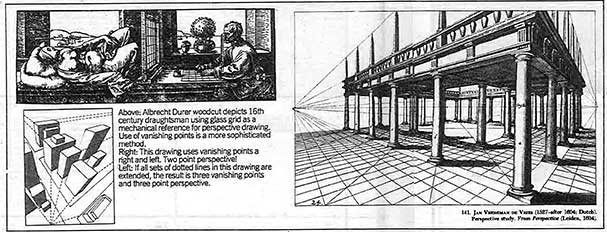
    And always, there is the six point perspective. For Joseph Meier it is a life-size Calvary. For Gary Muledeer it is a typewriter on the shoulder. For Dick Termes it is six point perspective. Compared to six point perspective, Christus portrayals and rock concert humor are easy to explain.

    Basically – very basically – imagine a cube. (As a matter of fact, you are warned to keep your imagination in gear from here on.) Now, in a simple drawing of a cube there are three sets of parallel lines. When one set of these parallel lines merges to a vanishing point on the horizon the result is simple, one point perspective.

    When two sets of parallel lines merge at two separate vanishing points on the same horizon you have two point perspective. You’ve seen this effect before when the walls of a building recede into the distance (getting smaller) in different directions. Consider, then, the parallel lines on the side of a cube. Extend them downward to a third vanishing point. Voila! Three point perspective. This effect is best visualized if you think of looking at a skyscraper viewed from high in the air. The two walls fade into the distance and the bottom gets smaller and smaller as it gets farther away from your eye. The plot thickens.

    So far we have used straight lines to extend to our vanishing point. And remember that the cube has three sets of parallel lines. When we arrive at four point perspective, an interesting phenomena occurs. To achieve the fourth vanishing point, one of the three sets of parallel lines must be extended through the optical center in both directions. The optical center is the center of the cube. However, when this is done Mr. Straight Line, whom we have known and loved in perspective since the days of DaVinci, deserts us. Here, a straight line just doesn’t look right. But. a gentle curve does quite nicely. Why? Termes explains:

    “When two or more lines are projected both directions to two given vanishing points, at least one of them must be bent. Only a line through the exact -optical center can be straight. Parallel lines that don’t run through the center, but vanish at the-same point, must turn a corner, overlap, or bend. The most natural effect comes with a gradual curve. A fish-eye lens or a reflection in a shiny Christmas tree ball are common examples of lines of perspective that blend to a vanishing point.”

    This same bending phenomenon holds true for the fifth and sixth point of perspective, but four points is the limit that can be drawn on a flat piece of paper. Five and six point perspective can only be demonstrated in space. By the time we have six vanishing points – north, south, east, west, up and down – the lines leading to the vanishing points all look proper only when curved! (Are you still there?)
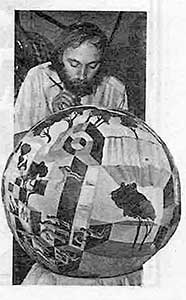
    Says Termes, “The only way to see this could be possible would be to see it from within a cube.” Having the eyes of two flies would help, too. Termes continues, “To hold the perspective from within and to view it from without leads to many exciting images and ideas.” Indeed.

    What happens to our cube as the lines become more curved, and as each of its six points of perspective approach the middle of its adjacent side? It becomes more and more sphere-like. When the cube becomes a sphere and a drawing based on the perspective of the cube is projected onto the surface of the sphere, _we have, in the artist’s own words, a perfect example of seeing from outside what was conceived from the inside of the cube.” Heady stuff, but you were warned not to let the sixteen-year-old J.C. Penney button-down shirt fool you.

    The result of all this projection is a completely spherical fish-eye lens, which produces some striking effects. For example, if you stare at a Termesphere for a minute or two as it revolves, it will suddenly appear to change the direction of its rotation, or just as suddenly become concave instead of convex.

    These visual illusions are interesting, but the essence of Termes’ work lies beyond tricks on the eye. Organization and a combination of the cognitive with the subjective give art meaning for Termes. “At the University of Wyoming I was doing very organic work, and I was getting bored with my art. Studying under Victor Flack at Wyoming was a turning-point for me. He taught me to know why I was doing what I was doing and to organize my mind.” And organize it Termes did.

    The organizing influence of Buckminster Fuller is unmistakable in Termes’ work. Fuller is best known for his pioneering work with the geodesic dome, two fine example of which form the Termes studio-home environment, but Fuller’s philosophy of synergy plays a more important role in Termes’ approach to his art. “Synergy,” says Webster’s New Twentieth Century, “is the simultaneous action of separate agencies which, together, have a greater total effect than the sum of their individual effects.” And that is the point of the Termesphere. “I want a painting to be organized as a human being is organized. Maybe that’s what beauty is.”

    Aha! There is a method to his madness. In geometric and mathematical relationships, especially those found in six point perspective, Termes finds a strong sense of the synergy and interdependence of man and his environment – of figure and ground. This theme carries over to the content of his work. Dick Termes is fond of mentioning the flip-flop effect. “I want to allow a ball to be a ball and a ball to be a hole at the same time. I find my own mind flip-flops between realism and surrealism, micro and macro…this is what Fuller talks about as being “in-ness and out-ness.”

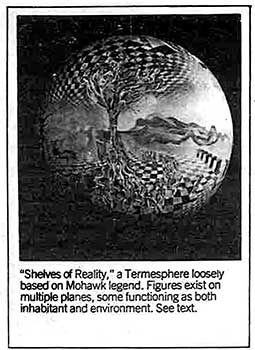
    The specific contents of Termes’ paintings range from abstract geometric shapes to surreal fantasy scenes, but the theme of the totality..of the yin yang relationship is omnipresent. The Termesphere he calls “Shelves of Reality” is loosely based on a legend of the Mohawk people. The legend tells of the people growing a tree from the sphere of the earth up to the sphere of the sky, where another world exists. In this painting Termes creates a central world of a checkered plain littered with geometric shapes and peopled by amorphous figures. Fantastic trees and structures reach up to the sky – another sphere world. Then, below the checkered plain, another sphere-world is teasingly revealed. And through a hole in the sky still another world is found. And between plain and sky yet another world. Shelf upon shelf of reality coexist, both independent from and dependent on each other.

    Expanding your sense of reality is a crusade with Termes. “I want to teach people about total visual awareness… awareness with the eyes the same way a musician is aware of totally enveloping sound. My spheres are an effort to alert people to the spaces in their worlds that are beautiful in every direction.”

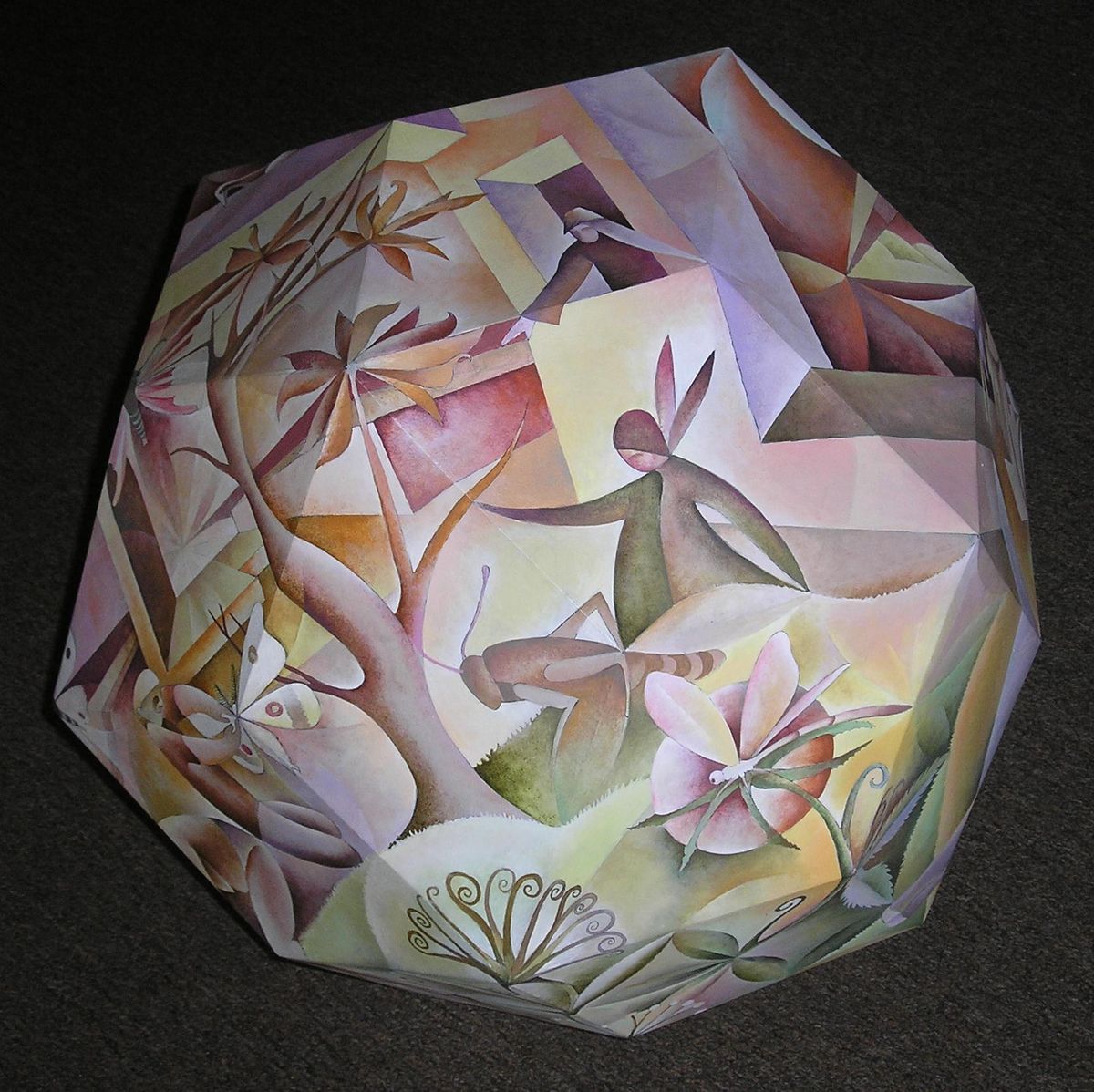
    A Termesphere starts with a rough sketch on a polyhedron. In the case of most six point perspective spheres, the particular polyhedron used is an octahedron, or two pyramids – one upside down and the other resting on it, right side up. The points of the octahedron coincide with-the vanishing points. Lest things are sounding too simple, it must be noted that Termes sees no reason to limit himself to this particular design. The icosahedron’s twenty sides form twelve vertices and, of course, twelve vanishing points. Says Termes, “I feel that people would have more trouble relating to (these more complicated) systems. But as man’s mind expands with the space age, he will find it easier to accept the loss of the horizon and the earth-like six directions.”
    So Termes continues his quest with tetrahedrons, hexahedrons, dodecahedrons and even – stand back – triakonta-hedrons! Once a rough sketch is completed on the many sided face of whatever polyhedron is being used, the work is transferred to a sphere made of Lexan plastic. “It’s what they make the astronaut’s helmets out of,” Termes tells anyone who asks. He seems to take a boyish pleasure in that.

    And he takes pleasure in other pursuits. Deer hunting is a family tradition. Cross country skiing, running and tennis keep him in shape, and Termes plays a mean harmonica.

    Dick Termes’ absent-mindedness is legend. Once, when being interviewed on the South Dakota Public Television show, Mosaic, the host of the show, Craig Volk,: asked Dick what the name of one of his spheres was.-Termes thought for a second and replied, in utter seriousness, “Gosh, I don’t know. What is the name of that one, Craig?”

    How does a bona fide art-pioneer make a living in the Black Hills? Major galleries are hundreds of miles away, but, somehow, Termes supports himself and his family with his- craft. His credentials are impeccable, and that helps. He has advanced degrees from the University of Wyoming and the prestigious Otis Art Institute in Los Angeles. He’s had shows in Omaha, Denver, Los Angeles, San Francisco and in smaller communities throughout the west – especially in South Dakota. Termes is a regular contributing artist to projects of the South Dakota Arts Council, and from time to time teaches color theory at Black Hills State College in Spearfish.

    Dick Termes is known to many communities in the state as an organizer and expediter of community mural projects. He’s done fourteen of these, including a large outdoor mural in Spearfish.

    That is how Termes makes his living in the Hills. And why does a bona fide art pioneer even try to make a living so far from so-called cultural centers? “Family is important to me. Both sets of my, grandparents made their homes within fifteen miles of Spearfish. I was raised here. I think everyone has his intellectual center, and, for me, it’s the Black Hills. I studied in L.A. for a couple of years and it seemed that I would get all my creative ideas when I came home for the summer. I could work on the technical stuff in the city, but I couldn’t think or function creatively. And now the Black Hills are attracting more and more creative people to bounce off of. ”

    And the ideas keep flowing. Termes’ latest project is his patented Total Photo. Using a process he developed, he can photograph, from one point, a three hundred sixty degree (including up and down) photograph which is printed on Termes’ old friend, the icosahedron. Each Total Photo is actually a series of twenty photographs fitted together by Termes. Total Photos have been done of Mt. Rushmore, Lower Falls in Yellowstone, downtown Deadwood and Spearfish, Main Street Sturgis during the motorcycle races and other locations. In a Total Photo the viewer can see from the outside-what is photographed from the , inside – literally. But you definitely have to be there. Like so much of Termes’ work, the Total Photo guffaws at attempts to describe it.

    And the growth process continues, too. Says Termes, whom many would consider an expert on color. theory, “I’d like to get my approach to color more organized. My work is all based in theory, but I usually get carried away.”

    Dick Termes welcomes visitors to his studio-home. Just give a call first; he’s in the book. The sight of thirty surrealistic spheres hanging from the top of a geodesic dome is worth the drive. Each sphere represents six to ten weeks of concentrated thought, inspiration and work. Some are for sale, with price tags ranging from $750 to $4000.

    And you’ll have the chance to meet the man who went to school with Gary Muledeer and carried spears for Joseph Meier – the Spearfish genius who stayed home.

    Six Point Perspective Explained… Sort of.

    The only way to thoroughly appreciate a Termesphere is to stand before one as it revolves in space. Even then, the vanishing paints and the rigid grid structure upon which the painting is based are elusive; partly because of Termes’ hide and seek playfulness in design, but chiefly because our eyes and minds are unaccustomed to visual organisation an a round surface with twice as many points of reference as are possible on a two dimensional work.

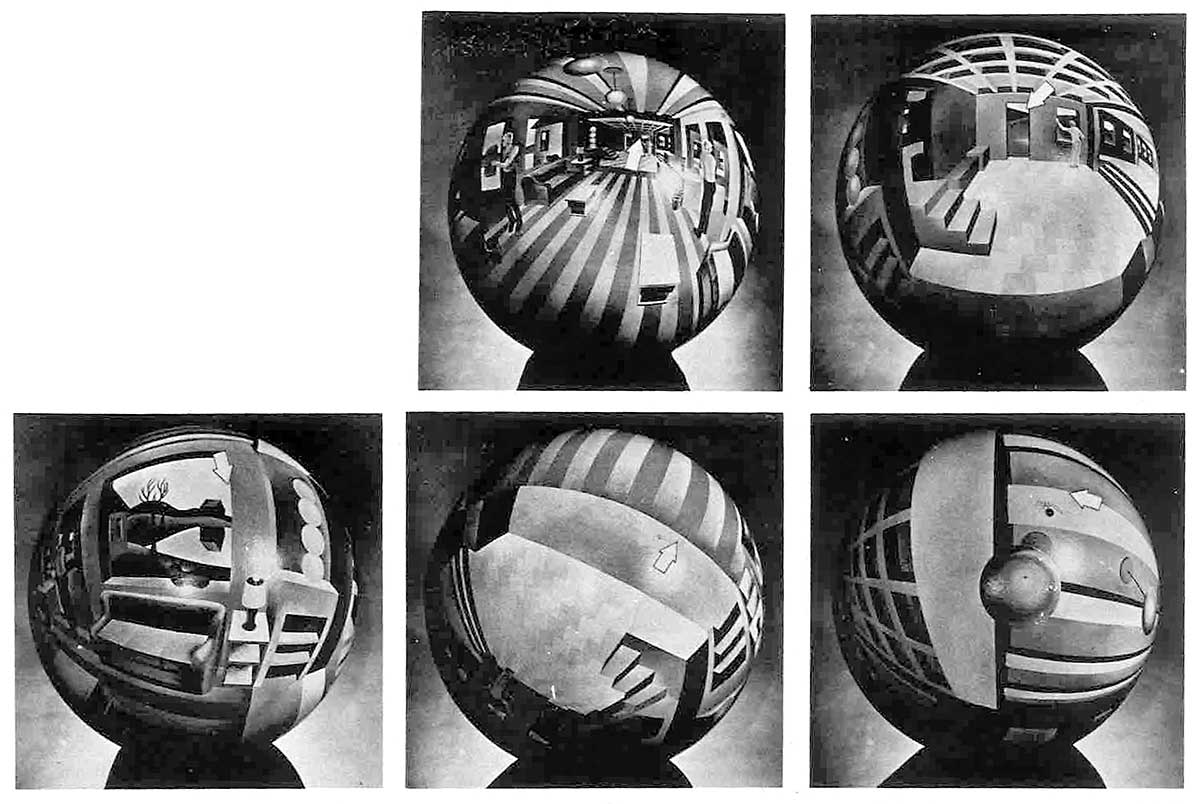
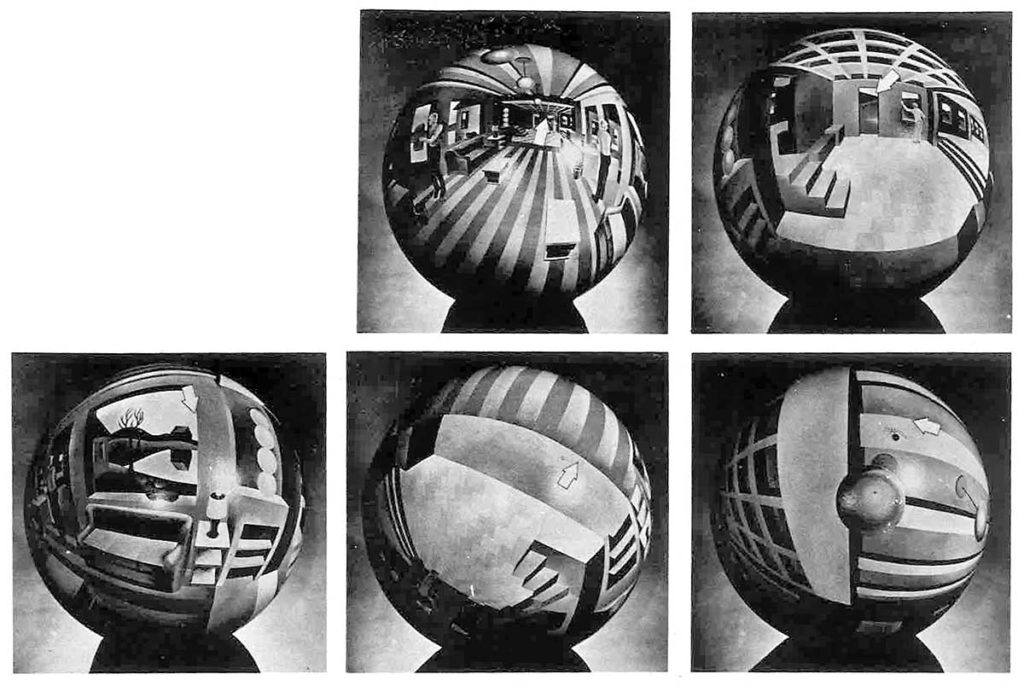
    Termes often has more than six vanishing points in a work (the extra few allow him to create space inside the surface). For simplicity’s sake, if any of this can be thought of as simple, we are presenting here a Termesphere photographed from six angles in such a manner that the six vanishing points are positioned just above and to the right of center (arrows).

    The lines, remember, are not curved, but straight. The roundness of the sphere makes them appear curved in a two dimensional photograph.

    Parallels with Einstein’s theory of curbed space are easily called to mind when studying Termes’ painting, and for this writer, a Termesphere is the most accurate visual aid imaginable when trying to grasp that visually impossible concept.

    If the universe is positively curved, an astronomer with an impossibly powerful telescope could look around this curved spare into the distant past to a point where the back of his own head will exist billions of years in the future. The subject matter of the Termesphere illustrated here suggests just such an occurrence. Notice that the man, the stairways, the furniture. In fact all elements of the room are presented in two aspects, all drawn in relationship to six vanishing points.
  • Black Hills Boomer: The Mind of a Maker: Dick Termes

    Black Hills Boomer: The Mind of a Maker: Dick Termes

    Article Source

    by Jenny Van Zanten   //   Photos by Kevin Ryan, Eyefrogs Photography

    In the air above the rolling grasslands of Wyoming, a helicopter hovered toward the Law Enforcement Academy—a 7-1/2-foot polycarbonate sphere tethered to its belly. The pilot skillfully lowered the piece of art entitled “Order/Disorder” to its permanent location on the Center’s grounds; a moment representing the culmination of nearly a year’s work by artist Dick Termes. “Nine months of work and the helicopter took that up into the air like it was a feather. It was very scary but I was too busy down below telling him where to bring the ball, up, down, left and right, that I just put trust in him. He was very good it turned out,” said the artist.

    Dick Termes has always had “a love for the arts, the thought of exploring the universe’s ideas and to add to our human experience.” It would seem the perfect formula. It was when Dick was working on his Masters in Art at the University of Wyoming that he discovered what would become his life’s work. “I was using a grid system to help me understand how you might expand the amount of visual space you could include in your drawings.” He had achieved success with four-point perspective, and when he started playing with a five, then six-point drawing, “Someone suggested to me it looked like a ball,” he explains. “That was what I needed, to try this system on a ball. It fit perfect.” The name “Termesphere” came a few years later after he left Wyoming. “They started calling my work Termespheres so I thought that sounded good and started using it myself.”

    For the past five decades, Dick has been researching, designing and painting Termespheres, creating an international legacy. He is an acclaimed one-of-a-kind artist, and Black Hills native, whose global recognition includes lectures and workshops in China, with shows and sales in Japan, France, New York, Australia, Singapore, and Germany—where he did eight years of workshops with the Defense Department Schools. In recognition of his talent, he has received countless awards.

    A visitor first sees a charming dome-shaped greenhouse, then several more geodesic buildings of varying size and designation come into view, six in all: distinct structures crafted by an original mind. This is the home of the Termesphere Gallery. Upon entering, one is instantly immersed in the visual; globes ranging from 2”- 60” float from the ceiling in every spellbinding direction. Viewers are drawn into an arched corridor of a Parisian cathedral, or a sphere of a coffee shop full of multi-generational life and the comfort of ritual. “I really enjoyed the building and also the people that came there,” Dick shares. “Rarely had I painted my own world. Most of my work was famous places around the world. Instead of painting the famous places, I thought maybe my art can make this become a famous place.” He adds playfully, “we shall see about that.” Dick is easy company, unpretentious and willing to take the time to share a story about the making of any dome.

    “When I do the Termespheres I imagine I am inside the sphere, a transparent sphere, and I am looking out at an environment around me.” Dick describes his creative process, “I copy that world I see or imagine onto the inside of the sphere. I then move to the outside to look at what I was inside seeing—this is all painted on the outside of the sphere, however.” He speaks about his ability to deviate from “the original plan” and go with the flow of his imaginative thought. He explains how design in art is like geometry to math. “I have found both are very closely related. When I got into studying patterns I found my love.”

    Merging language from more than one discipline unravels wisdom; in layers, with words not only applicable to art and his spheres, but easily transferable to life itself as a metaphor to our unique individual perspectives, whether it be flat, or 6-point.

    “See if you can find the biker in this one.” Dick’s assistant, Sue, prompts, “it took me two months to find it.” After a few hints, Dick points to a front tire, then to the biker’s profile…and suddenly there are handlebars where there had been tree branches a moment before; the biker is now in full view. This is typical of the spirited thought behind each design Dick imagines, as noted in George Escher’s apt words in the most meaningful compliment Dick has received, “… I enjoyed the sudden discovery of double interpretations, the switches in space perception, the hunt for hidden images, the little concealed jokes. I thought of your planning for a new sphere, and of your exciting explorations…”

    Behind the gallery, Dick’s dome-world continues. A worn path takes the visitor to a studio; a Geppetto-like workshop—an unapologetically cluttered space alive with ideas in the making; drop cloths, putties, paints and dozens of brushes in jars. Items, colorful and stimulating—primarily circles—hang from the ceiling, including a huge plastic bag of red and green ornaments that Dick, “will likely use to play with new designs before transferring to the large globes.” More raw art materials are affixed to a wall and stacked and piled unrestrained upon the floor. Most wall space is covered with newspaper clippings, notes and photos— manifestations of an unconstrained, gifted mind.

    In the early years, Dick sought any spherical surface on which he could paint. Initially, Termespheres were made from two joined half domes of a then commercial product called “Tip a Tub”. Today, he gets his round canvasses directly from the factory of a lighting fixture manufacturer. Once received, there is a substantial amount of prep work needed. “The seam never lines up just right and so I putty, sand and prep with layers of Gesso.” Depending on the size, a Termesphere can take from 1-1/2 to 9 months to complete.

    Suspended from the ceiling is a pulley, part of a stealthy, built-in system used to hoist the spheres. By design, the studio floor has an 8’x8’ hole with removable floor joists which allows globes to enter through the lower level garage doors. This is where the sphere that now sits at the Law Enforcement Academy in Douglas, WY was completed—Dick’s largest work to date.

    As to future plans, Dick states, “I never know that. I will work on ideas until mother nature says that is enough.”

    CONTACT:

    termespheres.com

    UPCOMING:

    • A book of mural compilations
    • A possible anniversary celebration in summer 2018 commemorating 50 years of Termespheres and 25 years of the Termesphere Gallery

    EDUCATIONAL MATERIAL:

    Article Source

  • 21 Piece Show in Peoria Arizona

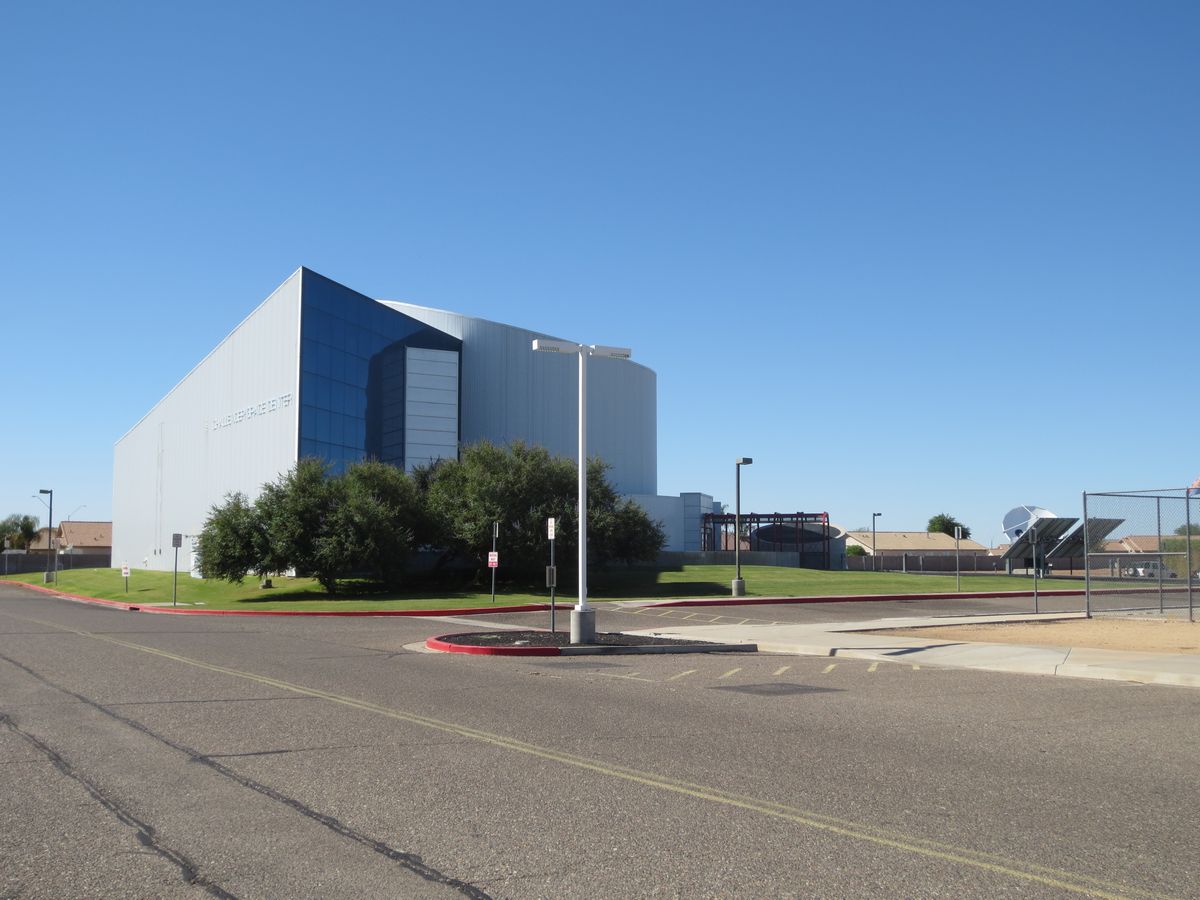
    IFSeptember 24 2013 we loaded up the trailer with 21 Termespheres and took off for Peoria Arizona for a show at the Challenger Space Center.   Peoria is north of Phoenix.   Scott Bohall from Glendale was our contact and supporter of this trip.  Another part of this trip was to deliver a piece to Oakland California and spend some time in San Francisco.

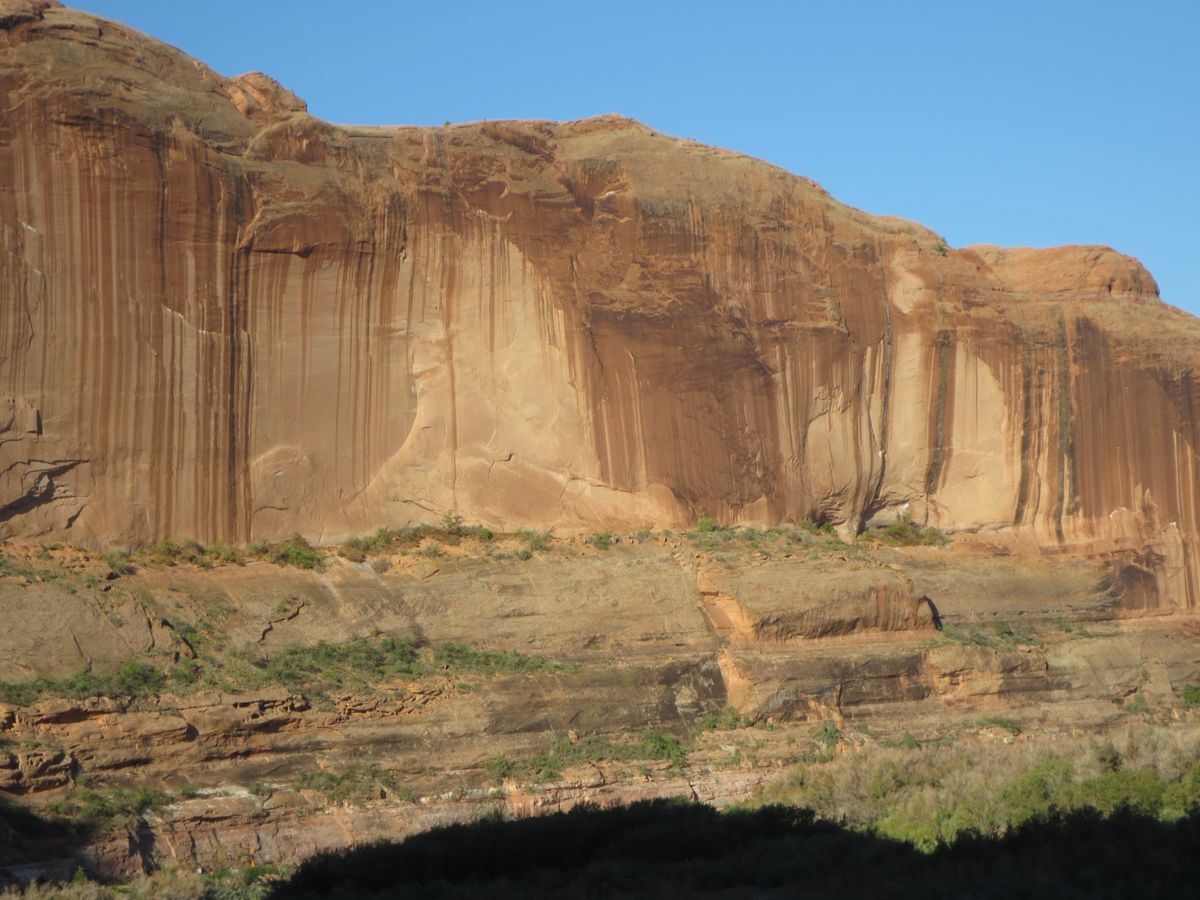
    Our first night on the road was in Grand Junction Colorado.   The next day we took Highway  128 off I-70 to Moab.  One of the narrow rough windy road that goes through one of  the most exciting, spectacular, breathtaking canyons we have seen.   We stopped in Moab to get a cup of coffee and I asked a guy who had been there for years what the name of the canyon was?   He said, “Canyon 128.”   I said, “ No, it has to have a special name.   It is a special place!”   He said, “Canyon 128.”   Well, I guess all places that are special don’t have special names.

    IFWe got to Peoria that evening and the next morning we started to put up the show.   By the time I started my workshops with middle school students, most of the show was hung. We had great help.   My afternoon was spent with two groups of middle school students. We learned some three dimensional geometries and how to apply them to small balls. Each of them ended up with different designs colored  with permanent colored pens.   The next day we finished putting up the show and I went through my 1-6 point perspective workshop with two groups of High School students.  They really got into what I call the continuous four point perspective which islooking for the order sold like a panoramic 360 degree drawing that can fit together like a cylinder.

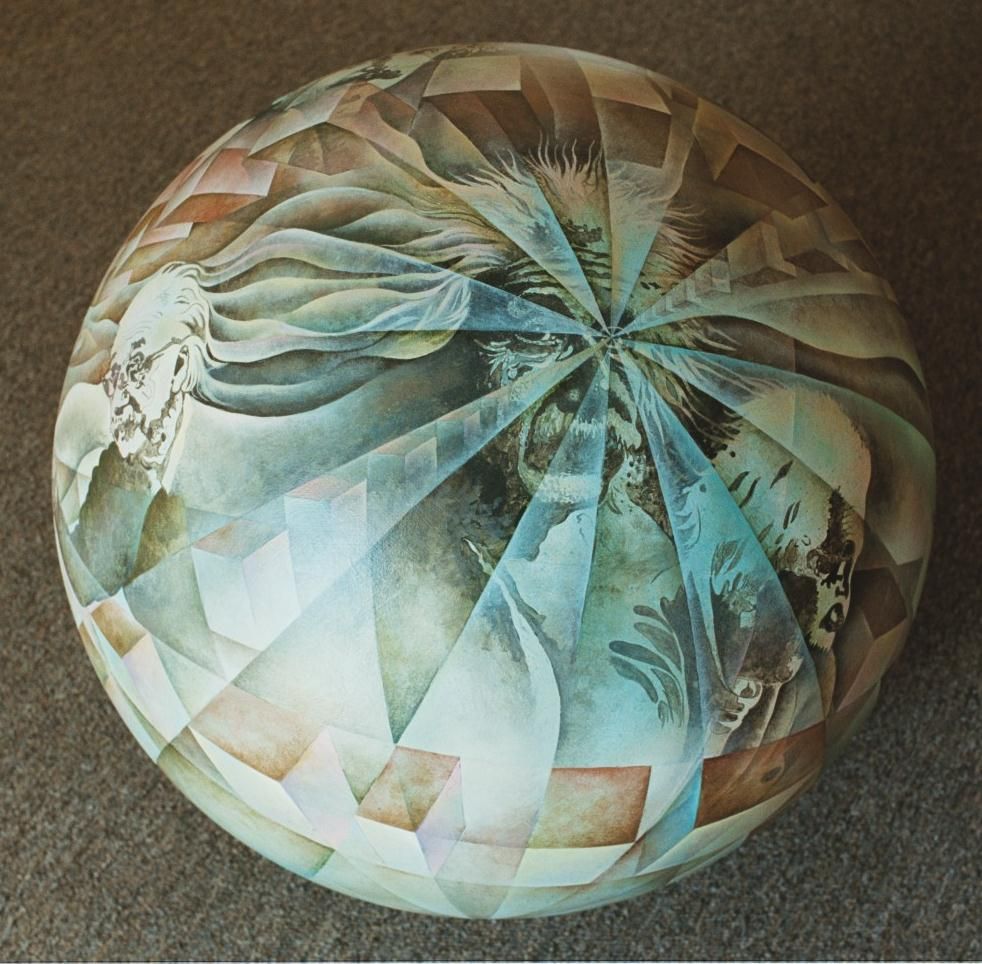
    The next day, the opening for the show at the Challenger Space Center went over very well.  Because of the show, three of the pieces are now hanging in Valley Art Museum for a month.  I was so pleased that my 24” sphere called LOOKING FOR THE ORDER (the Einstein sphere) sold. It has been a favorite to many people but now has a permanent home in Scott and Danielle Bohall’s residence in Glendale Arizona.

    IFOn to San Francisco

    We left Peoria and headed toward San Francisco.  We stayed in Morro Bay California, a fishing village which has turned now to tourism.   We enjoyed this town very much. It is right on the Pacific Ocean.  The next day we went up the coast on Highway 1 to San Francisco. We saw elephant seals in one spot laying all over the beach. It was unbelievable!  What strange creatures they are.    We stayed that night in the Seaside Motel which is north central San Francisco.  This was a good spot to be because we were able to walk to Ghirardelli Square, Fishman Wharf, Pier 39, Coit Tower, China Town  and then all the way up (and back down) the windiest street in the world—Lombard Street and back to the motel in one day. I am not counting how many steps that is but way too many!  We also drove over to the Cliff House to see Markie’s favorite attraction, Camera Obscura which is credited to Leonardo da Vinci.

    IFIt is probably the first type of camera ever invented and maybe could be thought of as the first moving picture camera.  It sits on the ocean edge.   This building has a mirror and concave and convex lens projecting the outside images into the building.   The apparatus in the ceiling rotates so the image on a slice of a large hemisphere shows the world outside inside the building.  The Giant Camera, as it is called www.GiantCamera.com , is the largest free standing Camera Obscura in the US.  It wasn’t opened so we had to return the next day.  It is something everyone should see.

    Next we went to Oakland to deliver a Termesphere called ORGANIZED INTUITION. This is about a 30” diameter polyhedron. It is officially called a rhombic triacontrahedron.   It has 30 diamond shaped sides.   This will now have a great home with Michael Branco in Oakland.

    IF

    Then to Tucson

    The next day it was time to head back to Tucson to spend some time with my brother Joe and his wife Lacy.   What an amazing place they live in! We had a wonderful time there.

    Back to Peoria

    Then back to the Phoenix.  Scott Bohall had gotten us tickets to watch the Phoenix Cardinals play the Carolina Panthers and to go to the tailgate party first.  It was great and the Cardinals won!  That evening we picked up the show.

    IFSanta FE!

    Next morning we were headed back to the Black Hills. Our first stop was in Santa Fe New Mexico.  The 8” limited LORETTO CHAPEL sphere is now being sold at the Loretto Chapel gift shop in the Loretto Inn.   The LaFonda Hotel gift shop will be selling my MOVA Globe/Termesphere of the Southwest pueblos/pottery scene, FROM THE EARTH.


    IFOn to Loveland

    The next day we headed to Loveland Colorado where I did a lecture on my work for the Good Samaritan Society Loveland Village. It was a great event.  The kitchen staff provided desserts, all were shaped like spheres and very tasty to boot.

    From there it was pretty much clear sailing to the Black Hills where our broken trees and 41 inch snow lay waiting for us. Our 4686 mile, 17 day road trip was done. Home sweet home…..


  • Illusions Create the Total Picture in Gillette News Record

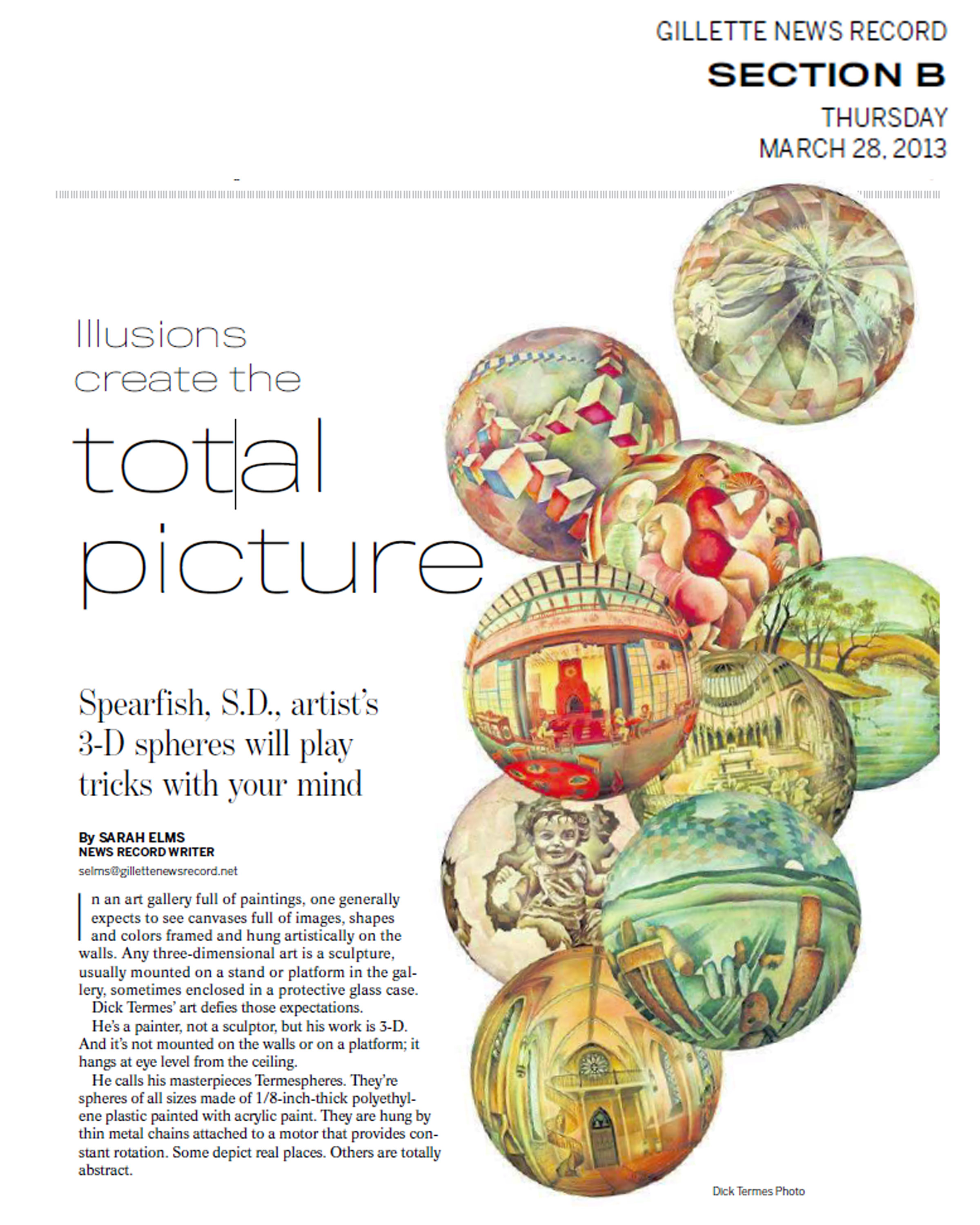
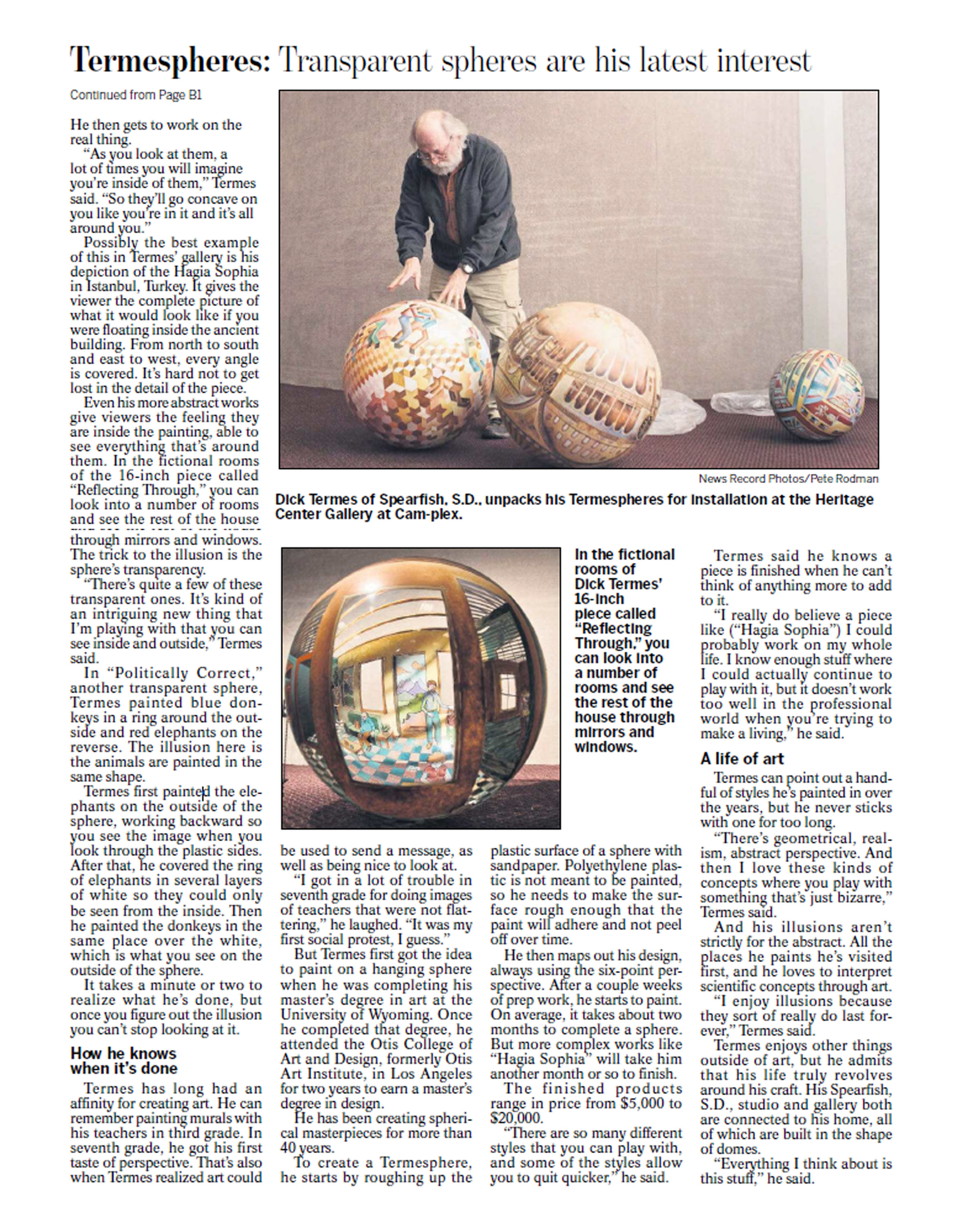
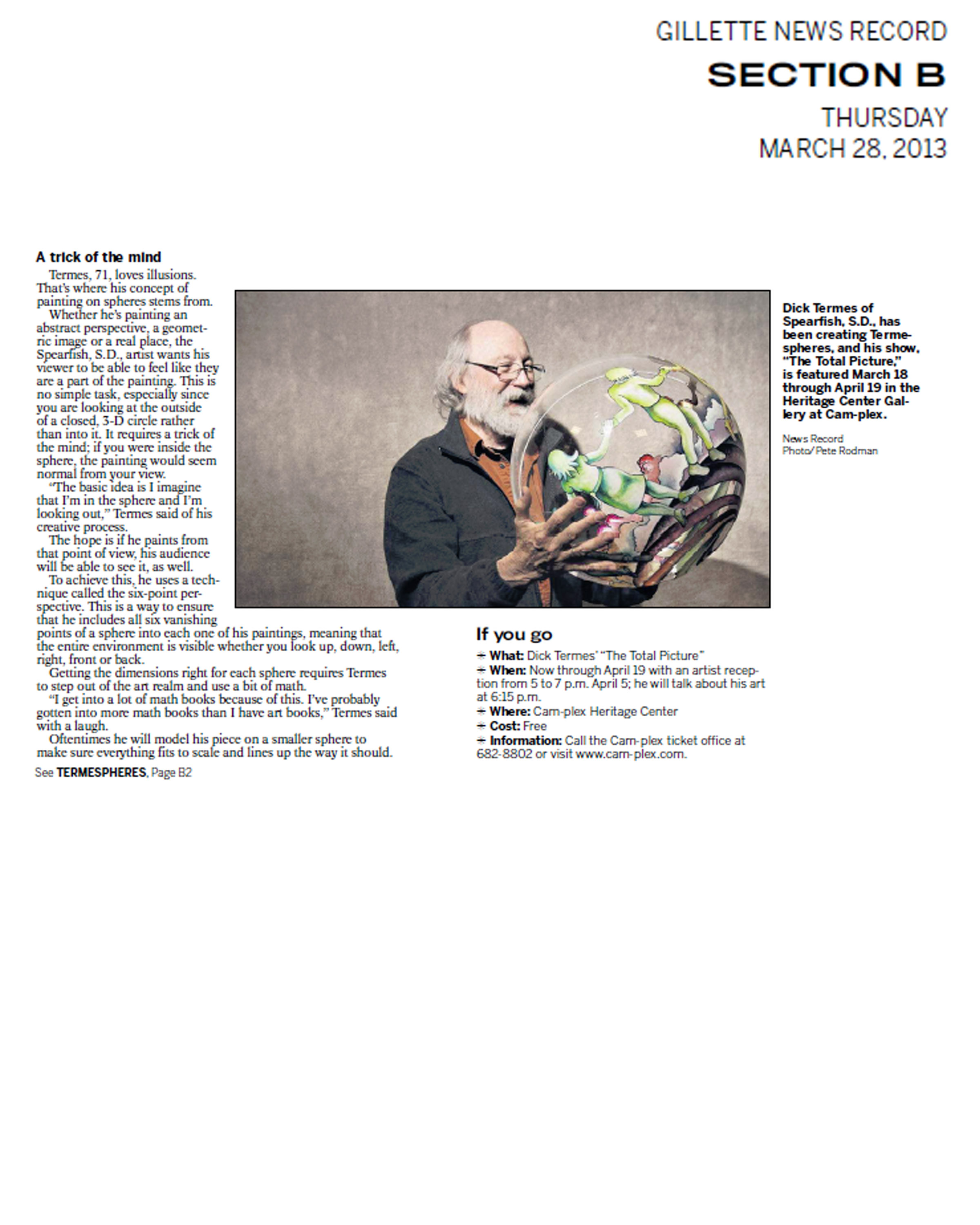
    This is a great article written by Sarah Elms in the News Record Writer for my show at the Cam-plex Center in Gillette Wyoming.    This show will be up until April 19th.

    NewsRecord Ad 3-28-2013


    NewsRecord Ad 3-28-2013-3NewsRecord Ad 3-28-2013-2

  • LIFE’S UPS AND DOWNS explained on a Termesphere®

    Life's Ups and Downs
    Life’s Ups and Downs

    This Termesphere® is called LIFE’S UPS AND DOWNS.   It is a 16” diameter sphere which played off of a 15th century stairway in India that helped people get to a source of water far below.  These stairways interested me because they didn’t just go straight up but rather up and out with each new step.  This helped more people get started on the top and focused them to the smaller area down where the water was.  It must have been a little crowded down there.  If you look at the image of this sphere you will see that.  As you go up to the next level you gain more and more stairs.  It was a great challenge to my perspective system and to me to figure out how you do this.  It is one thing to just spread out normal stairs as you go up and out but to go up and have this many choices of which way to go added another complexity to the painting.

    It is fun when playing with a new idea like this to try to figure out how you use it to say something you want to talk about.  I used it for this reason.  I have humans working their way from the bottom world to the top.  Along the way they find evil monsters under many of the stairways.  They have to get by these evil creatures or confront them.  Sometimes we have to go sideways or even back down the stairs to find the proper way to continue life’s progress.,  We all have to find out own way.

    Here  is a youtube video that shows this sphere in motion.

    It is traveling with the South Dakota Governor’s 5th Biennial Art Exhibition to three museums in South Dakota, the Dahl Fine Arts Center, the South Dakota Art Museum and the Sioux Falls Washington Pavilion.


    Save

    Save

  • What is a Termesphere®?

    I am planning to spend a little more time on my blog.   That doesn’t mean I am giving up on Facebook,   I just plan to move you over to the blog for more details in some of my concepts so I have a little more room.   I really enjoy getting replies back from people on some of these ideas.  So at least once a week I will explain some new and old ideas to see if I can get some input from you.

    I thought I would start at the beginning, explaining what I am trying to accomplish.  So, what is a Termesphere®?

    For over 40 years I have been exploring a whole new concept in art and math.   I paint on spheres which, when completed, are known as Termespheres®.   Each Termesphere® is a revolving three-dimensional space/time exploration of an entirely closed universe, meaning that what you see, rotating in front of you, is a complete environment.   This uses a concept of Six Point Perspective to make it work.   I have lectured on Six Point Perspective and shown my Termespheres® and polyhedron paintings worldwide.

    This shows two spheres that demonstrate Six Point Perspective.

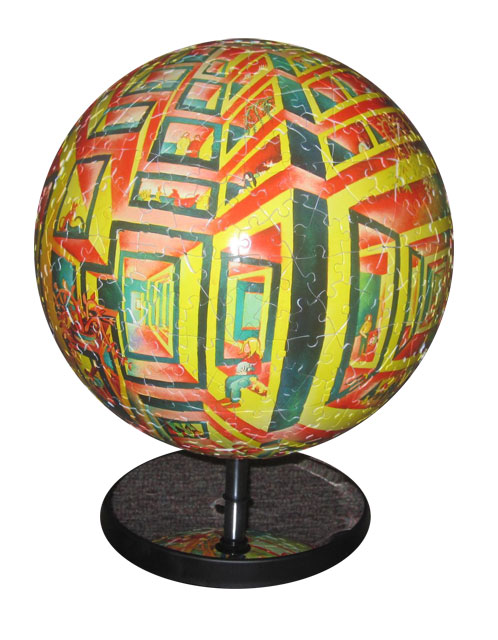
    Cubical Universe

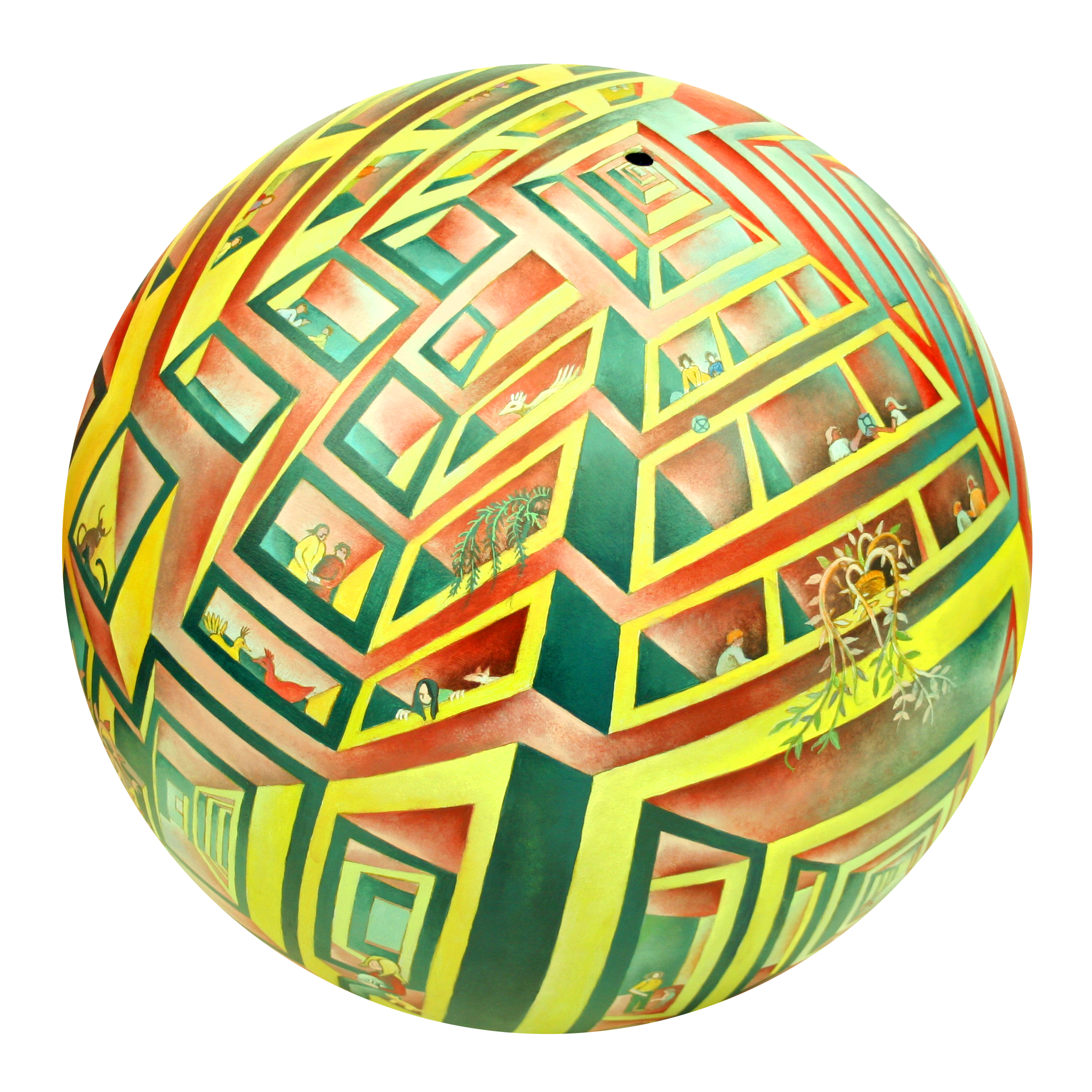
    CUBICAL UNIVERSE is a sphere of endless rooms within rooms which uses the Six Point Perspective.   Notice the three sets of lines within this piece and how the lines project to the vanishing points.
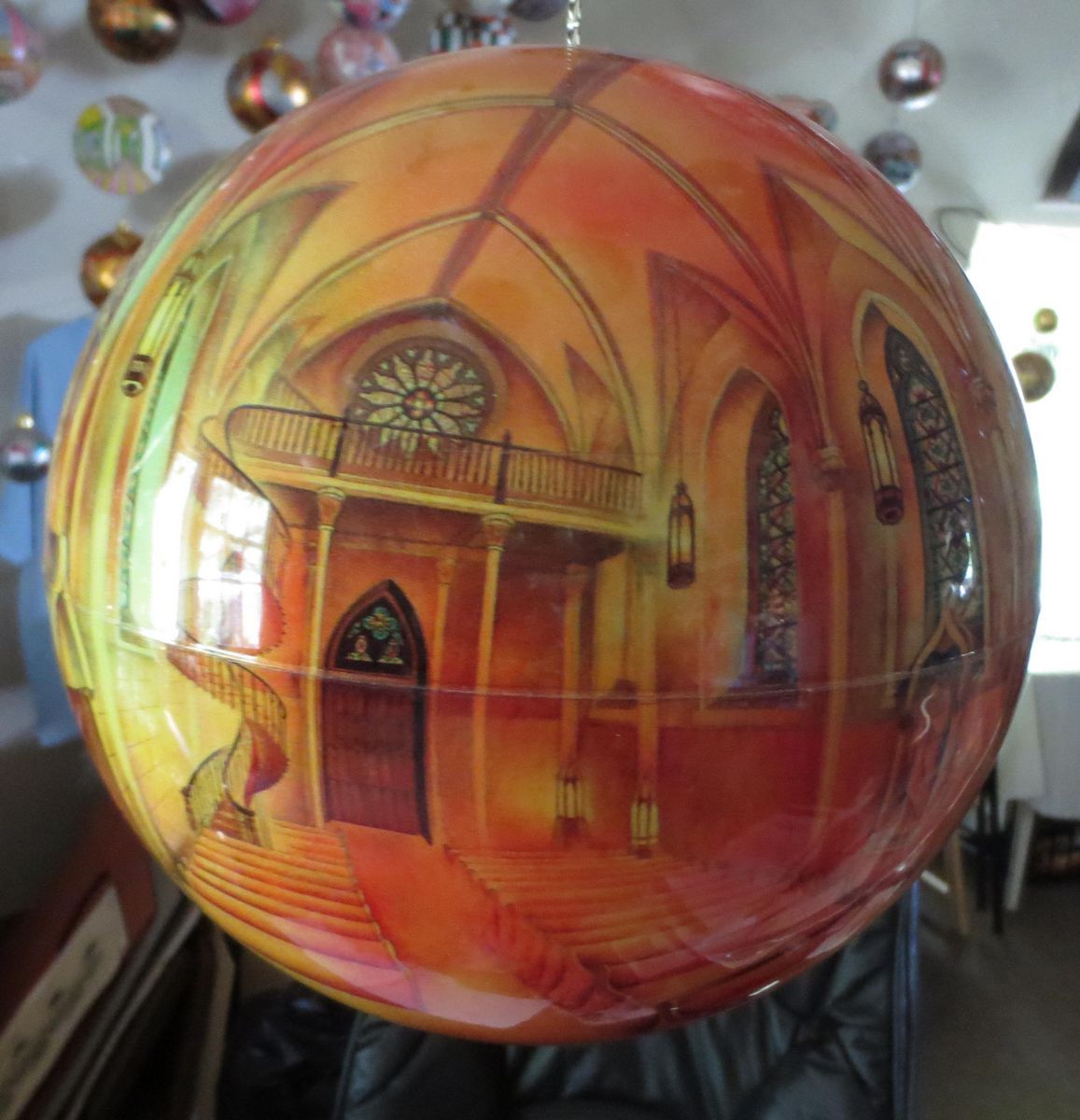
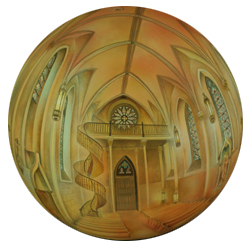
    With THE LORETTO CHAPEL,   I spent about six days in the Loretto Chapel capturing this environment in Santa Fe, New Mexico.   I started this piece with six equal distant vanishing points.   If a line projects to the north, the same line projects to the south.   Look closely at the pews.  They run to the north and to the south?   I could have been located anywhere within this Chapel and the six points would still be in the same place, equal distance from each other.   If you know of any environments like this, let me know, OK?

    So, this is a summary, this is one of the things I do in my work.   I hope to break down my thoughts and get some ideas back from you on some of these.  Hope you will join me.

    Save

  • The Summer-Is-Almost-Here Event

    On MAY 28 from 9 TO 4  Everyone is invited out to the Termesphere Gallery to see the new 540 piece Termesphere Puzzleball and to check out the limited edition signed and numbered MOVA Globe/Termespheres not to mention new Termespheres, tshirts, crystals, books, finger puppets, DVDs etc.   It will be fun to talk to you and show you my new work.

    We are looking forward to having the gallery open from 9 to 5 everyday all summer.

  • The MOVA Globe/Termesphere

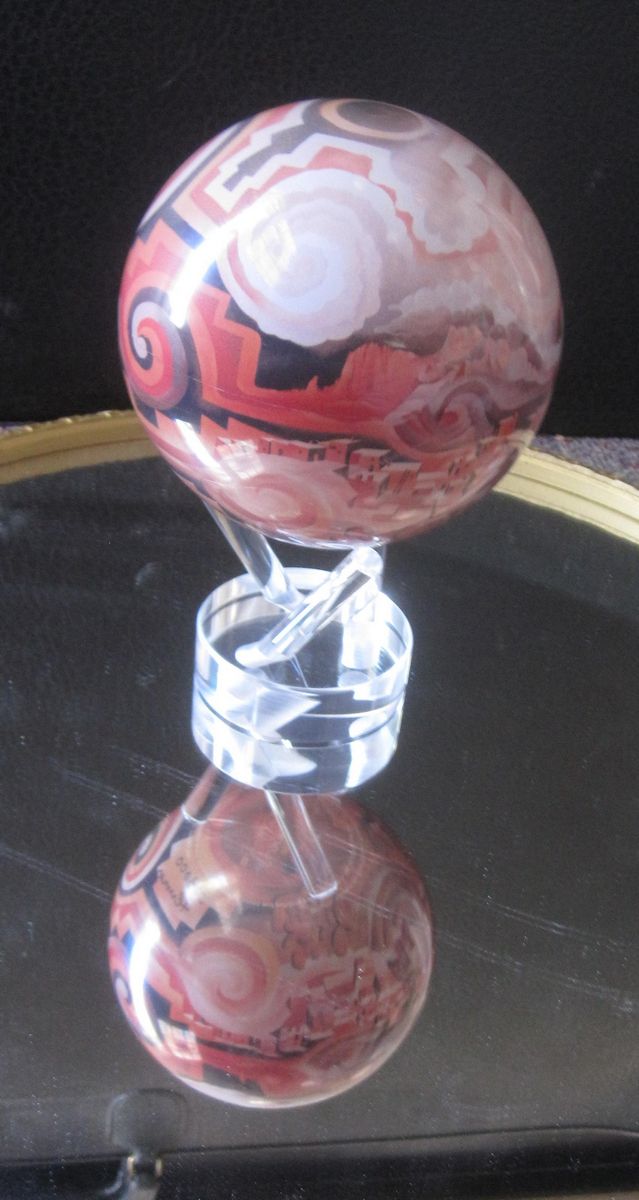
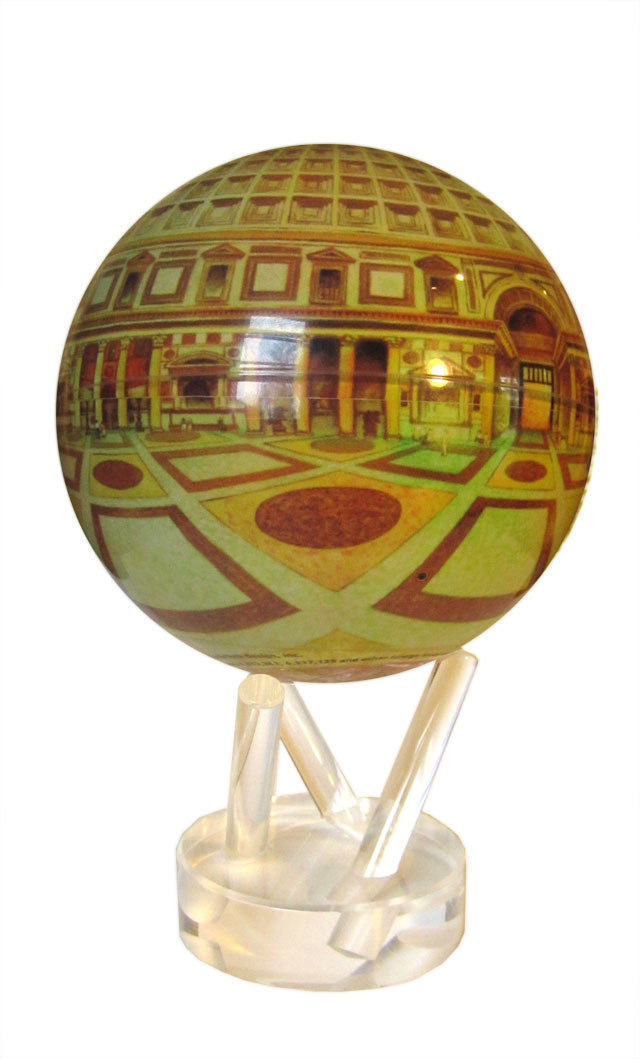
    Two signed and numbered MOVA Globe/Termespheres limited editions have finally come into reality.  It has taken a good three years but at last two limited edition Termespheres, the PANTHEON and FISH EYE VIEW are now in my gallery.   Turtle Tech Design is an international company that invented the solar motion sphere, MOVA Globe,  which is a sphere floating within a transparent sphere with a solar cell to provide power for the motor.

    http://termespheres.com/mova is a video of these 4.5 inch MOVA Globe/Termespheres in motion.  A third one called FROM THE EARTH sphere will be coming in two or three months.   The motion is powered by solar energy so no batteries or gasoline is needed.

    The MOVA Globe/Termesphere gives me a wonderful new magical motion and a great optical illusion as well as a totally new way to reproduce my work that allows it to be in full color.

  • Sphere Puzzle

    Another new, very exciting addition to the Gallery  is the Termesphere Puzzleball.   The Termesphere, CUBICAL UNIVERSE, was used to make a jigsaw three dimensional puzzle.  One of the oldest puzzle companies in the world, Ravensburger Puzzle Company from Germany contacted me a couple of years ago to see if we could work together on producing a 540 piece 8.5 inch diameter spherical puzzle of one of my Termespheres.  A 16” Termesphere, CUBICAL UNIVERSE was created especially for this Puzzelball.  It was inspired by a spherical painting of mine that now is owned by the Math Department at West Point Military Academy.   The result is a spherical puzzle that fits together beautifully and is mounted on a stand with a mirror under it.  The 540 pieces are all slightly convex which makes it form a smooth sphere. Check it out here. There are numbers on the back of the pieces for those who have trouble with puzzles.